Seoul High Court: "Maintaining a fixed value for 20 days constitutes autonomous price fixing... Suppresses price reduction"
Supreme Court: "Must consider minimum price during '20 days before advertisement'... Not an actual discount event"
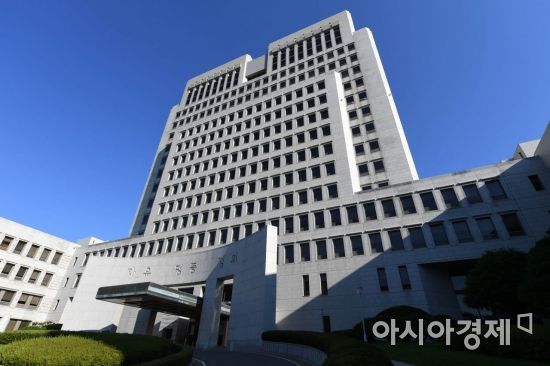
[Asia Economy Reporter Heo Kyung-jun] The Supreme Court has ruled that Homeplus raising and then lowering product prices before starting a ‘1+1’ promotion constitutes false and exaggerated advertising, but the Fair Trade Commission’s order to pay a fine should be canceled.
The Supreme Court’s First Division (Presiding Justice Park Jeong-hwa) announced on the 22nd that it upheld the appellate court’s ruling partially in favor of the plaintiff in the final appeal trial filed by Homeplus against the Fair Trade Commission’s corrective order and other dispositions.
In November 2016, the Fair Trade Commission imposed corrective orders and fines totaling 62 million KRW on large discount stores including Homeplus, Lotte Shopping, and E-Mart for false and exaggerated advertising during various promotions. Homeplus was fined 13 million KRW. The commission argued that although the stores advertised a ‘1+1’ event where customers receive one additional product for each purchase, the prices were set as if customers were buying two products, constituting exaggerated advertising. These companies filed lawsuits, and in 2018, the Supreme Court ruled that the ‘1+1’ promotions by Lotte Shopping and E-Mart were exaggerated advertising.
However, the court’s judgment regarding Homeplus was different. The Fair Trade Commission considered the lowest price among those applied to the product for about 20 days before the ‘1+1’ event as the ‘previous transaction price.’ However, the Seoul High Court ruled that from the perspective of an ordinary consumer with reasonable care, the ‘previous transaction price’ should be understood as the ‘actual selling price during a period close to the advertisement date,’ and canceled the commission’s order to pay the fine for exaggerated advertising.
Furthermore, according to the Fair Trade Commission’s criteria, large discount stores cannot advertise as they wish unless they maintain a certain price for 20 days, which the court found infringes on their pricing autonomy. The court also pointed out that maintaining a high selling price for 20 days suppresses price reductions that would benefit consumers.
The Supreme Court acknowledged that there were errors in the Seoul High Court’s judgment but agreed with the conclusion to cancel the fine payment order. The court stated, “While the Fair Trade Commission’s criteria are not absolutely binding in determining the ‘previous transaction price,’ which is the standard for judging false or exaggerated advertising, they must be considered. The appellate court’s judgment that equated the previous transaction price with the actual selling price immediately before the advertisement was incorrect, and the lowest price during the 20 days before the advertisement, as per the commission’s criteria, should also be taken into account.”
It added, “Based on these standards, the advertisement in question cannot be considered a genuine discount event but was advertised as such, constituting false and exaggerated advertising, so the appellate court’s judgment was wrong. However, the appellate court’s conclusion to cancel the entire fine payment order is justified.”
© The Asia Business Daily(www.asiae.co.kr). All rights reserved.
![Clutching a Stolen Dior Bag, Saying "I Hate Being Poor but Real"... The Grotesque Con of a "Human Knockoff" [Slate]](https://cwcontent.asiae.co.kr/asiaresize/183/2026021902243444107_1771435474.jpg)











