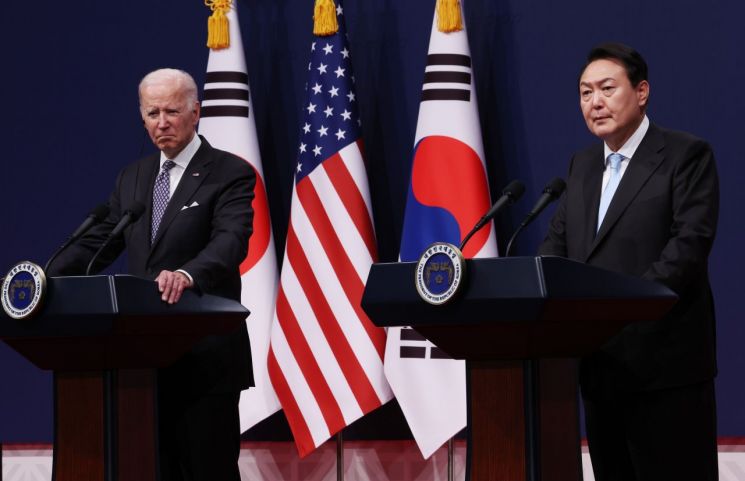
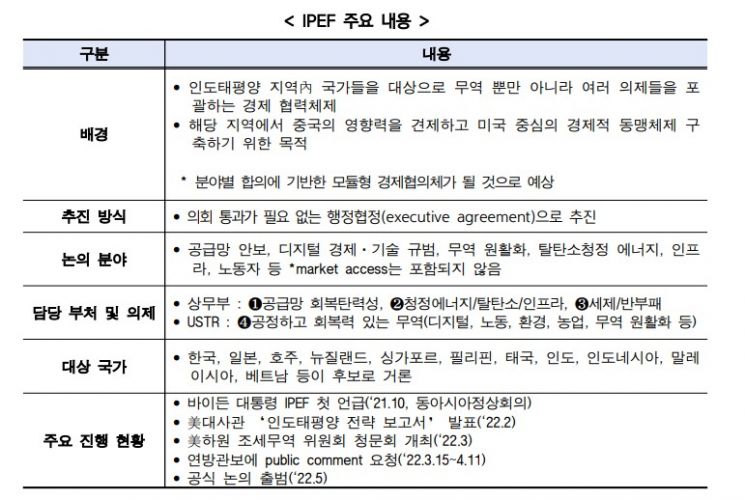
[Asia Economy Reporter Kang Nahum] As the government has confirmed its participation in the Indo-Pacific Economic Framework (IPEF), the domestic gaming industry is on high alert regarding China's reaction. While there are concerns about the emergence of a 'second THAAD (Terminal High Altitude Area Defense) incident,' some believe this could be an opportunity to open new markets.
On the 20th, an industry insider said, "The uncertainty has increased for domestic game companies highly dependent on China or those preparing to enter the Chinese market," adding, "There are concerns that the 'Hanhanryeong' (Korean Wave ban), which has been difficult to resolve since the THAAD incident, might actually be strengthened."
China has avoided issuing foreign game licenses for domestic games since the THAAD incident in March 2017. This was a retaliatory measure through the Hanhanryeong to prevent Korean content from entering China. It took a long 1,473 days for Com2uS's 'Summoners War: Sky Arena' to receive a license.
Recently, with Pearl Abyss's Black Desert Mobile entering China and Chinese authorities resuming license issuance, expectations in the domestic market had risen. However, these expectations have completely vanished following the news of our government's participation in IPEF.
While the export route for domestic games to China is blocked, Chinese capital and games are intensifying their penetration into the domestic market. In fact, Chinese games such as miHoYo's 'Genshin Impact,' Lilith Games' 'Rise of Kingdoms,' Kuka Games' 'Three Kingdoms Strategy Edition,' and 37Mobile's 'Heroes Tales' consistently rank high in domestic app market sales. Voices within the industry are calling for government measures in response. Another industry insider said, "As major Chinese game companies turn overseas to avoid domestic regulations, the possibility of capital dependence on the domestic market has increased," adding, "Based on the principle of reciprocity, stricter review of Chinese games is necessary."
Some argue that our government's decision to participate in IPEF should be seen as an opportunity to pioneer new markets. Recently, as the quality of Chinese games has improved, demand for Korean games within China has decreased. Meanwhile, emerging markets such as India, which has a population comparable to China, and Southeast Asian countries with high growth potential, are rapidly rising as new markets.
In fact, the domestic gaming industry is increasing investments in the Indian market, considered a blue ocean, to reduce dependence on China. NCSoft invested 12 billion KRW in Paramark KB No.1 Private Equity Fund in October last year to secure partners for tech and platform companies in the growth stage within India. In November of the same year, it also invested 3 million USD (about 3.6 billion KRW) in Lumikai Fund No.1 to secure partners for early-stage game startups in India.
Krafton invested a total of 100 billion KRW in India, including 20 million USD (about 24.7 billion KRW) in Series B funding for India's largest audio content platform 'KukuFM' and 5.4 million USD (about 650 million KRW) in the Indian sports game specialist developer 'Nautilus Mobile.'
An industry insider said, "Even if the Chinese market reopens, the general perception in the industry is that Korean games will find it difficult to succeed as they did in the past," adding, "To improve global recognition and sales, it is now time to reduce dependence on China and pioneer new markets."
© The Asia Business Daily(www.asiae.co.kr). All rights reserved.
![Clutching a Stolen Dior Bag, Saying "I Hate Being Poor but Real"... The Grotesque Con of a "Human Knockoff" [Slate]](https://cwcontent.asiae.co.kr/asiaresize/183/2026021902243444107_1771435474.jpg)

















