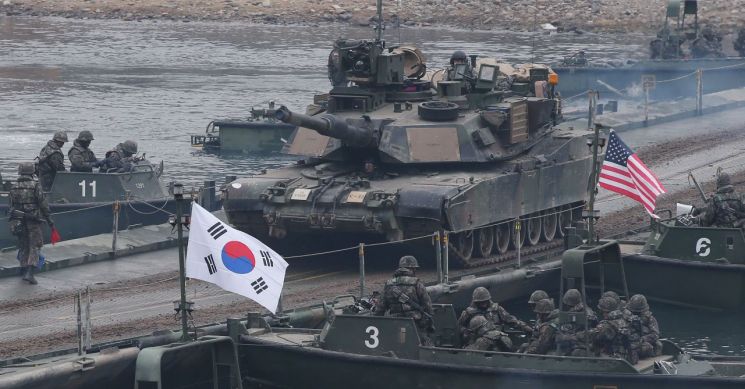
 It has been reported that South Korea and the United States will begin joint military exercises starting on the 5th. The photo shows a US 2nd Infantry Division M1A2 SEP tank crossing a pontoon bridge during the South Korea-US joint river crossing operation training held at the Hantan River in Yeoncheon-gun, Gyeonggi Province, in December 2015.
 [Asia Economy Yang Nak-gyu, Military Specialist Reporter] Starting from the second half of this year, the Korea-US Combined Command Post Training (CCPT) is expected to be significantly strengthened.
President Yoon Suk-yeol said at a press conference after his summit with US President Joe Biden on the 21st, "Considering North Korea's evolving threats, the two leaders agreed to initiate consultations to expand the scope and scale of combined exercises and training on and around the Korean Peninsula."
President Yoon also explained, "There was also discussion on whether various forms of combined training to prepare for a nuclear attack are necessary. In the past, extended deterrence was thought to mean only the nuclear umbrella, but the discussion covered timely deployment of various strategic assets including fighter jets and missiles."
Operational control of our military was fully delegated by then-President Syngman Rhee to UN Commander Douglas MacArthur immediately after the outbreak of the Korean War (June 25 War) on July 14, 1950, but only peacetime operational control was regained in December 1994. At that time, our government had set a goal to fully transfer wartime operational control by 1995, but as North Korea's nuclear development intensified and war crisis rumors surfaced in 1994, the US side and our government agreed to an indefinite postponement after consultations.
Later, during the Roh Moo-hyun administration, an agreement was reached for the Korea-US wartime operational control transfer in 2012, but after the inauguration of the Lee Myung-bak administration, the timeline was postponed again to December 2015 citing concerns over a security vacuum. Under the Park Geun-hye administration, a "Conditions-Based Transfer Plan" (COTP) without a specified timeline was established, which remains in effect today.
During the Moon Jae-in administration, following the 2018 North Korea-US Singapore Summit, the command post exercises were scaled down to computer simulations without large-scale troop and equipment mobilization. The COVID-19 pandemic further delayed the evaluation work directly linked to the transfer of wartime operational control (OPCON).
However, the Korea-US militaries plan to resume the second phase "Full Operational Capability" (FOC) evaluation of the future combined command led by our military, according to the COTP, during the Korea-US Combined Command Post Training (CCPT) in the second half of this year. Among the three phases of capability evaluation for the future combined command, the first phase "Initial Operational Capability" (IOC) evaluation was completed during the 2019 Korea-US exercises, but the second phase FOC and third phase "Full Mission Capability" (FMC) evaluations have yet to begin.
© The Asia Business Daily(www.asiae.co.kr). All rights reserved.

















