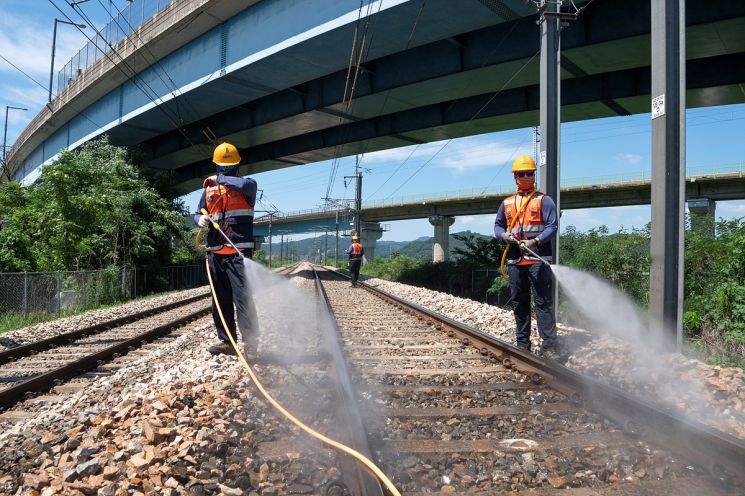
 Railway field workers are sprinkling water on the tracks near Sejong Jochiwon Station, heated by the scorching sun, to lower the temperature. Photo by Korea Railroad Corporation
[Asia Economy (Daejeon) Reporter Jeong Il-woong] Korea Railroad Corporation (KORAIL) is preparing and implementing a comprehensive plan to cope with heatwaves and wind and flood damage.
On the 21st, Korea Railroad announced that it will operate a heatwave countermeasures headquarters composed of seven sectors including safety, passengers, logistics, metropolitan, vehicles, facilities, and electricity until the end of September, monitoring railway sites nationwide and activating a 24-hour emergency response system.
Earlier, reflecting the Korea Meteorological Administration's forecast that the number of heatwave days this summer will increase compared to the average, Korea Railroad has analyzed changes in railway environments based on weather conditions over the past five years since February and established a comprehensive safety plan to prepare for heatwaves and wind and flood damage.
The core of the plan is to select 29 key tasks, including 18 related to heatwaves and 11 related to wind and flood damage, focusing on vulnerable sites such as tracks, vehicles, and stations susceptible to heat, and to gradually improve risk factors during the summer season.
First, according to the comprehensive plan, Korea Railroad will manage tracks to minimize train slowdowns caused by rising rail temperatures.
On 314.6 km of vulnerable sections where ventilation is poor or sunlight is excessive, 'heat-reflective paint' will be applied, which typically lowers the temperature by about 4 to 5℃ by blocking heat.
Additionally, 'sprinkler devices' that spray water directly on the tracks to cool the heat will be newly installed at 18 high-speed line locations by next month, expanding the operation to 171 locations including 45 general line sites.
Cooling devices inside trains and stations are also being intensively inspected. Korea Railroad has formed a special safety inspection task force composed of air conditioning experts to check the driver’s cabin, passenger car air conditioning, and major cooling devices on 5,386 cars including KTX, general trains, and electric trains, with inspections scheduled to be completed by this month.
For sudden failures of train air conditioning systems, emergency response teams are operating at 81 stations nationwide including Seoul, Daejeon, Busan, and Gwangju Songjeong stations, and emergency supplies such as wet towels, bottled water, fans, and cooling vests are kept on hand at all times.
Measures to prevent track flooding, roadbed erosion, and station flooding caused by wind and flood damage have also been proactively completed. After inspecting areas prone to falling rocks and drainage channels and completing preemptive measures, Korea Railroad plans to finish checking the grounding functions of communication and signaling equipment to prepare for lightning by the end of this month.
Korea Railroad President Na Hee-seung said, “Natural disasters such as heatwaves and wind and flood damage require proactive prevention and preparation above all else,” and added, “Korea Railroad will strive to create an environment where citizens can safely use trains throughout all four seasons through thorough preparation and strengthening emergency response capabilities against natural disasters.”
© The Asia Business Daily(www.asiae.co.kr). All rights reserved.

















