KIST Research Team Develops TF-QKD System Architecture

[Asia Economy Reporter Kim Bong-su] Domestic researchers have succeeded in developing the second core technology in the world necessary for the commercialization of quantum cryptography.
The Korea Institute of Science and Technology (KIST) announced on the 21st that the research team led by Han Sang-wook, head of the Quantum Information Research Division, proposed a system structure that applies a Plug and Play (PnP) configuration using a single light source to reduce the operational difficulty of the Twin-Field (TF) Quantum Key Distribution (QKD) system, while simultaneously enabling expansion to a many-to-many network rather than one-to-one. Following the University of Toronto in Canada, this is the second success worldwide in experimental verification of the TF QKD network.
Modern cryptographic systems are typically based on public key methods that generate public and private keys based on mathematical problems. However, most of these can be decrypted using high-performance supercomputers. In contrast, quantum cryptography, which is based on the laws of quantum mechanics rather than computational complexity, can guarantee high security regardless of the computational power of quantum computers, and is expected to replace modern cryptographic systems soon.
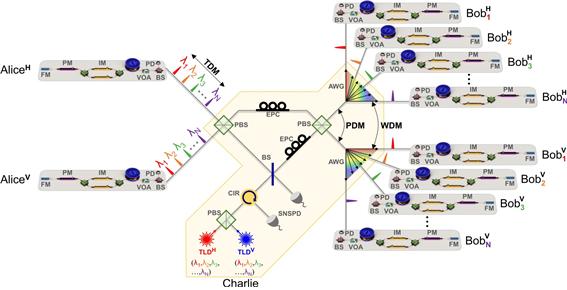
QKD technology is considered a core technology essential for the commercialization of quantum cryptography. There are two main technical issues to be solved for implementing QKD. The first is the communication distance, which is currently limited to about 100 km, and the second is the expansion from one-to-one (1:1) communication to one-to-many (1:N) or many-to-many (N:N) network communication.
TF QKD, announced in 2018, attracted attention as a long-distance protocol that can dramatically increase the communication distance of existing QKD systems. In QKD systems, quantum signal loss occurs during transmission between sender and receiver, but TF QKD allows both sender and receiver to send information simultaneously from both ends, and by adding a third-party measurement device in the middle, communication is possible even if the sender and receiver transmit information only halfway, thereby increasing the communication distance. However, verification of the TF QKD protocol has been successful only in leading global QKD groups due to the high difficulty of system development, and research on network communication expansion remains insufficient.
To improve the development difficulty of the TF QKD system, the research team applied a Plug and Play (PnP) structure. In existing TF-QKD systems, the sender and receiver each use two light sources for quantum signals, requiring a control system to make the characteristics of the two different light sources identical. The PnP TF QKD structure developed by the research team operates with only one light source, where a third-party measurement device delivers the same light source to both sender and receiver, and the system shares information using that light source. For this reason, since the same quantum signal travels back and forth through the communication channel, polarization noise generated in the channel is automatically compensated.
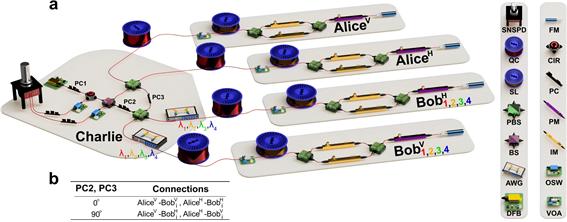
The research team also proposed and experimentally verified a new TF QKD network structure expandable to a 2:N network by applying polarization, time, and wavelength division technologies. This is the second successful experimental verification of a TF QKD network in the world. While the first research case used a Ring network structure, the team’s structure is a Star network structure. In the Ring structure, quantum signals must pass through all connected points on the ring, but in the Star structure, signals only pass through the center, enabling a more practical QKD system implementation.
Director Han said, “This research achievement simultaneously solves the two challenges that have hindered the commercialization of QKD: long-distance and network expansion,” adding, “It is significant that we have secured foundational technology to lead the field of long-distance quantum cryptography networks.”
The research results were published in the latest issue of the international journal ‘npj Quantum Information’ (IF: 7.385, top 4.054% in JCR category).
© The Asia Business Daily(www.asiae.co.kr). All rights reserved.
![Clutching a Stolen Dior Bag, Saying "I Hate Being Poor but Real"... The Grotesque Con of a "Human Knockoff" [Slate]](https://cwcontent.asiae.co.kr/asiaresize/183/2026021902243444107_1771435474.jpg)

















