Confirmed Cases Increase 4.5 Times After Quarantine Release... Earlier Epidemic Onset
Considering New Variants, Immunity Decline, and Healthcare System Preparedness
Fourth Dose Vaccination Plan for Under 60s Also Under Review in Second Half
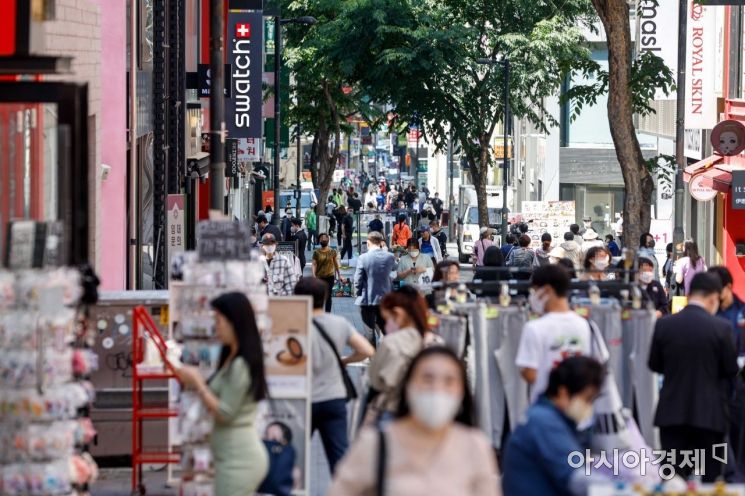 On the 10th, as eased social distancing measures continue, citizens and tourists visiting Myeongdong in Jung-gu, Seoul, are strolling along the streets. Photo by Jinhyung Kang aymsdream@
[Asia Economy Reporter Jo In-kyung] The government has forecast that the expected resurgence of COVID-19, initially anticipated for this fall, could be brought forward to the summer. This is due to the continuous emergence of new variants and the waning effectiveness of vaccines over time. Accordingly, the '7-day mandatory isolation for confirmed cases,' which was under review for lifting as early as the 23rd, will be maintained for an additional four weeks.
According to the quarantine authorities on the 21st, Kim Heon-ju, the 1st Deputy Head of the Central Disease Control Headquarters (Vice Commissioner of the Korea Disease Control and Prevention Agency), stated at a briefing the previous day, "Even under the premise of maintaining the isolation obligation, due to the effect of immune decline, a resurgence could begin as early as this summer and peak around September to October." He added, "If the isolation obligation is lifted, the current downward trend may not be sustained, and a rebound could occur in June to July."
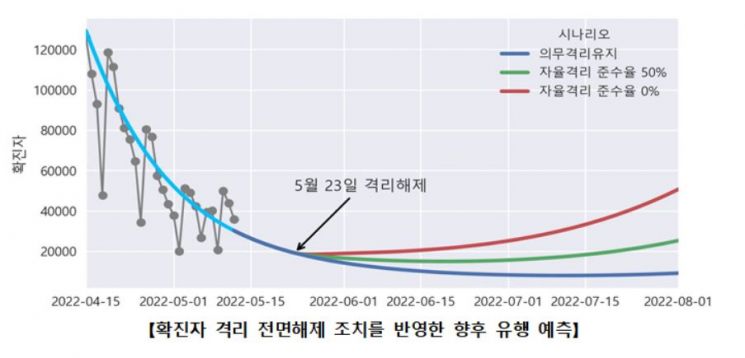
If the isolation obligation is lifted, the number of confirmed cases is predicted to increase by 1.7 to 4.5 times or more, depending on the degree to which isolation recommendations are followed. Among ten domestic research teams, nine concluded that without the isolation obligation, confirmed cases would rebound, with some estimating that up to 7.5 times more cases could occur about eight weeks later compared to the current numbers.
Currently, most other countries also impose mandatory isolation upon a positive COVID-19 diagnosis. However, some countries in the United States and Europe are moving toward easing this to voluntary isolation.
The recent slowdown in the decline of COVID-19 cases was also taken into account. Meanwhile, the infection reproduction number has fallen for four consecutive weeks since the third week of March, dropping to 0.72 in the first week of May, but rebounded to 0.90 last week.
Regarding whether to expand the fourth dose vaccination, currently administered to those aged 60 and over, to those under 60, the government plans to comprehensively review the quarantine situation, vaccination effectiveness, and new vaccine developments before formulating a vaccination strategy again in the second half of the year.
Son Young-rae, Head of the Social Strategy Division at the Central Accident Response Headquarters of the Ministry of Health and Welfare, said, "(Separate from maintaining the isolation obligation) other stabilization tasks will be steadily promoted," adding, "We will ensure a smooth transition to the general medical system so that confirmed and suspected COVID-19 patients can receive treatment smoothly in general wards and local clinics."
The lifting of the indoor mask-wearing mandate will also not be considered immediately. However, contact visits to nursing hospitals and facilities, which were temporarily allowed until the 22nd, have been completely lifted.
To facilitate a smooth transition to the general medical system, some health insurance fees with reduced effectiveness have been adjusted. Accordingly, starting from the 6th of next month, the 'Integrated Isolation Management Fee' paid when confirmed patients are isolated in general wards will be discontinued.
© The Asia Business Daily(www.asiae.co.kr). All rights reserved.
![Clutching a Stolen Dior Bag, Saying "I Hate Being Poor but Real"... The Grotesque Con of a "Human Knockoff" [Slate]](https://cwcontent.asiae.co.kr/asiaresize/183/2026021902243444107_1771435474.jpg)

















