WSJ "Russian Forces Seeking Locals to Cooperate in Establishing Pro-Russian Governments in Occupied Areas"
Ukrainian Collaborators Left After Russian Withdrawal Face Criminal Charges
Ukrainian Prosecutors Investigating 914 Cases of Treason
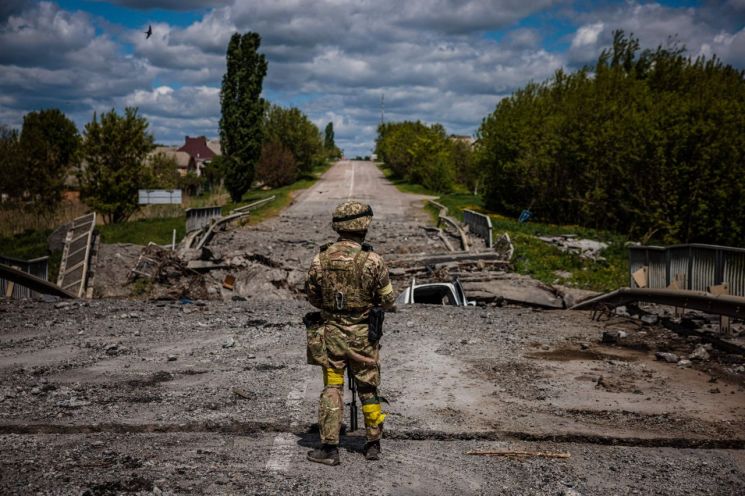 A Ukrainian soldier is on guard duty in front of a destroyed bridge near the village of Ruska Lozova, north of Kharkiv, on the 16th (local time). [Image source=Yonhap News]
[Asia Economy Reporter Park Hyun-joo] As Russian troops withdraw from parts of Ukraine, local residents who had cooperated with them are being left behind and face the risk of criminal prosecution, the Wall Street Journal (WSJ) reported.
According to the recent WSJ report, Russian forces occupied the small town of Dymer, located northwest of Kyiv, the capital of Ukraine, where about 5,000 residents live, at the end of February. They then appointed Oleksandro Kharchenko as the new mayor. Kharchenko, a previously unknown businessman, emphasized that he only followed Russian media and sided with the invading Russian troops by pledging support to them.
On March 28, in a video speech released by the Russian Ministry of Defense, he said, "Do not trust Ukrainian media," adding, "The Russian military is not hostile, and you can approach them normally to resolve all issues." The video also showed Russian troops distributing food and medicine to residents.
Russian forces sought local individuals who could help suppress opposition and establish pro-Russian governments in occupied areas including Dymer. Initially, Russia attempted to recruit current and former mayors, city council members, and prominent local figures in the southern and eastern occupied regions, but faced resistance and difficulties. As a result, they ended up partnering with unknown figures like Kharchenko, WSJ explained. For example, in Berdyansk, Zaporizhzhia, a security guard became deputy mayor, and in the southern Kherson region, an anti-vaccine blogger was appointed to key positions such as deputy governor.
However, the situation reversed rapidly as Russian troops withdrew. Those who had shown pro-Russian actions now face the threat of criminal prosecution.
Kharchenko himself is now awaiting trial. After the Ukrainian military resistance forced Russian troops to retreat from Dymer, Kharchenko, who remained alone in Dymer, was detained on charges of collaborating with the enemy. Kharchenko’s mother claimed, "He intentionally cooperated with the Russian troops to help residents during difficult times," adding, "Everyone was starving and there was nothing to eat. The Russian occupation brought hard times, and Kharchenko was only trying to help."
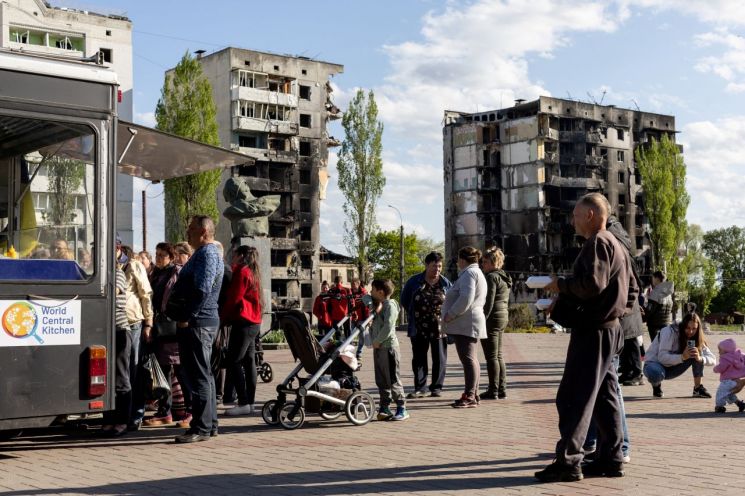 Near Borodianka, close to Kyiv (Kiev), the capital of Ukraine, citizens lined up on the 16th (local time) to receive meals provided by the free kitchen 'World Central Kitchen'.
 [Image source=Yonhap News]
The Security Service of Ukraine (SBU) suspects Kharchenko of assisting Russian troops in various ways, including providing lists of Donbas veterans and territorial defense forces. Anton Gerashchenko, advisor to the Ukrainian Minister of Internal Affairs, emphasized, "The vast majority of the people believe that traitors who sided with the enemy must be held accountable under the law," adding, "There can be no compassion."
According to the Ukrainian Prosecutor’s Office, since the Russian invasion, 914 cases of treason and 788 cases of collaboration with the enemy have been filed. Treason during wartime can be punished by life imprisonment, while collaboration with the enemy carries a sentence of up to 15 years in prison.
© The Asia Business Daily(www.asiae.co.kr). All rights reserved.
![Clutching a Stolen Dior Bag, Saying "I Hate Being Poor but Real"... The Grotesque Con of a "Human Knockoff" [Slate]](https://cwcontent.asiae.co.kr/asiaresize/183/2026021902243444107_1771435474.jpg)

















