Benefits of Issuing Commercial License Plates
Sales Exceed 1,000 Units by Model
[Asia Economy Reporter Yoo Hyun-seok] Hyundai Motor Company and Kia's small electric truck models, Porter2 Electric and BongoⅢ EV, are gaining attention for their steady sales. Despite the termination of the commercial license plate issuance benefit for electric trucks in mid-last month, sales for each model have surpassed 1,000 units. While some analyze this as a temporary sales increase due to the sunset effect, Hyundai and Kia explain that the trend of increasing reservations continues based on high product competitiveness.
According to the completed car industry on the 23rd, Hyundai and Kia's domestic eco-friendly vehicle (hydrogen, hybrid, electric) sales last month totaled 28,835 units. Among these, electric vehicle sales reached 10,781 units, a sharp increase of 167.4% compared to the same period last year.
Among Hyundai and Kia's electric vehicle models, Kia's EV6 sold the most with 2,976 units. Hyundai's Ioniq 5 (2,963 units) and Porter2 Electric (1,819 units) followed, with Kia's BongoⅢ EV (1,536 units) ranking fourth.
Porter2 Electric and BongoⅢ EV together sold a total of 3,355 units, accounting for 11.64% of total eco-friendly vehicle sales and 31.12% of electric vehicle sales.
This is also true for domestic automakers. Last month, 10,942 electric vehicles were sold domestically, accounting for 30.66% of the total. One out of every three electric vehicles sold last month was either a Porter2 Electric or BongoⅢ EV. They are playing a hidden leading role in the expanding eco-friendly vehicle market.
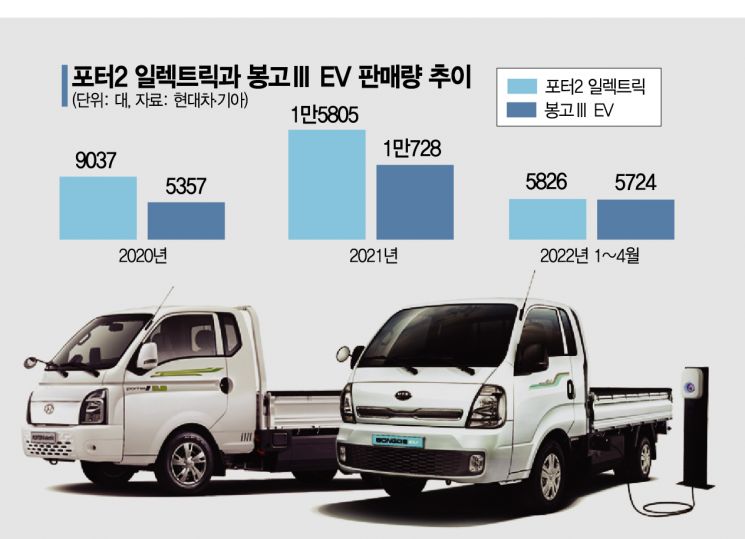
In particular, Porter2 Electric and BongoⅢ EV have been models consistently loved by consumers since their launch. Porter2 Electric and BongoⅢ EV, launched in December 2019 and January 2020 respectively, sold 9,037 and 5,357 units in 2020, and 15,805 and 10,728 units last year. This year, up to April, they have recorded a cumulative total of 5,826 and 5,724 units, totaling 11,550 units.
The biggest reason for the strong sales is the policy merit. Since November 2018, electric trucks have been allowed to install commercial license plates free of charge. Until now, the issuance of commercial license plates was restricted under the pretext of protecting the freight industry and controlling the number of workers. As a result, operators entering the freight transport business with regular trucks had to purchase existing commercial license plates. Considering that the price of a regular freight vehicle license plate ranges from 20 million to 30 million KRW, this is a significant advantage.
The price attractiveness is also high. The prices of Porter2 Electric and BongoⅢ EV range from 40.6 million to 42.74 million KRW and 41.85 million to 43.7 million KRW, respectively. With national and local government subsidies, the actual purchase price drops to the low 20 million KRW range.
With the license plate benefit ending on the 13th of last month, there are forecasts that sales of Porter2 Electric and BongoⅢ will also decline. In fact, the Korea Automobile Manufacturers Association (KAMA) stated in its April automobile industry trend (provisional) report that "the expiration of the commercial license plate issuance benefit for electric trucks caused an increase in deliveries."
However, Hyundai and Kia explain that the impact of the license plate issuance termination is not significant. They say that Porter2 Electric and BongoⅢ continue to receive reservations due to their strong product competitiveness. A Hyundai and Kia official said, "After assessing the situation, there was no meaningful impact," adding, "They are still selling well due to their product competitiveness, and contracts are numerous."
© The Asia Business Daily(www.asiae.co.kr). All rights reserved.

















