Government Reviews Financial Support for KEPCO
If Raw Material Prices Continue to Rise
Only Rate Hikes and Self-Help Measures Are Difficult
"Need to Consider Strengthening the Progressive Rate System"
The government’s consideration of financial support for KEPCO stems from growing concerns that the ‘golden time’ for normalizing management could be missed if the situation is left as is. It is interpreted that the prolonged rise in raw material prices triggered by the Russia-Ukraine conflict makes it insufficient to resolve KEPCO’s capital erosion concerns solely through limited electricity rate hikes and self-help measures.
Especially since the government is planning to directly support KEPCO in the form of subsidies, the feasibility of fiscal input is increasing. Subsidy support affects the government’s KEPCO shareholding ratio less directly than capital injection. Currently, the government holds a 51% stake in KEPCO, and if financial support is provided through capital injection, there could be more controversy over fairness. Some argue against using taxpayers’ money to support KEPCO, which has 49% private ownership, treating it essentially as a private company.
Therefore, before the government’s financial support can be implemented, a high-intensity financial structure improvement plan worth about 6 trillion won must be prioritized. Earlier, Deputy Prime Minister and Minister of Economy and Finance Choo Kyung-ho mentioned the need for public utility rates to contribute to stabilizing prices for low-income households, stating, “(Public institutions) should not irresponsibly approach the issue by operating wastefully, accumulating other price increase factors, and then deciding to raise (public utility rates) when the time comes.” Ultimately, since the government also needs a ‘justification’ for taxpayer funding, discussions on subsidy support can only accelerate after KEPCO’s self-help efforts.
Additionally, the government is closely monitoring the limit of corporate bonds that KEPCO can issue. The timing is crucial for a smooth normalization of KEPCO’s management through financial support before pressure from corporate bonds intensifies. If the government decides to implement subsidy support, it plans to consult with the Ministry of Economy and Finance regarding the form and budget of the subsidies.
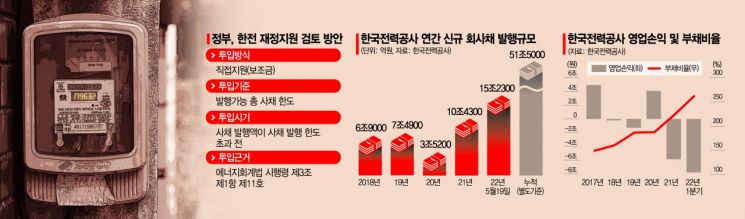
The problem is that self-help measures, which are like ‘squeezing a dry towel,’ are only temporary fixes that fall far short of normalizing KEPCO’s management. KEPCO’s self-help plan includes raising 800 billion won through selling equity stakes, 700 billion won through real estate disposals, 1.9 trillion won through restructuring overseas businesses, and 2.6 trillion won through tight management. Even if 6 trillion won is raised with difficulty, it cannot cover KEPCO’s operating loss of 7.8 trillion won in the first quarter. Considering that KEPCO has raised an average of 3 trillion won per month this year solely through corporate bond issuance excluding borrowings, this amount would not last even two months. Moreover, with the stock market sluggish and interest rates rising, it is expected to be difficult to sell assets such as equity stakes and real estate at fair value. The capacity for corporate bond issuance is also nearly exhausted.
Experts advise that for the government’s subsidy support not to become a poisoned chalice, it must be accompanied by maximizing self-help measures and normalizing electricity rates. Sung Tae-yoon, a professor in the Department of Economics at Yonsei University, said, “KEPCO can also be seen as a private company in which the government participates as a shareholder,” adding, “Before government subsidy support, realistic policies such as electricity rate hikes should be prioritized.” Jeong Dong-wook, a professor in the Department of Energy Systems Engineering at Chung-Ang University, also said, “Ultimately, the rate system needs to change so that consumers can bear part of the increased fuel costs,” adding, “However, since electricity is an essential good, measures such as strengthening the progressive rate system should be considered to increase the burden for heavy users in order to mitigate the impact on low-income households and small businesses.”
© The Asia Business Daily(www.asiae.co.kr). All rights reserved.
![Clutching a Stolen Dior Bag, Saying "I Hate Being Poor but Real"... The Grotesque Con of a "Human Knockoff" [Slate]](https://cwcontent.asiae.co.kr/asiaresize/183/2026021902243444107_1771435474.jpg)












