The Three Major Agricultural Investments Are 'Soybeans, Corn, Wheat'
US ETFs and ETNs Are the Most Famous... Beware of Currency Exchange Losses
Domestic ETFs and ETNs Also Show High Returns
However, Approach with Caution... Information Asymmetry Is Very High
Many Unexpected Variables Such as Climate, War, and Exports
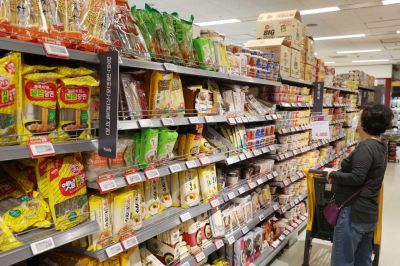 On the 19th, amid concerns over a surge in flour prices due to Russia's invasion of Ukraine and India's ban on wheat exports, citizens are shopping at a large supermarket in downtown Seoul. Photo by Moon Honam munonam@
[Asia Economy Reporter Hwang Yoon-joo] The butterfly effect caused by war is pushing up prices on the dining table. This is due to Ukraine, one of the world's granaries, being invaded by Russia. Investors who turned to agricultural commodity exchange-traded funds (ETFs) immediately after the war recorded double-digit returns within three months. Interest from individual investors in agricultural commodity trading, once considered the domain of alternative investment experts, has also increased. Experts warn that due to the high information asymmetry in this area, hasty investments based solely on returns can lead to significant losses. Accordingly, we have easily summarized everything from agricultural commodity investment targets to methods and precautions.

◆ The three major traded crops: 'Soybeans, Corn, Wheat'... Confirming investment targets and related information is essential = The hub of grain trading is the United States. 80% of the world's grain trading volume takes place at the Chicago Mercantile Exchange. Therefore, the representative commodities are not rice, which Koreans are familiar with, but soybeans, corn, and wheat. These grains have the largest demand and wide applications (food, feed, industrial use), so they are called the three major grains. In addition, various agricultural and livestock products such as raw sugar, coffee, cocoa, cotton, rice, and pork are also traded.
If you want to invest in agricultural commodities, you must first decide on the investment item because inventory and demand differ for each grain. There is a significant difference in returns depending on whether you invest in a single grain or bundle several grains together. Single agricultural commodities typically include soybeans, corn, and wheat. There are also products that bundle the three major grains or include more than ten types.
Once you decide on the investment target, checking related information is fundamental. Various issues such as climate affecting production, export-import policies of specific countries, and wars influence prices.
Investors must check the 'World Agricultural Supply and Demand Estimates (WASDE)' report published by the U.S. Department of Agriculture (USDA). It discloses basic information such as supply (inventory, planting area, etc.). You can find it online by searching for 'WASDE Report.'
◆ Investing in exchange-traded products (ETPs) is the easiest... Consider exchange rates when investing in U.S. ETFs = There are three main ways to invest in agricultural commodities: ① direct futures trading ② investing in agriculture-related companies ③ exchange-traded products (ETNs, ETFs). Generally, investments are made through exchange-traded funds (ETFs) or exchange-traded notes (ETNs) because direct investment is not easy due to storage, transportation costs, and management of grains.
Domestic ETFs listed include ▲KODEX Soybean Futures (H) ▲TIGER Agricultural Commodity Futures Enhanced (H) ▲HANARO Agricultural Convergence Industry ▲KODEX 3 Major Agricultural Commodity Futures (H). ETNs (excluding leverage and inverse) include ▲Daishin Wheat Futures (H) ▲Meritz Representative Agricultural Commodity Futures (H) ▲Shinhan Corn Futures (H) ▲Shinhan Soybean Futures (H).
The U.S. offers a wider variety of products. ETFs include ▲DBA ▲WEAT (Wheat) ▲CORN (Corn) ▲SOYB (Soybean) ▲CANE (Sugar). DBA is a product composed of more than 10 types of agricultural commodities traded in the U.S., including soybeans, corn, coffee, live cattle, and pork. WEAT, CORN, SOYB, and CANE invest in single agricultural commodities as indicated by their names: wheat, corn, soybean, and sugar, respectively.
The most famous ETN is 'RJA,' which consists of 20 agricultural commodities traded in 10 countries. If you want to invest in agriculture-related companies, MOO (ETF) is suitable. It is an ETF composed of 52 global companies with more than 50% of their sales related to agriculture.
Researcher Kim Hae-in of Daishin Securities explained, "However, individual agricultural commodity ETFs have small assets under management (AUM) but relatively high total fees, so ETFs that invest broadly in agricultural commodities tend to have more active trading. In Korea, all individual agricultural commodity ETFs hedge currency risk."
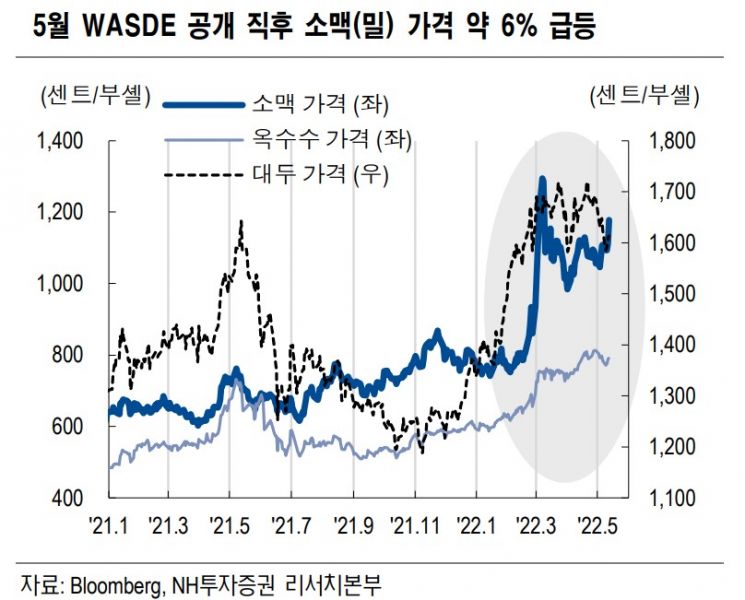
◆ "Agricultural commodity trading risks are too high" ... "General agricultural commodity performance expected to be favorable" = Wheat prices are expected to continue rising for the time being. According to the 'May World Agricultural Supply and Demand Estimates (WASDE)' released by USDA on the 12th, wheat prices surged about 6% due to lower-than-expected production. Soybean production is forecasted to increase this year. As wheat supply became unstable, India, the world's second-largest wheat producer, banned wheat exports. Moreover, the deterioration of wheat crop conditions in the U.S. last winter also contributed to the price increase.
Hwang Byung-jin, a researcher at NH Investment & Securities, analyzed, "The U.S. Department of Agriculture is likely to lower its wheat production estimates again in the June WASDE. The performance of DBA ETF or TIGER Agricultural Commodity Futures Enhanced (H) ETF, which are exposed to the entire agricultural commodity sector rather than just grains like JJG ETN, is expected to be favorable."
However, experts with alternative investment experience recommend caution when investing in agricultural commodities. In 2020, when COVID-19 spread, agricultural commodity prices were on a gentle downward trend due to decreased demand. Grain prices surged sharply in a short period due to Russia's invasion of Ukraine in February. Ukraine, known as Europe's granary, was unable to plant wheat.
As a result, the 'KODEX 3 Major Agricultural Commodity Futures (H) ETF' and 'TIGER Agricultural Commodity Futures Enhanced (H) ETF' recorded three-month returns of 26.54% and 26.33%, respectively. This contrasts with the 6.08% return of 'KODEX Soybean Futures (H)' during the same period. Looking at six-month returns, they were 38.44%, 35.51%, and 31.83%, respectively. This is truly the butterfly effect caused by war.
Kang Dae-kwon, CEO of Life Asset Management, pointed out, "In the past 10 years, agricultural commodity futures prices have not risen as sharply as they have now. Agricultural commodity investment is structured so that three major traders determine prices, resulting in high information asymmetry. There are many unpredictable variables such as weather and war, so price volatility is greater compared to other investment products."
© The Asia Business Daily(www.asiae.co.kr). All rights reserved.
![Clutching a Stolen Dior Bag, Saying "I Hate Being Poor but Real"... The Grotesque Con of a "Human Knockoff" [Slate]](https://cwcontent.asiae.co.kr/asiaresize/183/2026021902243444107_1771435474.jpg)


















