Public Interest Projects Needed for Power Supply
Burden of Securing Project Funds Through Borrowing
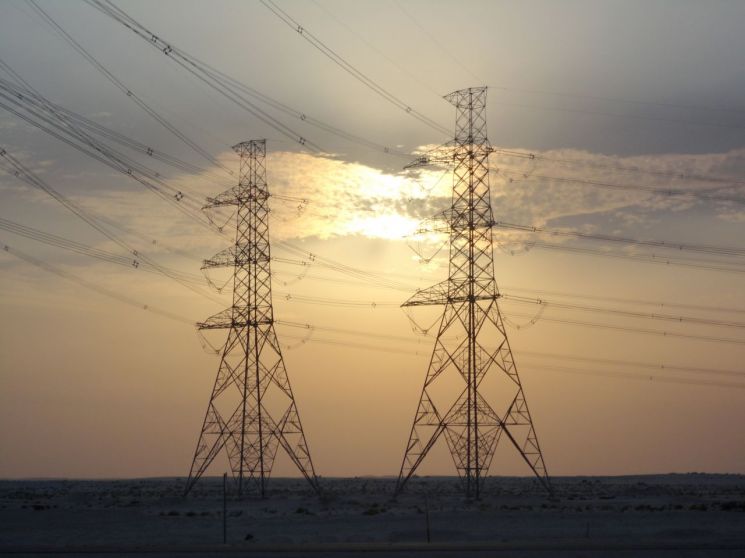
Korea Electric Power Corporation (KEPCO) has decided to invest 800 billion KRW in corporate bonds for the construction of a new transmission line project as scheduled, despite facing the worst management crisis. Although it entered an emergency management system due to a large-scale deficit in the first quarter of this year, it appears that the decision was made based on the judgment that the project cannot be delayed any longer to ensure stable power supply in the region.
According to KEPCO on the 20th, the company decided earlier this month to invest a total of 842.8 billion KRW for the construction of the Donghaean~Singapyeong 500kV HVDC transmission line (eastern section). HVDC (High Voltage Direct Current) is a technology that converts electricity generated as alternating current (AC) at power plants into direct current (DC) for transmission, and then converts it back to AC. It is characterized by its ability to stabilize the system even in the event of faults caused by sudden changes in power.
KEPCO plans to connect an overhead transmission line of 137 km x 2 Bi-pole from the Donghaean Converter Station in Uljin, Gyeongbuk to the Singapyeong Converter Station in Gapyeong, Gyeonggi Province to supply power. Specifically, the transmission line will pass through Uljin and Bonghwa in Gyeongbuk, then Samcheok, Yeongwol, Taebaek, Jeongseon, Pyeongchang, Hongcheon, and Hoengseong counties in Gangwon Province, and finally through Yangpyeong and Gapyeong counties. The total length of the transmission line combining both eastern and western sections is approximately 220 km, with about 440 transmission towers, making it a large-scale construction project. The construction period is from early this month until the end of June 2025. Upon completion, the transmission line will transport electricity generated from the Uljin nuclear power plant and other power plants to the Singapyeong Converter Station to supply electricity to residents in the metropolitan area.
The reason KEPCO is pushing forward with the transmission line construction is based on the judgment that the power supply to major regions, a large-scale public interest project, can no longer be delayed. The Donghaean~Singapyeong transmission line project began serious discussions in 2016 but faced long delays in securing converter station sites and environmental impact assessments due to regional conflicts.
The issue is that KEPCO is again raising project funds through borrowing. Having recorded a deficit of about 8 trillion KRW in the first quarter and taking measures to improve its financial situation, there are concerns that this ambitious project could further deteriorate KEPCO’s financial structure. Since the beginning of this year until now, KEPCO has issued corporate bonds totaling 15.23 trillion KRW, borrowing an average of 3 trillion KRW per month to continue operations.
KEPCO expects the impact of securing funds for this project on its financial structure to be minimal. A KEPCO official explained, "The corporate bonds for this transmission line project will basically be issued in installments of 20 to 30 billion KRW with time intervals," adding, "It is not a case where a large amount of funds is needed all at once."
© The Asia Business Daily(www.asiae.co.kr). All rights reserved.
![Clutching a Stolen Dior Bag, Saying "I Hate Being Poor but Real"... The Grotesque Con of a "Human Knockoff" [Slate]](https://cwcontent.asiae.co.kr/asiaresize/183/2026021902243444107_1771435474.jpg)











