War-Driven Supply Chain Crisis Realized-③
Samsung and LG Electronics Face Disruptions at Russian Local Factories and Sales
Semiconductor Industry Struggles with Equipment Shortages
Rising Logistics Costs Impact Earnings
The prolonged Russia-Ukraine war and China’s ‘Zero COVID’ policy-induced city lockdowns have worsened global supply chain disruptions, delivering a direct blow to the home appliance and semiconductor industries, which have a large share of overseas sales. Due to parts shortages, production factories are not operating smoothly, causing ‘sold-out crises’ in some regions. The sharp rise in raw material prices has also triggered increased production and logistics costs, putting profitability management under strain.
◆ "No products to sell" = Samsung Electronics and LG Electronics have indefinitely suspended shipments to Russia, citing global maritime logistics disruptions caused by the Russia-Ukraine war, resulting in depleted inventories of home appliances in the Russian market.
According to the industry on the 20th, most home appliances are sold out at Samsung Electronics’ and LG Electronics’ official local online stores and local appliance retailers in Russia. For example, a look at Samsung Electronics’ official online store in Russia shows that out of about 60 refrigerators on sale, only 2 models are currently available for purchase. The situation is similar for Samsung’s and LG’s washing machines and TVs, which are popular in Russia.
Samsung Electronics operates a factory producing TVs and monitors in the Kaluga region of Russia, and LG Electronics also has a home appliance factory in the Ruza area on the outskirts of Moscow, but they are not receiving the necessary parts for finished product assembly. Both local factory operations and exports of finished products have been blocked.
This is because, after Russia’s invasion of Ukraine on February 24, global shipping companies have boycotted transporting Russian cargo, and the U.S. has banned exports of semiconductors, smartphones, and home appliances to Russia. An insider familiar with internal affairs said, "Considering relations with Russia, there have been no factory closures or suspensions yet," but added, "Parts procurement has become impossible, causing production lines in factories to stop frequently."
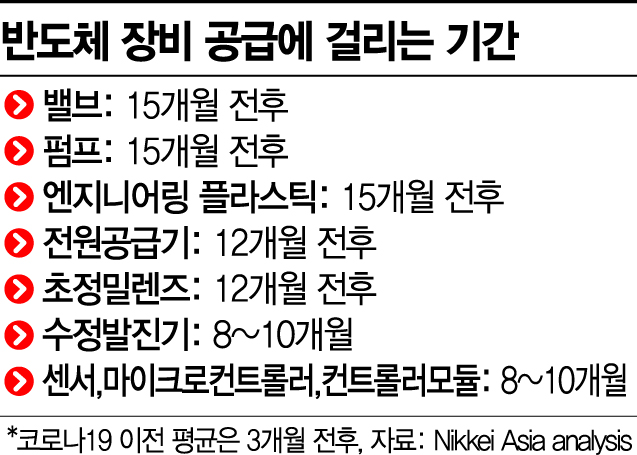
◆ "Cannot increase production due to lack of equipment and materials" = The semiconductor supply shortage is expected to continue this year. Even if the semiconductor industry tries to increase production, the prolonged Russia-Ukraine war has made the supply of materials, parts, and equipment (MPE) required for semiconductor production extremely tight.
Ukraine, which accounts for half of the world’s production of neon, a key semiconductor material, was invaded, causing supply prices to skyrocket by tens of times compared to a year ago. As the prices of materials needed for semiconductor production surged, foundry companies are now considering raising semiconductor supply prices. Following industry leader TSMC’s 6% production price increase planned for next year, Samsung Electronics is reportedly reviewing a 15-20% price hike.
Equipment capable of increasing semiconductor production is also in critically short supply. For example, 8-inch (200mm) wafers used in automotive semiconductors are produced at full capacity by DB HiTek and SK Hynix System IC, but additional investment in production facilities has become difficult. An industry official explained, "Compared to memory semiconductors, manufacturing technology is not very advanced, so older equipment can be used, but since equipment manufacturers have shifted lines to 12-inch (300mm), 8-inch equipment is hardly produced, making equipment supply unstable."
As countries worldwide develop semiconductors as strategic industries, competition to secure advanced equipment is intensifying. Consequently, equipment lead times (the time from order to delivery) have lengthened from several months in the past to 2-3 years currently.
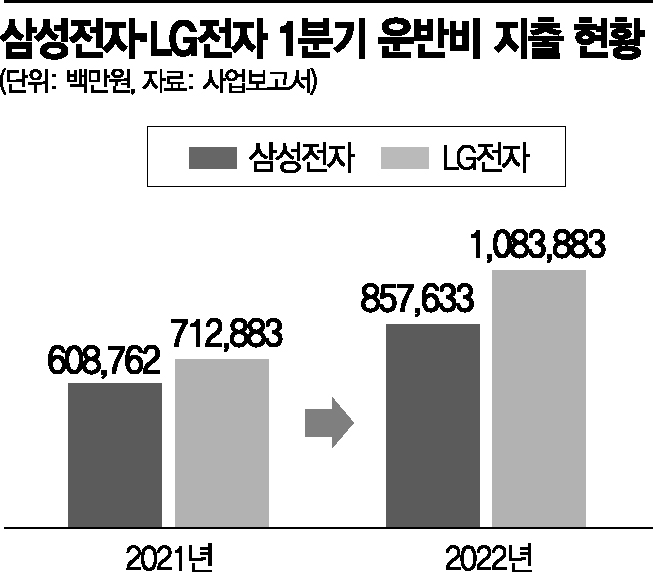
Domestic electronics companies, selling products globally, are fully reflecting the burdens of parts supply disruptions and rising raw material and logistics costs in their corporate performance. LG Electronics disclosed in its Q1 business report this year that prices of steel, resin, and copper used as raw materials for home appliances rose 20.4%, 16.3%, and 36.4% respectively compared to the same period last year, and various semiconductor chip prices increased by 20-40%. The transportation costs for products incurred by Samsung Electronics and LG Electronics in Q1 this year also rose 41% and 52% respectively from last year, reaching 857.6 billion KRW and 1.0838 trillion KRW.
© The Asia Business Daily(www.asiae.co.kr). All rights reserved.


















