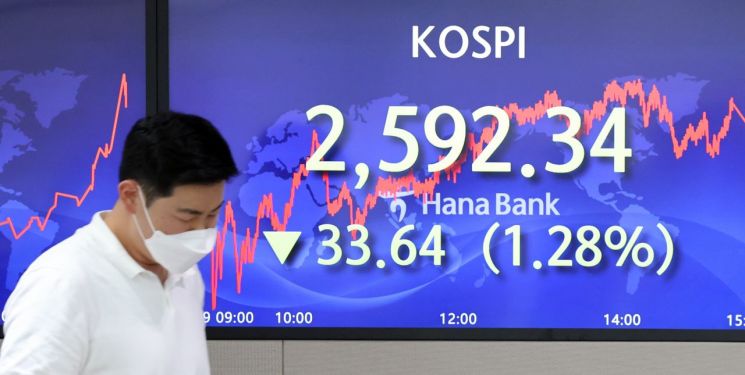
[Asia Economy Reporter Myunghwan Lee] On the 19th, the KOSPI fell below the 2600 mark for the first time in three trading days due to the plunge in the US stock market and inflation concerns. However, the index, which had dropped nearly 2% in early trading, partially recovered its losses thanks to net purchases exceeding 500 billion KRW by individual investors and the strength of secondary battery-related stocks.
On that day, the KOSPI closed at 2,592.34, down 33.64 points (1.28%) from the previous trading day. The KOSPI opened at 2,576.24, down 49.74 points (1.89%) from the previous day, but the decline gradually narrowed in the afternoon. By investor type, individuals alone net purchased stocks worth 520.3 billion KRW, while foreigners and institutions sold 98 billion KRW and 483.5 billion KRW, respectively.
Most of the top market capitalization stocks closed lower. Samsung Electronics closed at 67,400 KRW, down 1.03% from the previous day. NAVER and Kakao also fell by 1.81% and 2.42%, respectively. Other decliners included ▲SK Hynix (-1.76%) ▲Samsung Electronics Preferred (-0.50%) ▲Samsung SDI (-1.99%) ▲Hyundai Motor (-1.62%) ▲LG Chem (-1.76%). LG Energy Solution (1.46%) and Samsung Biologics (0.63%) closed higher.
By sector, non-metallic minerals rose 1.65%, the only sector to increase. Meanwhile, textiles and apparel (-4.00%), paper and wood (-3.18%), and construction (-2.31%) showed downward trends.
The KOSDAQ index closed at 863.80, down 7.77 points (0.89%) from the previous day. The KOSDAQ started at 853.23, down 18.34 points (2.10%), but partially recovered losses in the afternoon. Similar to the KOSPI, individuals net purchased 53.5 billion KRW, while foreigners and institutions sold 100 million KRW and 57.7 billion KRW, respectively.
Among the top market capitalization stocks on KOSDAQ, L&F surged 8.51% to close at 269,100 KRW following news of a 7 trillion KRW supply contract for cathode materials with LG Energy Solution. Cheonbo also rose 1.18% from the previous day. Conversely, HLB fell 5.35%. Other decliners included ▲Celltrion Pharm (-3.77%) ▲Celltrion Healthcare (-2.85%) ▲CJ ENM (-1.68%) ▲Rino Industrial (-0.88%).
By sector, IT components (3.07%), paper and wood (1.18%), and IT hardware (0.82%) rose, while transportation (-4.34%), entertainment and culture (-2.71%), and internet (-2.30%) declined.
The securities industry analyzed that the domestic stock market's resilience despite the US market plunge was due to the strength of secondary battery-related stocks. Seokhwan Kim, a researcher at Mirae Asset Securities, explained, "Domestic major indices narrowed their losses due to the concrete announcement of Shanghai lockdown easing and the strength of secondary battery-related stocks. L&F surged on news of a 7 trillion KRW cathode material supply contract with LG Energy Solution, leading the overall rise in related stocks."
There was also an analysis that excessive declines in the domestic stock market are unlikely. Jungwhan Na, a researcher at Cape Investment & Securities, said, "Although stocks in semiconductor and electronic components sectors are showing a downward trend, most of the negative factors have already been reflected. Since the stock prices of major semiconductor stocks have fallen excessively, their valuation attractiveness is highlighted, so further price declines will be limited."
© The Asia Business Daily(www.asiae.co.kr). All rights reserved.
![Clutching a Stolen Dior Bag, Saying "I Hate Being Poor but Real"... The Grotesque Con of a "Human Knockoff" [Slate]](https://cwcontent.asiae.co.kr/asiaresize/183/2026021902243444107_1771435474.jpg)
















