Voters Complain of 'Fatigue' Due to Repeated Election Season Contacts
Some Voters Say "Blocking Numbers Doesn't Stop Calls from Others"
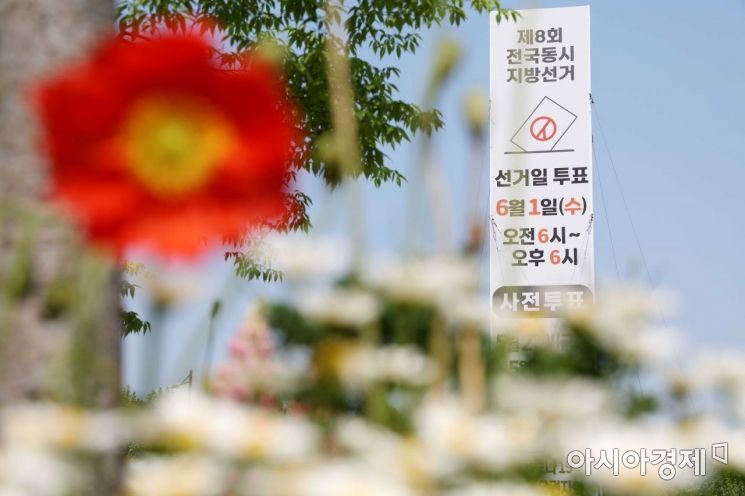 A sculpture encouraging voters to participate in the election is installed in the plaza in front of Seoul City Hall. Photo by Mun Ho-nam munonam@
[Asia Economy Reporter Heo Midam] # Jeong Mo (25), an office worker living in Uijeongbu-si, Gyeonggi-do, has been struggling with multiple election-related calls several times a day recently. Jeong said, "During election season, I receive texts from candidates asking me to vote for them, and I keep getting survey calls. Even if I answer thinking it might be a work call, it always turns out to be election-related." He added, "I don't know how they get my number. Even if I block the calls, they keep coming from different numbers, which is stressful. I don't want to answer unknown numbers at all."
With the 8th nationwide simultaneous local elections scheduled for the 1st of next month, the increase in survey calls and support solicitation texts from candidates is causing voter fatigue. Especially due to random calls coming regardless of morning or evening, some voters are experiencing inconvenience in their daily lives. Additionally, some receive contacts from candidates in unrelated regions, leading to criticism that promotional calls and texts are rather fostering negative feelings toward the election.
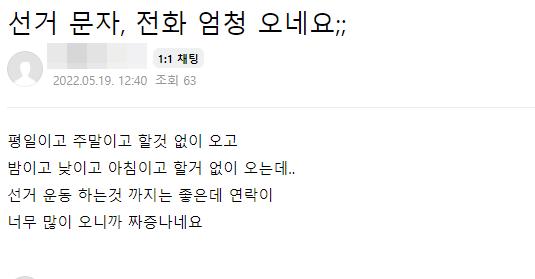
On the 20th, posts from netizens expressing stress over incessant election-related contacts have been appearing on online communities.
One netizen said, "I get a lot of election-related texts and calls," adding, "They come on weekdays and weekends alike. Campaigning is fine, but the excessive contact is annoying." Another netizen said, "I think I get about eight survey calls a day. Is it okay to contact my personal phone without consent? They have been coming more frequently lately. I don't know where my personal information leaked from."
Some voters are considering blocking incoming calls due to the flood of election-related contacts. A netizen who runs a restaurant said, "I get over 10 texts a day asking me to vote for someone in the local elections, and it's driving me crazy. When I check texts or calls thinking it might be from a business partner, they are all election-related. Is there a way to block these contacts?"
According to the National Election Commission, sending texts by candidates is legal under the Public Official Election Act. Text messages are limited to 8 times until just before the local elections, but calls encouraging voting using a random automatic response system (ARS) can be made unlimited times regardless of frequency.
However, election campaign messages must include the sender's phone number, a method to refuse reception, and a phone number to report illegally collected information. Violations can result in candidates facing imprisonment of up to one year or fines of up to 1 million won.
As election-related text promotions increase, reports related to personal information are also rising. According to the Personal Information Infringement Report Center, during the 21st general election in April 2020, 156 reports and 10,507 consultations were received. A total of 105 administrative actions were taken, including one fine and 104 corrective orders.
Voters say they have no choice but to refuse or block numbers whenever they receive election-related contacts, but they find it troublesome as they cannot block all random calls. Lee Mo, a 20-something office worker, said, "I keep getting contacts from various candidates like the superintendent, which stresses me out. Even when I block the calls during work, they keep coming."
Meanwhile, when collecting personal information directly from voters to send election texts, consent must be obtained, and only the minimum personal information necessary to achieve the purpose should be collected. Under the Public Official Election Act, the personal information that can be collected includes name, date of birth, address, phone number, and email address. Even when receiving personal information from a third party for sending election texts, voter consent is mandatory.
© The Asia Business Daily(www.asiae.co.kr). All rights reserved.
![Clutching a Stolen Dior Bag, Saying "I Hate Being Poor but Real"... The Grotesque Con of a "Human Knockoff" [Slate]](https://cwcontent.asiae.co.kr/asiaresize/183/2026021902243444107_1771435474.jpg)

















