Permanent Magnet Material Neodymium and Others
Annual Production of About 5,000 Tons Expected by Next Year
Cost Reduction Anticipated for Electric Vehicles and Phones
Contributing to Supply Chain Stabilization
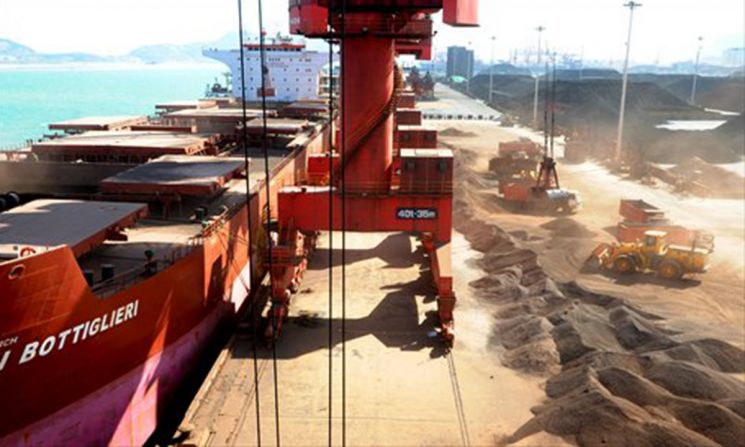
[Asia Economy Reporter Moon Chaeseok] South Korea has secured inbound foreign direct investment (FDI) from an overseas rare earth processing specialist company for the first time. By next year, it will be able to produce more than 5,000 tons annually of materials such as 'neodymium,' a raw material for 'permanent magnets' used in electric vehicles, wind turbines, and mobile phones. This is expected to enhance the stability of the domestic rare earth supply chain.
According to the government and industry sources on the 19th, KSM Metals, the Korean subsidiary of Australian rare metal mining and processing company ASM, completed a factory in Ochang, Chungcheongbuk-do on the 12th. This marks the first case of inbound FDI from an overseas rare earth company. Since it is a foreign company entering Korea rather than a Korean company going abroad, it is expected to bring benefits beyond investment, such as job creation, technology transfer, production capacity enhancement, and cost reduction.
KSM Metals' Ochang factory produces materials such as neodymium used in permanent magnets. Permanent magnets are raw materials widely used not only in electric vehicle drive trains and various parts but also in wind turbines, defense industry equipment, mobile phones, and electronic products. The electric vehicle drive train is a system encompassing drive components such as electric motors, inverters, and reducers, which improve the driving efficiency of electric vehicles. Given its diverse applications, once a stable production line is established, it is expected to contribute to cost reduction for various finished product companies.
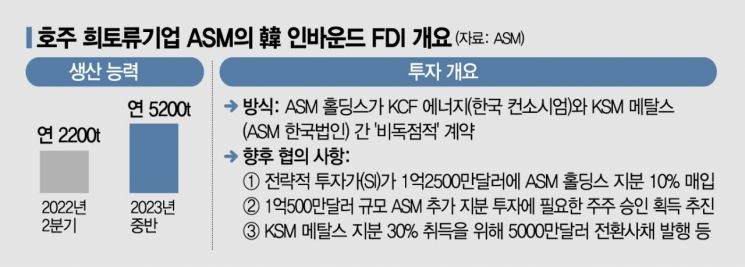
The factory's production capacity is planned to increase more than twofold from 2,200 tons annually in the second quarter to 5,200 tons by mid-next year. Currently, the first phase of equipment installation has been completed and is undergoing test operation. Initially focusing on neodymium, copper, and titanium metals, the factory plans to begin producing core magnet alloys after completing the first phase of equipment test operations in the third quarter. The company expects that after completing the second phase of equipment installation by mid-next year, annual production of 5,200 tons will be achievable.
The 'financial issue' will be addressed jointly by ASM Holdings and the Korean consortium KCF Energy. Funding required for investments in ASM, ASM Holdings, KSM Metals, and the supply of 'neodymium-iron-boron' alloys will be secured through attracting strategic investors (SI), shareholder approval, and issuing convertible bonds (BM). A non-exclusive purchase agreement with a five-year maturity has been signed in this regard. The current task is to find an SI to purchase a 10% stake in ASM Holdings worth approximately $125 million (about 159.6 billion KRW) and to obtain shareholder approval for an additional ASM equity investment of about $105 million (about 134 billion KRW).
The 'financial issue' will be addressed jointly by ASM Holdings and the Korean consortium KCF Energy. Funding required for investments in ASM, ASM Holdings, KSM Metals, and the supply of 'neodymium-iron-boron' alloys will be secured through attracting strategic investors (SI), shareholder approval, and issuing convertible bonds (BM). The current task is to find an SI to purchase a 10% stake in ASM Holdings worth approximately $125 million (about 159.6 billion KRW) and to obtain shareholder approval for an additional ASM equity investment of about $105 million (about 134 billion KRW). Depending on customer demand, production will focus on finished products such as electric vehicle drive trains, wind turbines, defense equipment, or mobile phones. ASM stated, "We cannot disclose the list of domestic customers."
Since an overseas rare earth specialist company has been attracted to Korea, the government expects the domestic industrial supply chain to be further strengthened. At a meeting with Choi Tae-won, chairman of the Korea Chamber of Commerce and Industry, the day before, Minister Lee Chang-yang of the Ministry of Trade, Industry and Energy said, "The part I am most concerned about is (equipment) investment," showing the government's commitment to expanding investment. An official from the Ministry of Trade, Industry and Energy said, "(This inbound FDI) has established a foundation for producing rare earths domestically," adding, "Reviving the broken 'permanent magnet ecosystem' link through this is very meaningful."
This FDI is also good news for electric vehicle, energy, defense, and home appliance businesses. According to a survey of 322 domestic companies released by the Korea Chamber of Commerce and Industry on the 8th, the highest response rate (58.6%) cited "deterioration of profitability after rising production costs" due to inflation. Regarding the impact of exchange rate increases, "increased manufacturing costs due to rising import raw material prices" (68.7%) was the top concern. This indicates that many companies are in a desperate situation where even a small cost reduction is necessary.
© The Asia Business Daily(www.asiae.co.kr). All rights reserved.
![Clutching a Stolen Dior Bag, Saying "I Hate Being Poor but Real"... The Grotesque Con of a "Human Knockoff" [Slate]](https://cwcontent.asiae.co.kr/asiaresize/183/2026021902243444107_1771435474.jpg)












