From Goryeo to Joseon, the King's Playground
Seohyeonjeong and Oungak Destroyed by Japanese Invasion
May Be Included in Gyeongbokgung Restoration Project Funding
Likely to Follow the Path of Restoring Damaged Historicity
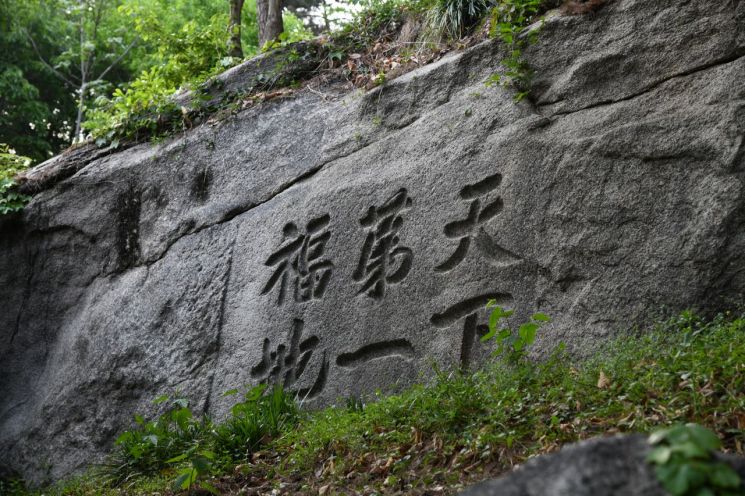 Near the official residence, there is an inscription called 'Cheonhajeilbokji,' which indicates that Cheongwadae has long been recognized as a prime location. It means "the most blessed land in the world."
In February 1990, a commemorative stone was discovered in the bushes within the Blue House grounds. It was a carved granite slab measuring 250 cm in width and 120 cm in height. The inscription read "Cheonhajeilbokji (天下第一福地)" in clerical script, meaning "the most blessed land under heaven." The Blue House invited the epigraphy expert Im Chang-soon to appraise it, and he concluded that it was created 300 to 400 years ago.
The story that the site of the Blue House is a prime location has long existed. During the Goryeo Dynasty, Kings Munjong and Sukjong built secondary palaces (Igung). King Sejong of the Joseon Dynasty developed it as a rear garden of Gyeongbokgung Palace. Structures such as Seohyeonjeong, Chwirojeong, Gwanjeojeon, and Chungsundang, built at that time, were destroyed during the Japanese invasions of Korea (Imjin War). King Gojong restored the site modeled after the rear garden of Changdeokgung Palace. Near the current Sangchunjae and Nokjiwon, he built Yungmundang and Yungmudang, which were used as military examination halls. Near the current Yeongbingwan, he created Paldobaemi, a rice field, and Gyeongnongjae, a study hall, to pray for a bountiful harvest.
King Gojong also established private spaces such as Oungak and Ongnyeonjeong near the current residential quarters. These were close to the site where the "Cheonhajeilbokji" inscription was found. Their exact nature is unclear, as all disappeared during the Japanese colonial period. The presidential residence is located right in front, making on-site investigation impossible. There are insufficient historical records to estimate their purpose, so restoration is out of the question. Only speculation based on comparisons is possible. One comparison is Okryucheon, located north of the rear garden of Changdeokgung Palace. Since it was the king’s private domain, it is believed to have been used similarly.
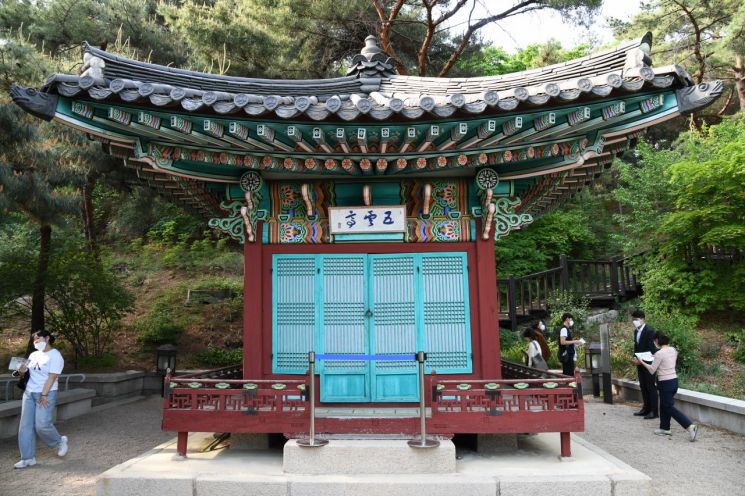 If you walk up the stairs at the entrance of the official residence for about 5 minutes, you will reach Ounjeong. It is a Seoul City Tangible Cultural Property named after Oungak, which was built in the rear garden of Gyeongbokgung Palace.
There are many similarities. Oungak and Ongnyeonjeong were constructed according to the given site conditions, like the buildings along Okryucheon. Ongnyeonjeong was situated on a high hill offering a panoramic view of Seoul, similar to Soyojeong in Changdeokgung Palace, which overlooks the Okryucheon waterfall. The Cheonhajeilbokjicheon stream flowing between the inscription site and behind the presidential residence appears to mimic the function of a "ryubaegyeo" (an artificial water channel). It evokes traces of "ryusanggoksu" (flowing cup water) seen in Okryucheon. The fact that Oungak was designed as a place where people could stay is also similar to Nongsanjeong in Changdeokgung Palace.
The reason for creating rear gardens inside palaces was the king’s limited range of movement. The palace was both the king’s residence and office. Officials discouraged leaving the palace due to costs, preparation, and security concerns. Leisure activities had to be conducted within the palace. The king’s daily life was exposed to many people, so a nearby private space was needed for relaxation. Thus, the rear garden was created. It allowed the king to stroll through the forest behind the palace briefly to clear his mind or reflect inwardly.
There was even a king who felt constrained by public attention and regulations. King Injo, who ascended the throne through a coup and suffered the humiliation of Samjeondo, dug a pond called Yongji (Dragon Land) to enjoy leisure freely, but bad rumors spread. He then sought a more remote and secluded place to create a rear garden. That place was Okryucheon, which he used as a private space and playground free from interference.
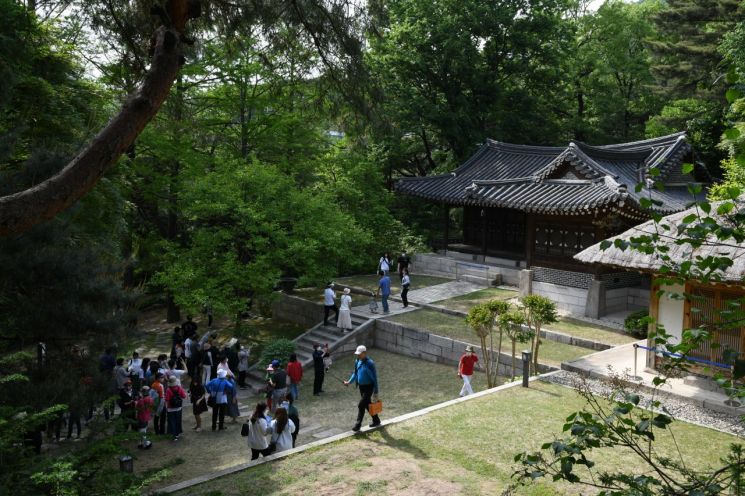 Chimryugak is an early 1900s building featuring a hipped-and-gabled roof. It is surrounded by three Metasequoia trees and seven bald cypress trees. Each stands over 20 meters tall, creating a picturesque landscape.
A rear garden cannot be strictly defined as a private space because military and agricultural facilities were also established there. The term is thus broad in concept. Some suggest calling it a "byeolseo" (villa). This means a place for rest or guests located near the main residence or in the countryside. However, a rear garden always exists within the palace walls. There can be no "second residence" or "countryside living space" inside the palace.
Jung Woo-jin, a researcher at Sangmyung University’s Korea-China Cultural Information Research Institute who earned a PhD studying Joseon palace rear gardens, used the term "byeolwon (別苑)" in his thesis titled "Characteristics of Joseon Dynasty Palace Villas Illuminated through the Oungak Area of the Reconstructed Gyeongbokgung Rear Garden." He combined the character "byeol," meaning "separate," "apart," or "distinct," with "won," meaning garden. He argued that even without strict dictionary definitions or historical usage, the term evokes the image of a "detached garden."
"Byeolwon is judged to emphasize the locational characteristic of being the farthest from the main palace space and deeply situated within the rear garden. From a usage perspective, many kings likely engaged in quiet contemplation and scholarly activities in this byeolwon, but some used it as a playground for entertainment or a place to harmonize with officials."
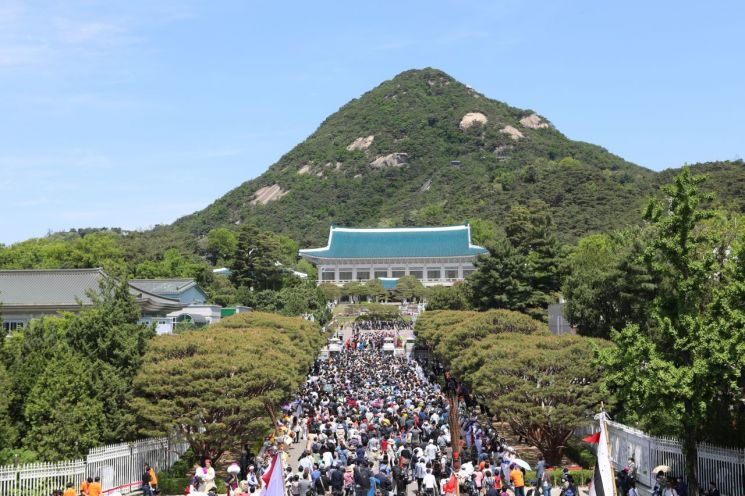 So far, 4.04 million people have applied to tour the Blue House. Since applications opened on the 27th of last month, only about 250,000 have actually visited. The Presidential Office is considering permanent opening after June 11.
The methods of creating rear gardens and their spatial composition remain shrouded in mystery. The similarity with Okryucheon also requires precise investigation such as actual topographical measurement. Researcher Jung said, "It is necessary to study the exact locations and historical changes of buildings, water systems, and original terrain, as well as to extract landscape enjoyment methods from key viewpoints represented by building sites." This is very important symbolically for overcoming foreign invasions and restoring historical authenticity. During the Japanese colonial period, the Japanese Governor-General’s residence was built in the Gyeongbokgung rear garden. After liberation, the Blue House was constructed, but remnants of Japanese colonial rule are still considered to remain.
Since the Blue House opened to the public on the 10th, opportunities for investigation and excavation have increased. The rear garden may be included in the Gyeongbokgung restoration project. In fact, the Yoon Suk-yeol administration’s national agenda includes plans to excavate, restore, and maintain key Blue House relics from next year through 2026. The goal is to restore the historical authenticity of the damaged Gyeongbokgung rear garden and transform it into a world-class historical and cultural space.
The Cultural Heritage Administration, which effectively took over management, is deliberating how to utilize the site. It has not yet decided whether to designate the entire Blue House as a historic site or register it as a modern historical cultural space. If the former, emphasis will likely be placed on restoring the historical authenticity of the Gyeongbokgung rear garden. If the latter, the focus will be on revealing the Blue House as a product of modern political history.
© The Asia Business Daily(www.asiae.co.kr). All rights reserved.



















