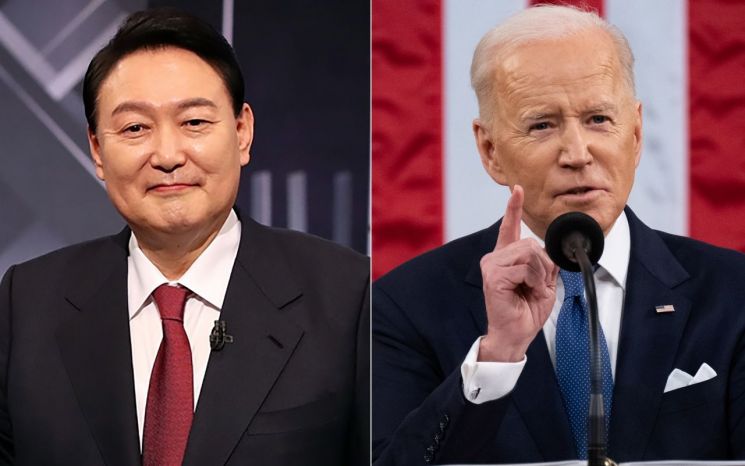
 The summit between President Yoon Suk-yeol and U.S. President Joe Biden will take place 11 days after President Yoon's inauguration. [Image source=Yonhap News]
[Asia Economy, So Jong-seop, Political and Social Editor] South Korea and the United States are solidifying their alliance beyond security and economic ties into a technological alliance. It can be seen that the U.S. has reassessed South Korea's strategic technological value. It is symbolic that U.S. President Biden visited South Korea before Japan. Although the agenda of the Korea-U.S. summit includes North Korean nuclear issues, economy, and global cooperation, the core message throughout the process is to check China.
The U.S. is paying particular attention to South Korea's advanced technology, especially in semiconductors, in an environment where technology determines future development. This movement became visible since the Korea-U.S. summit held in Washington on May 21 last year. The joint statement at that time included, "The two presidents recognize the importance of mobile communication security and supplier diversity --- and agreed to work to enhance resilience in supply chains, including priority sectors such as semiconductors and eco-friendly EV batteries." This is a 'technological alliance.'
For the economy to continuously develop, technology must advance. The core is semiconductors. This is why China has declared a 'semiconductor rise.' The U.S. has responded accordingly. A representative example is banning allied countries from using Chinese Huawei equipment and imposing export controls on semiconductor equipment. South Korea possesses the world's top technology in the memory semiconductor sector. This is the background why the U.S., which holds fundamental technologies, and China, which declared a semiconductor rise, are paying attention to South Korea. The same applies to batteries and other sectors. The U.S. aims to block China's technological advancement and strengthen economic hegemony through semiconductor competitiveness. South Korea is at the center of this.
The Korea-U.S. technological alliance shakes the structure of 'security by the U.S., economy by China.' A new international order where economy and security are deeply linked is emerging. Our participation in the 'Indo-Pacific Economic Framework (IPEF)' is one example. The issue lies in the relationship with China. Last year, trade volume between South Korea and China exceeded $300 billion, and export dependence on China was 25.3%. China views the Korea-U.S. summit with discomfort. Fortunately, China's dependence on South Korean technology in advanced fields such as semiconductors and mobile phone components is increasing. This Korea-U.S. summit is expected to be a turning point marking the beginning of new Korea-U.S. and Korea-China relations.
© The Asia Business Daily(www.asiae.co.kr). All rights reserved.

















