Q1 Listed Companies' Sales Reach 661 Trillion Won
Up 24% Year-on-Year
Brokerage Firms Raise Q2 Forecasts
"Challenges Remain from Rising Costs Like Interest Rates
Q2 Outlook Not Entirely Optimistic"
[Asia Economy Reporter Kwon Jae-hee] As companies wrapped up their first-quarter results with an 'earnings surprise,' attention is turning to whether this positive momentum can continue into the second quarter. Despite the seasonal off-peak period, companies posted strong performances, raising expectations within the securities industry. However, concerns about unfavorable business conditions such as exchange rates, inflation, and interest rate hikes have increased, casting a cautious outlook on the second quarter. Although estimated earnings were raised out of inertia, there is unease about being overly optimistic.
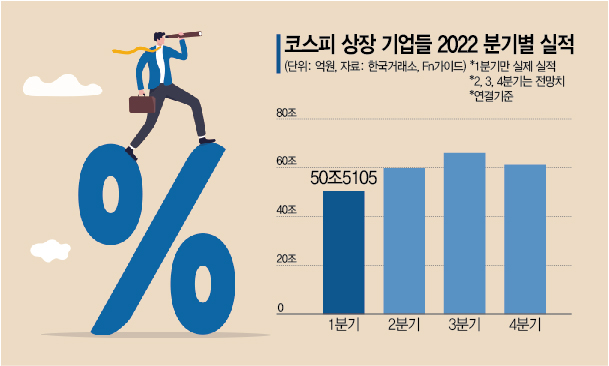
According to the Korea Exchange on the 19th, the first-quarter sales of KOSPI-listed companies this year amounted to KRW 660.9141 trillion, and operating profit was KRW 50.5105 trillion. This represents increases of 24.18% and 14%, respectively, compared to the same period last year. However, net profit decreased by 13.79% to KRW 41.691 trillion. This analysis is based on the performance of 608 listed companies with December fiscal year-end that submitted consolidated financial statements (excluding 71 companies newly established or with non-standard audit opinions out of 679 December fiscal year-end companies).
Even excluding Samsung Electronics, which accounts for about 12% of total KOSPI-listed company sales, overall results were positive. Sales of listed companies excluding Samsung Electronics increased by 24.91% (KRW 116.2993 trillion) to KRW 583.1326 trillion, and operating profit rose by 4.69% (KRW 1.6313 trillion) to KRW 36.3891 trillion. This improvement was driven by major conglomerates such as HMM (208.9%), SK (89%), SK Hynix (115%), SK Innovation (182%), Korean Air (665%), and Hyundai Steel (129%) reporting better results than a year ago. Taking seasonality into account, the general assessment is that the overall performance was positive.
In response, the securities industry has begun revising upward the annual earnings forecasts for major companies, especially rapidly adjusting second-quarter earnings estimates. Aggregating earnings forecasts from 145 KOSPI and KOSDAQ-listed companies (with consensus from three or more estimating institutions), second-quarter operating profit is estimated at KRW 63.7414 trillion. Considering that these companies posted KRW 59.2512 trillion in operating profit in the second quarter last year, this suggests a 7.58% increase year-over-year.
Samsung Electronics is a prime example. It recorded first-quarter sales of KRW 75.0823 trillion and operating profit of KRW 13.0283 trillion, setting a quarterly sales record. According to financial information provider FnGuide, the securities industry's forecast for Samsung Electronics' consolidated operating profit in the second quarter is KRW 15.2774 trillion, about 22% higher than the same period last year. Sales are projected to rise approximately 24% to KRW 78.6432 trillion.
However, considering the unfavorable market conditions such as inflation and cost concerns, some analysts caution against viewing the second-quarter earnings outlook too optimistically. High inflation and high interest rates are expected to persist for the time being. Although sales and operating profit increased, the operating profit margin relative to sales?a measure of a company's fundamental strength?fell to 7.64%, down 0.65 percentage points from the same period last year. In other words, the proportion of sales actually retained as profit in the first quarter decreased compared to a year ago.
Yeom Dong-chan, a researcher at Korea Investment & Securities, said, "Rising raw material prices, a strong dollar, and interest rate hikes all increase corporate costs. While the positive first-quarter results led to upward revisions for the closest quarter, considering inflation and cost concerns, it is difficult to view the second-quarter earnings upgrades optimistically."
Yoon Ji-ho, head of the research center at Ebest Investment & Securities, also noted, "Although first-quarter sales increased relatively, net profit declined. The main cause is the cost burden from rising raw material prices, and unless these cost-related negative factors are resolved, the second-quarter earnings outlook cannot be viewed positively."
© The Asia Business Daily(www.asiae.co.kr). All rights reserved.
![Clutching a Stolen Dior Bag, Saying "I Hate Being Poor but Real"... The Grotesque Con of a "Human Knockoff" [Slate]](https://cwcontent.asiae.co.kr/asiaresize/183/2026021902243444107_1771435474.jpg)
















