KOSPI Declines Over 90%
Impact of Signs of Intensifying Inflation
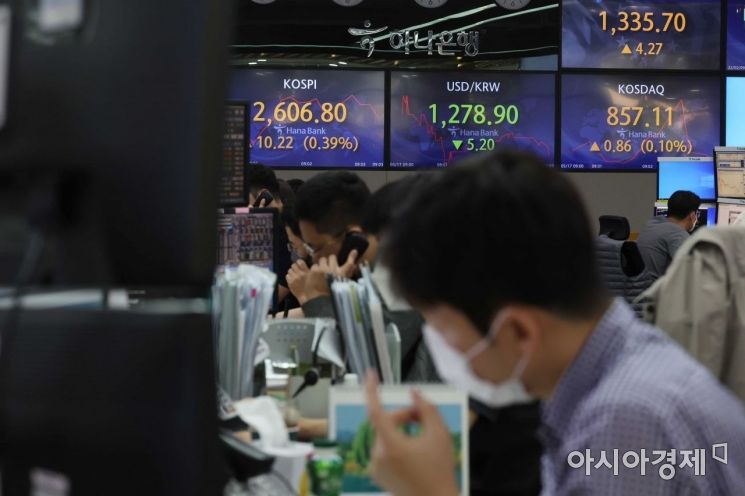 On the 17th, dealers were working in the dealing room of Hana Bank in Euljiro, Seoul. On that day, the KOSPI index opened at 2603.58, up 7.00 points (0.27%) from the previous trading day. The won-dollar exchange rate started at 1280 won, down 4.1 won. Photo by Moon Honam munonam@
[Asia Economy Reporter Hwang Junho] The fear of a 'cost of living crisis' raised in the United States has frozen even the Korean stock market.
On the 19th, the KOSPI started below the 2600 mark as concerns arose that inflation is actually impacting corporate earnings.
On that day, the KOSPI opened at 2,576.24, down 1.89% from the previous day, and even dropped to 2,568.54, down 2.19%, by 9:10 a.m. More than 90% of all listed stocks, including the top market capitalization stocks, showed a downward trend, indicating a broad bearish market.
This was the result of the fear of a 'cost of living crisis' spreading from the U.S. to the domestic stock market. Brian Cornell, chairman of U.S. retail company Target, stated on the 18th (local time) after announcing first-quarter earnings, "We did not anticipate any increase in transportation costs such as freight," and estimated that "an additional $1 billion in costs will occur this year."
Following the statement that inflation is directly impacting corporate earnings, Target's stock plunged 24.93%. Subsequently, stocks of similar companies such as Costco (-12.45%) and Walmart (-6.79%) also declined. The drop in U.S. retail stocks dealt a direct blow to domestic retail stocks. Leading Korean retail stocks such as Lotte Shopping, Shinsegae, and E-Mart fell more than 3%, dropping about twice as much as the index. Seo Sang-young, head of the Media Content Division at Mirae Asset Securities, analyzed, "Since the release of the U.S. Consumer Price Index in April on the 11th, the market has focused on the 'cost of living crisis,' which is judged to increase the possibility of corporate earnings slowdown, thereby dampening overall market investment sentiment."
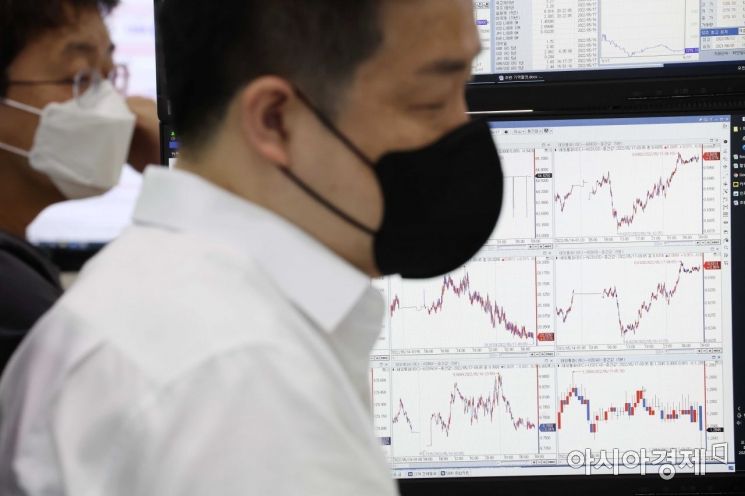 On the 17th, dealers are working in the dealing room of Hana Bank in Euljiro, Seoul. On this day, the KOSPI index opened at 2603.58, up 7.00 points (0.27%) from the previous trading day. The won-dollar exchange rate started at 1280 won, down 4.1 won. Photo by Moon Honam munonam@
The rising won-dollar exchange rate also acts as a burden on the stock market. As the exchange rate rises again to the 1,270 won level, anxiety grows, and downward pressure on the stock market may intensify. There are concerns about a vicious cycle where the strong dollar causes foreign capital outflows, leading to stock market declines, which in turn cause further capital outflows. However, there is also analysis that the upper limit may be constrained as South Korea and the U.S. are discussing cooperation measures equivalent to a currency swap, and dollar sales by exporters may also expand.
Negative economic outlooks for China, one of Korea's major export countries, are also a burden. Overnight, U.S. investment bank Goldman Sachs downgraded China's annual economic growth rate from 4.5% to 4.0% due to the Chinese government's continued zero-COVID policy. They explained that this figure also considers the possibility of government policy support such as COVID-19 response and real estate market stabilization.
However, there is also an interpretation that the cold snap in the U.S. stock market the previous day was due to increased supply-demand volatility ahead of the options expiration on the 19th (local time), causing a sharp decline. It is difficult to conclude that this is a trend decline. Contrary to the growing concerns about the cost of living crisis and the Fed's tightening intensity, the possibility of a June giant step (a 50 basis point interest rate hike) has fallen below 10%, and the probability of a July giant step is also below 20%. The U.S. 10-year Treasury yield recorded 2.884%, down 10.2 basis points. Lee Kyung-min, a researcher at Daishin Securities, said, "As concerns about corporate earnings deterioration and consumer anxiety leading to recession fears have emerged, already weakened investment sentiment has turned into fear. Although another bottom test will continue, the possibility of a new downward trend developing is low."
© The Asia Business Daily(www.asiae.co.kr). All rights reserved.
![Clutching a Stolen Dior Bag, Saying "I Hate Being Poor but Real"... The Grotesque Con of a "Human Knockoff" [Slate]](https://cwcontent.asiae.co.kr/asiaresize/183/2026021902243444107_1771435474.jpg)

















