Additional US-Korea Tech Alliance Expected... Leading Participation in IPEF
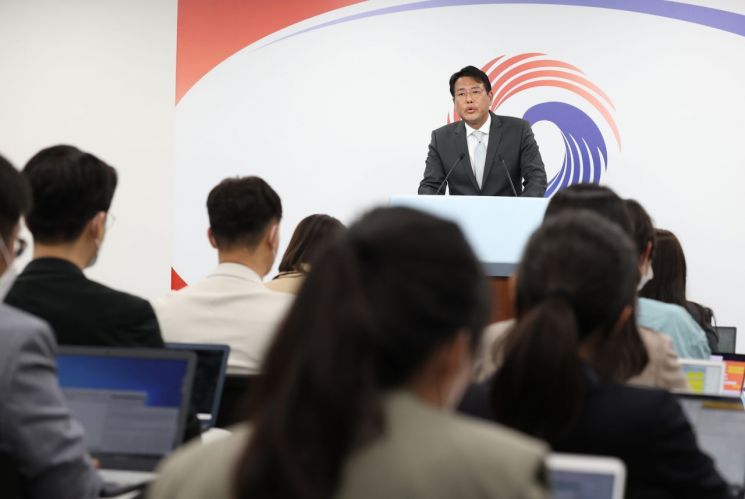
[Asia Economy Reporter Ki-min Lee] The Presidential Office announced on the 18th that the upcoming South Korea-U.S. summit, held in conjunction with U.S. President Joe Biden's visit to Korea, will serve as an opportunity to strengthen the South Korea-U.S. alliance into a comprehensive strategic alliance.
Kim Tae-hyo, First Deputy Director of the National Security Office at the Presidential Office, stated at a press conference held in the briefing room of the Yongsan Government Complex that "based on a value alliance, the military alliance that has continued so far has expanded into an economic alliance through the Free Trade Agreement (FTA)," adding, "It is expected that a South Korea-U.S. technology alliance will be added at this summit."
He emphasized President Yoon Seok-yeol's vision to strengthen the South Korea-U.S. relationship into a comprehensive strategic alliance, saying, "We will closely pursue policy and strategic coordination based on shared values and mutual interests," and stressed, "Cooperation will continue to expand in terms of geographic scope and agenda."
Deputy Director Kim's remarks are interpreted as Korea's intention to actively participate in the U.S.-led Indo-Pacific Economic Framework (IPEF) to enhance economic security capabilities.
IPEF is a comprehensive economic cooperation initiative announced by U.S. President Biden at the East Asia Summit last October to promote joint prosperity in the Indo-Pacific region by establishing common principles and standards in areas such as trade facilitation, supply chain stabilization, digital economy, decarbonized clean energy, and infrastructure cooperation. Unlike existing trade agreements that focus on goods, services, and market opening, technology cooperation is considered an essential element.
So far, eight countries including the U.S. have confirmed their participation in IPEF, and President Yoon will attend the IPEF launch summit in Japan on the 24th via video conference. Deputy Director Kim emphasized, "Besides the eight countries, one or two more may join, but the U.S. and South Korea will play leading roles, creating new norms and standards, inviting other countries, and realizing our national interests within IPEF."
However, regarding relations with China, which is also considered a key player in global trade conflicts alongside the U.S., Deputy Director Kim drew a clear line, saying, "This is not about excluding China." He mentioned, "Our country currently designates about 199 supply chains as sensitive items and monitors them in real time, many of which involve trade with China. Although the Korea-China FTA already exists, follow-up agreements are being discussed with China." A Presidential Office official explained, "Among the 199 items, 60 to 70 are traded with China, and the rest with the U.S."
He particularly added, "We will minimize relationships based on 'socialism versus liberal democracy' or 'discomfort due to participation by certain countries,'" and said, "We will separate security issues and strive to respect each other and expand mutual benefits."
© The Asia Business Daily(www.asiae.co.kr). All rights reserved.

















