The Korea Employers Federation Holds the First ESG Management Committee Meeting of the Year
[Asia Economy Reporter Hyunseok Yoo] Sohn Kyung-shik, chairman of the Korea Employers Federation (KEF), argued that the pace of carbon neutrality should be adjusted to fit domestic conditions.
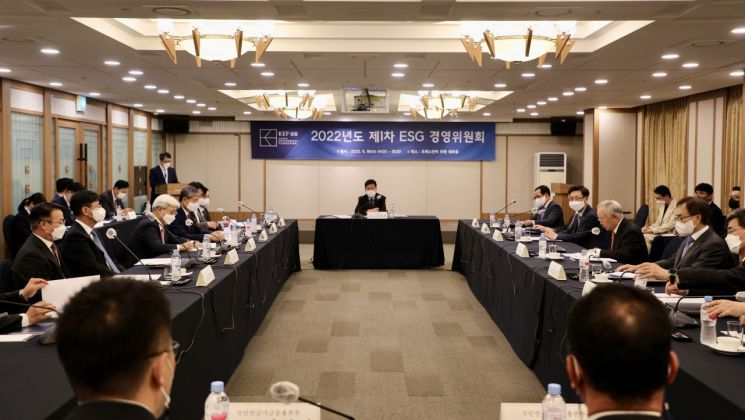
KEF held the 'ESG Management Committee' on the 18th at the Press Center in Jung-gu, Seoul. Chairman Sohn Kyung-shik stated, "The responsibility as a global leader nation emphasized in the president's inaugural speech will never be light," adding, "However, we must carefully consider the domestic industrial realities and energy situation to ensure that related industries and the national economy are not burdened."
He said, "Since the committee's launch last year, our companies have devoted great effort to creating a corporate culture trusted by various domestic and international stakeholders despite difficult global competition," and encouraged, "Let's further advance ESG management and actively inform the public of our achievements to enhance corporate value on our own."
At the meeting, the committee shared the current status of ESG management promotion among participating groups and reaffirmed their commitment to 'establishing corporate-led autonomous ESG management.' Each company has completed building organizational and operational foundations such as establishing new corporate visions and goals based on ESG values, setting up ESG committees and dedicated departments, and refining evaluation systems, and is now moving forward with full-scale strategy implementation.
The committee, held for the first time since the new government took office, invited Seong Chang-hoon, Director of the Long-term Strategy Bureau at the Ministry of Economy and Finance, to explain the ESG policy directions reflected in the new government's national agenda and conveyed various difficulties faced by companies on the ground. The proposals made to the government at the meeting mainly focused on environmental issues. In particular, they requested national-level infrastructure expansion and securing related technologies to expand renewable energy and power supply, which are key to carbon neutrality but difficult to resolve at the individual company level.
Flexible policy implementation by industry was also proposed. Regarding the 2030 Nationally Determined Contribution (NDC) for greenhouse gas reduction, it was pointed out that using 2018, a year with low shipbuilding volume due to industry recession, as a baseline does not align with the current situation where orders are increasing in the shipbuilding sector. Additionally, participating companies urged leading research and development (R&D) investment to secure carbon-neutral innovative technologies, active policy support for the use and production of green hydrogen, and expanded communication with the industrial sector.
The committee also held stakeholder dialogues regarding recent voting trends with the National Pension Service (NPS) Fund Management Headquarters, which leads domestic ESG responsible investment. The NPS exercised voting rights on 3,378 agenda items at corporate general meetings last year. Among these, it exercised opposition voting rights on 549 cases (16.3%). Of the opposed proposals, those related to director appointments and director remuneration limits each accounted for 178 cases (32.4%).
The committee suggested that if the NPS disclosed specific reasons for exercising opposition voting rights, it would help companies find directions for improvement. Some members expressed concern that although the NPS exercised opposition voting rights, the actual rejection rate was only 1.8% last year, significantly lower than the five-year average of 2.4%, arguing that this decision does not reflect the overall shareholders' will.
A KEF official said, "With expectations following the new government's launch, ESG management will continue," adding, "We plan to strengthen our own efforts to spread flexible and proactive ESG management on the ground while also expanding communication between the government and industry."
The ESG Management Committee was launched on April 26 last year, declaring eco-friendly management, social value creation, and the establishment of transparent and ethical decision-making structures. It is the highest-level ESG consultative body in the business community, composed of CEOs and presidents from 17 major groups including the four largest conglomerates. The domestic affiliates of the participating groups number 966 companies.
© The Asia Business Daily(www.asiae.co.kr). All rights reserved.

















