President Yoon's Unprecedented Singing of 'March for the Beloved' in Conservative Government
Some Conservative Groups Previously Raised 'Pro-North' Controversy Over 'March for the Beloved'
Neglect in Lee Myung-bak and Park Geun-hye Administrations, Including Exclusion from Program and Refusal to Sing
President Yoon's Progressive Decision to Sing... Could It Become an Opportunity for National Unity?
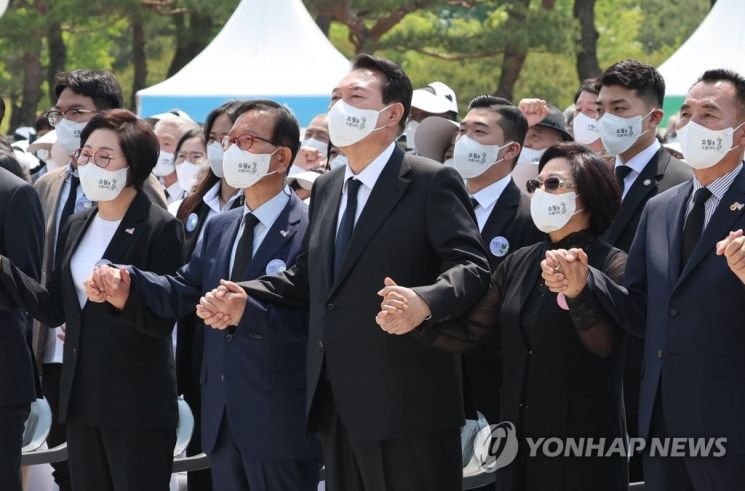 President Yoon Suk-yeol attended the 42nd anniversary ceremony of the May 18 Gwangju Democratization Movement held on the morning of the 18th at the National May 18 Democratic Cemetery in Buk-gu, Gwangju, and led the singing of the "March for the Beloved."
 [Image source=Yonhap News]
[Asia Economy Reporter Yoon Seul-gi] President Yoon Suk-yeol led the singing of the song "March for the Beloved" at the 42nd anniversary ceremony of the May 18 Democratic Uprising. Leading the singing is a format where everyone sings together to add meaning, but some conservative groups raised a "pro-North Korea controversy" over "March for the Beloved," opposing the group singing. During the Lee Myung-bak and Park Geun-hye administrations, this song was either excluded from the official ceremony order or maintained in a choral form where only those who wished to sing did so. The "pro-North Korea frame" surrounding "March for the Beloved" had been a subject of debate between ruling and opposition parties, but with President Yoon’s progressive decision, there is also a prospect that it could become a turning point for national unity.
On the 18th, President Yoon, National Assembly Speaker Park Byeong-seug, Constitutional Court Chief Justice Yoo Nam-seok, People Power Party leader Lee Jun-seok, Emergency Committee Chairs Park Ji-hyun and Yoon Ho-jung of the Democratic Party, and Justice Party leader Yeo Young-guk attended the May 18 Gwangju Democratic Uprising ceremony and led the singing of "March for the Beloved," symbolizing the May 18 Democratic Movement.
"March for the Beloved" is a popular song commemorating citizen soldiers spokesperson Yoon Sang-won and labor activist Park Ki-soon, who were shot dead by martial law troops during the May 18 Democratic Movement. Novelist Hwang Seok-young took the lyrics from labor activist Baek Ki-wan’s poem "Motbinari" and created the lyrics, while Jeonnam University student Kim Jong-ryul composed the music to complete the song. In 1997, when the May 18 Democratic Movement was elevated to a national memorial day, it was included as an official song in the ceremony order.
The issue arose when the song was inserted into the 1991 North Korean documentary film "Symphony for the Beloved." Some conservative groups such as the Liberation Association and the Korean War Veterans Association claimed that the words "Beloved" and "New Day" in the song’s title and lyrics symbolized Kim Il-sung and socialist revolution, sparking the pro-North Korea controversy.
The Lee Myung-bak administration led the singing of "March for the Beloved" until 2008, its first year, but due to backlash from conservatives, the group singing was excluded from the official ceremony order starting in 2009. During the Park Geun-hye administration, the Ministry of Patriots and Veterans Affairs refused to lead the singing of "March for the Beloved" at the May 18 Gwangju Democratic Uprising ceremony, maintaining a choral form where participants could follow the choir or choose not to sing. The conservative government’s neglect of "March for the Beloved" sparked backlash from progressive parties, becoming a source of conflict between ruling and opposition parties.
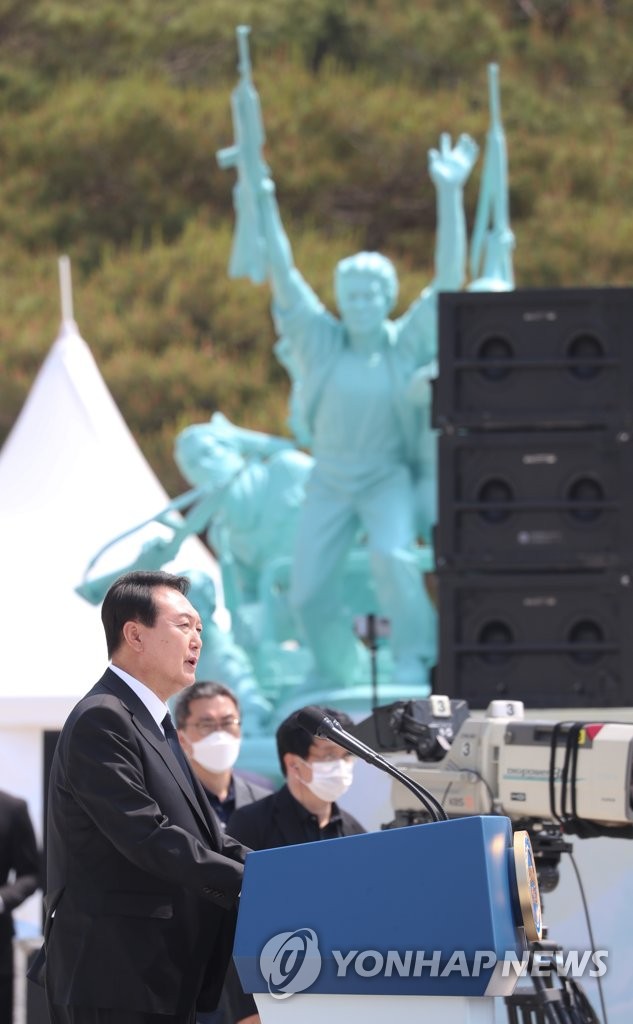 President Yoon Suk-yeol delivers a commemorative speech at the 42nd anniversary ceremony of the May 18 Democratic Movement held at the National May 18 Democratic Cemetery in Buk-gu, Gwangju, on the morning of the 18th.
 [Image source=Yonhap News]
President Yoon’s decision to lead the singing of "March for the Beloved" appears to be aimed at strengthening the message of national unity. Unlike previous conservative governments, he actively demonstrates the intention to inherit the May 18 legacy and use it as an opportunity for national unity. After attending the 42nd anniversary ceremony of the May 18 Democratic Uprising held at the National May 18 Democratic Cemetery in Buk-gu, Gwangju, People Power Party leader Lee Jun-seok told reporters, "I hope our (People Power Party’s) change will be an irreversible change that does not regress," adding, "Today can be said to be the culmination of the sincere efforts our party has made for nearly two years."
When asked about his impressions of leading the singing of "March for the Beloved," symbolizing the May 18 Democratic Movement, at the ceremony, Lee said, "Some of our party members have individually led the singing before, but this time there was a policy to lead it at the party level, so it was meaningful," emphasizing, "The change we chose today is a change that should have naturally been made, and I hope it will be a change that does not revert."
Meanwhile, in a commemorative speech that he personally revised, President Yoon recognized the history of the Gwangju May 18 Democratic Movement as a precious national "asset" and emphasized the "May Spirit." President Yoon said, "The May Spirit, which defended liberal democracy with blood, is the cornerstone of national unity," adding, "I am confident that the May Spirit will unite our people and protect us in times of crisis and challenge. Let us work together so that the power of justice and truth embraced by May will shine forever beyond the times."
© The Asia Business Daily(www.asiae.co.kr). All rights reserved.


















