Ulsan National Institute of Science and Technology Develops Core Wireless Communication Technology for New Concept Transportation System Hyperloop
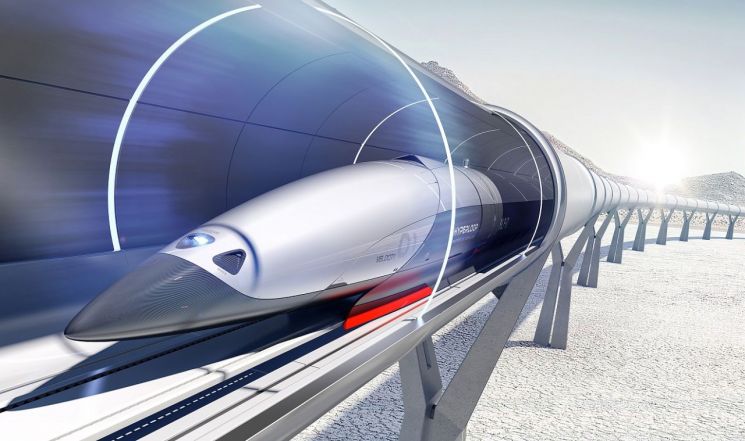
[Asia Economy Reporter Kim Bong-su] Domestic researchers have devised a technology that enables wireless communication such as internet and phone calls inside a new concept transportation system, the Hyperloop, which runs at an ultra-high speed of 1,200 km/h.
The Ulsan National Institute of Science and Technology (UNIST) announced on the 18th that Professor Kim Hyo-il’s team from the Department of Electrical and Electronic Engineering developed a method to analyze wireless communication waves (communication channels) inside the Hyperloop. This is expected to serve as a foundational technology for designing wireless communication systems to monitor the safety of high-speed passenger pods and provide internet services.
The Hyperloop is a next-generation transportation system where passenger pods called "pods" are accelerated one by one inside a near-vacuum tube to run at speeds of 1,200 km/h. When designing a wireless communication system for the Hyperloop, communication channel analysis that predicts how radio waves propagate in three-dimensional space is essential to determine antenna design, carrier frequency, bandwidth, and more.
The problem is that existing electromagnetic wave simulators have limitations in analysis. The tube resembles a waveguide that can confine radio waves and is extremely long?several hundred kilometers?allowing radio waves to propagate much farther than in normal space. This greatly expands the range of targets (such as base stations) to be included in the simulation. The influence of pods running at high speed inside the tube is another variable.
To solve this, the research team used a new method that simulates three representative sections separately and mathematically connects them to analyze the entire tube. They performed electromagnetic wave simulations by dividing the tube into a single base station section, a single pod section, and an empty tube section without base stations or pods, then connected these using a ‘network parameter modeling’ technique.
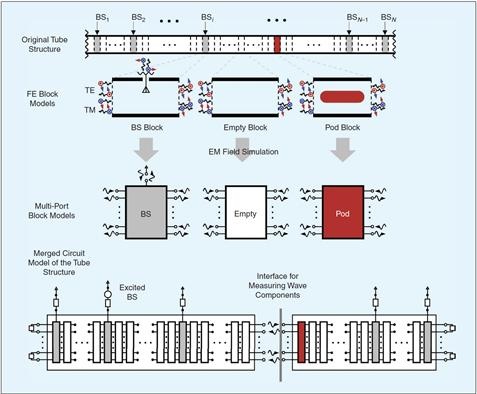
The analysis revealed various signal distortion phenomena such as signal transmission and reflection occurring at each pod. A representative example is the reception of multiple interference signals caused by some interference signals transmitted from other base stations passing through multiple pod sections.
Based on these analysis results, the research team identified the most suitable frequency band, maximum possible bandwidth, and optimal electromagnetic modes for wireless communication inside the Hyperloop. They were also able to accurately predict the reception strength of communication signals depending on the pod’s running position.
Professor Kim Hyo-il said, “The analysis method is flexible, so it can be easily applied even if the specifications of the Hyperloop change,” and added, “It is expected to play a fundamental role in related fields such as antenna design optimized for the Hyperloop environment, development of communication methods, and pod design considering communication performance.”
The research results were published in the international journal IEEE Vehicular Technology Magazine.
© The Asia Business Daily(www.asiae.co.kr). All rights reserved.


















