"Finland Has Different History from Sweden...Maintains Neutrality"
"EU Must Listen to Opinions of Countries Highly Dependent on Russian Energy"
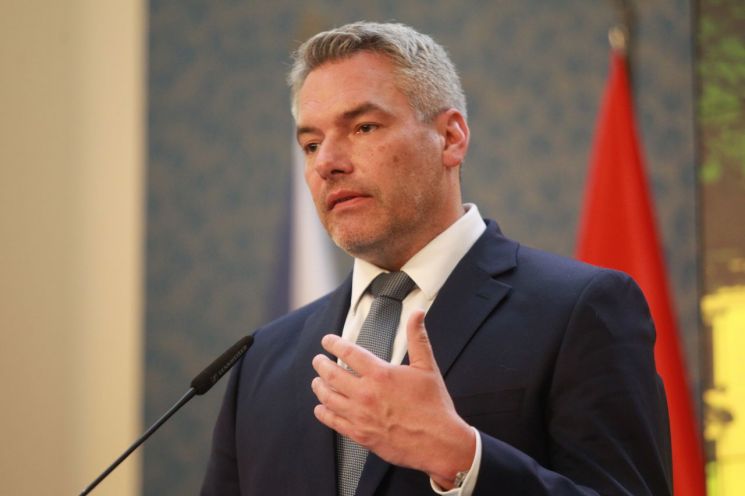
[Asia Economy Reporter Hyunwoo Lee] Austrian Chancellor Karl Nehammer stated that Austria has no plans to join the North Atlantic Treaty Organization (NATO) and will maintain its neutrality policy. He also pointed out that the European Union (EU) should better accommodate the opinions of countries highly dependent on Russian energy to strengthen sanctions against Russia, including the oil embargo.
According to AFP on the 17th (local time), Chancellor Nehammer, after visiting Prague, Czech Republic, and holding talks with Czech Prime Minister Petr Fiala, said at a press conference, "Austria has no plans to discuss NATO membership," adding, "We have a different history from Sweden and Finland and will maintain our neutrality policy." He emphasized, "However, we support the EU's sanctions against Russia and stand in solidarity with Ukraine by approving arms supplies to Ukraine."
Nehammer's remarks are interpreted as a response to the controversy sparked by the possibility of Austria joining NATO following Finland and Sweden. On the same day, Finland signed an application to join NATO after 74 years, and Sweden after 208 years, abandoning their neutrality policies. Consequently, the possibility of major neutral countries in Europe, such as Austria, Switzerland, and Ireland, joining NATO has been raised both domestically and internationally.
Regarding the EU's sixth round of sanctions against Russia, particularly the key issue of the Russian oil embargo, Chancellor Nehammer also expressed criticism. He stated, "The EU should not conduct negotiations on the Russian oil embargo inconsistently," emphasizing, "The EU must first engage in consultations with countries highly dependent on Russian oil and gas about their energy security, and the embargo should be announced afterward."
Meanwhile, negotiations on the EU's sixth round of sanctions against Russia continue to stall without reaching an agreement. After the EU Foreign Ministers' meeting held in Brussels, Belgium, Josep Borrell, the EU's High Representative for Foreign Affairs and Security Policy, said at a press conference, "We have not reached an agreement on the Russian crude oil embargo." The sanctions require unanimous consent from member states, but Eastern European countries highly dependent on Russian energy, led by Hungary, oppose the measures, making it difficult for the sixth round of sanctions to find a breakthrough.
© The Asia Business Daily(www.asiae.co.kr). All rights reserved.

















