Edible Oil Industry "No Plans to Raise Supply Prices"
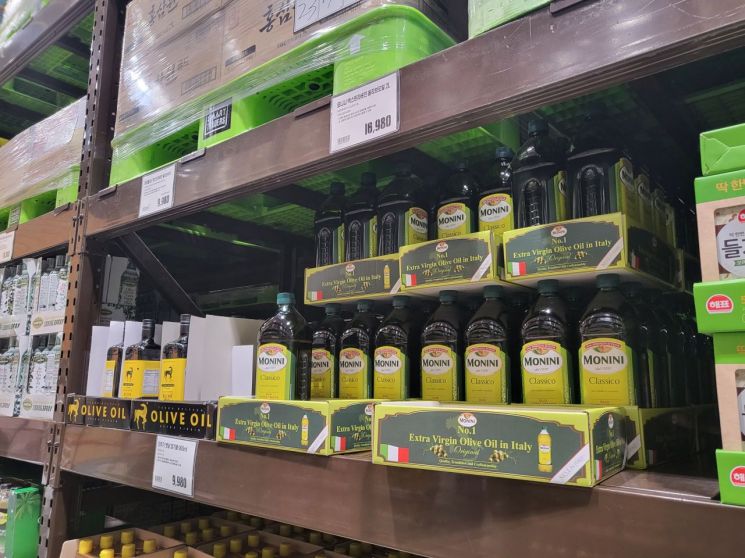
[Asia Economy Sejong=Reporter Son Seonhee] The government is promoting a plan to apply a temporary tariff reduction, known as 'quota tariff,' on edible oil import items to alleviate the industry's burden caused by the rise in international edible oil prices.
On the 18th, the Ministry of Agriculture, Food and Rural Affairs held a meeting to check the supply situation of edible oil and discuss market stabilization measures at the Korea Food Industry Association in Seocho-gu, Seoul, chaired by Kwon Jae-han, Director of Food Industry Policy Office. The meeting was attended by five major edible oil suppliers including CJ CheilJedang, Lotte Foods, Sajo Daerim, Nongshim, Ottogi, and the Food Industry Association.
Despite Indonesia's palm oil export ban, the government stated that there is no problem with the domestic supply of edible oil. Domestic suppliers hold inventory equivalent to about 2 to 4 months, including shipments in transit, and the domestic food industry mainly uses Malaysian products, so there is no disruption in supply.
However, orders for commercial canned edible oil (18ℓ) supplied through distribution agencies and large-capacity household use (1.8ℓ) have recently increased significantly. This is understood to be caused not by actual demand shortage but by speculative demand in some distribution channels due to concerns over price increases.
The related industry said, "Since there is no problem with domestic edible oil supply, if only some speculative demand subsides, the possibility of problems in edible oil purchases by concerned consumers is low," and "There are currently no plans to raise edible oil supply prices," according to the Ministry of Agriculture, Food and Rural Affairs.
Jeon Han-young, Director of Food Industry Policy at the Ministry of Agriculture, Food and Rural Affairs, held a briefing at the Government Complex Sejong in the afternoon and said, "Canola oil, olive oil, etc., mainly used for household and chicken franchise stores, are also being imported without disruption," adding, "In the case of sunflower seed oil, alternative supply sources such as Spain and Argentina have been secured since the Ukraine situation."
He also stated, "Since the edible oil supply issue is directly linked to the livelihood stability of small and medium-sized food service businesses and small merchants such as chicken restaurants, Chinese restaurants, and Jeon (Korean pancake) restaurants, the government and companies agreed to actively cooperate to closely monitor the edible oil supply situation and work together to alleviate situations where consumers purchase more than necessary due to price anxiety."
In this regard, the Ministry of Agriculture, Food and Rural Affairs plans to regularize public-private edible oil supply checks at least once a week to ensure accurate supply information and thorough supply chain management. In addition, to prepare for the possibility of distribution disruption by intermediate distributors, each company will actively monitor order situations.
© The Asia Business Daily(www.asiae.co.kr). All rights reserved.

















