[DTx Era②] COVID-19 Remote Classes Shake Education Field
Daegu Office of Education 'Ppomi' Pilot Project
77% of Parents Say "Reduced Parenting Stress"
Significant Contribution to Essential Self-Regulation Skills in Lower Grades Without Medication
Expected Synergy Effect of Korean IT + Medical Technology
[Asia Economy Reporter Lee Gwan-joo] The COVID-19 pandemic shook the educational landscape in South Korea. Schools were more than just places for acquiring knowledge; they were venues for holistic education where students developed self-regulation skills and concentration through group activities within established rules. However, with the widespread adoption of remote learning due to COVID-19, students inevitably became distanced from school.
What impact did prolonged remote learning have on young students? According to industry sources on the 24th, from May last year to March this year, the Daegu Metropolitan Office of Education conducted a special pilot project over 10 months titled "Creating Children Who Plan for Themselves: A Habit Program to Enhance Self-Regulation Ability." The pilot project began by conducting a detailed mental health assessment of 233 first and second graders from six elementary schools in the Daegu area.
The results were shocking. Using the mental analysis screening tool (CNT) to precisely assess the children's mental health, about 13% of the participating children showed tendencies toward Attention Deficit Hyperactivity Disorder (ADHD). Additionally, 2.1% exhibited signs of cognitive decline. Even considering the disruption of normal education due to COVID-19, these figures exceeded expectations. Professor Jung Woon-sun of the Department of Psychiatry at Kyungpook National University Hospital, who led the diagnosis, said, "I was somewhat shocked by the survey results," and emphasized, "Various stakeholders responsible for child care must come together urgently to find solutions."
Treating Childhood ADHD with DTx
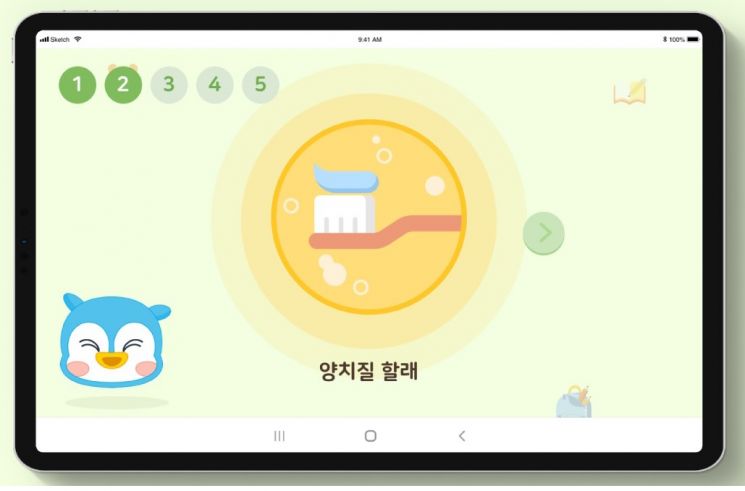
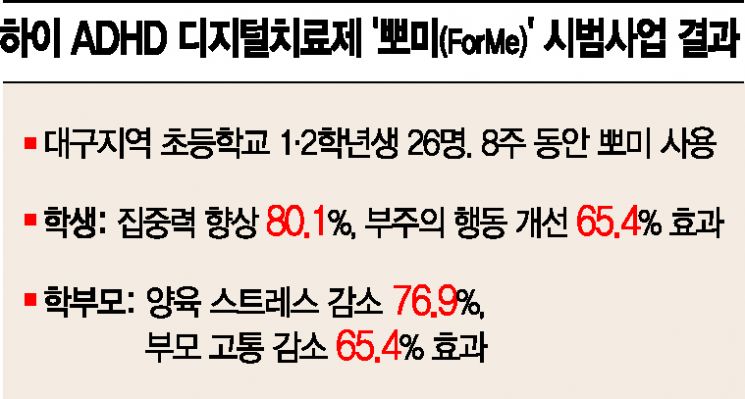
Among the children identified with ADHD tendencies, 26 began a special form of treatment. This involved using 'ForMe,' an ADHD digital therapeutic (DTx) developed by HAII, a company specializing in digital targeted therapeutics. After installing ForMe on each household's tablet PC, three weekly commitments, such as brushing teeth, were set, and the program was designed to encourage adherence to these commitments. The results after eight weeks of treatment were remarkable. Attention deficit and hyperactivity levels decreased in 21 children (80.1%), improving concentration, and 17 children (65.4%) showed improvement in inattentive behaviors.
The changes in the children directly affected their parents. Responses indicating reduced parenting stress related to their relationship with their child reached 20 parents (76.9%), and 17 parents (65.4%) reported a decrease in their personal distress. One parent participating in the pilot project said, "When my child started having outbursts, I couldn't control them, and they couldn't even participate in class, but after using ForMe, things have improved significantly." Another parent shared, "My child speaks more nicely than before and has started to regain focus."
Although ADHD is a serious condition that requires treatment in severe cases, social awareness remains low. Many parents do not acknowledge that their child has ADHD, which often leads to hesitation in seeking treatment. ADHD borderline cases are often identified during school classes, but schools have limited means to address them effectively.
This pilot project demonstrated that DTx can be a tool for managing ADHD both at school and at home. Professor Shin Eui-jin of Yonsei University's Department of Child Psychiatry explained, "Self-regulation skills necessary for forming children's lifestyle and study habits must be developed in the early elementary years," adding, "One of the important outcomes of this pilot project is confirming that digital healthcare devices can significantly contribute to this."
Improved Accuracy and Adherence in DTx
The DTx ForMe used in this pilot project is one of six pipelines owned by HAII. Regarding ForMe’s remarkable therapeutic effects, HAII CEO Kim Jin-woo cited 'high adherence.' Adherence refers to how consistently a DTx is used in daily life according to prescribed methods and dosages. A common skeptical argument about DTx is that low usage frequency in daily life inevitably leads to low therapeutic effects. However, ForMe showed an 88.4% continuous usage rate over eight weeks and a 69.3% completion rate according to instructions. CEO Kim said, "With this level of adherence, therapeutic effects become clear," adding, "The most important factors in increasing adherence are feedback and rewards. Providing objective, real-time feedback after treatment and offering appropriate rewards amplify the effects."
Along with high adherence, HAII’s DTx strength lies in the accuracy of its 'digital biomarkers.' HAII is developing not only simple DTx but also biomarkers capable of diagnosing specific diseases.

A representative pipeline is 'Alzguard,' a DTx under development for cognitive impairment. HAII recently presented the accuracy of its early screening and diagnostic software for mild cognitive impairment at the Korean Dementia Association, showing 90.6% accuracy even without any information about the examiner. CEO Kim stated, "While the accuracy of digital biomarkers is important, we pride ourselves as global leaders in improving accuracy efficiently in terms of time and cost," emphasizing, "Combining accurate diagnosis, high-adherence DTx, and medical knowledge can produce much stronger effects."
HAII’s technological capabilities are based on a DTx development process named 'HAII WAY.' This systematizes everything from exploratory research, including proposals and initial feasibility reviews by medical professionals, to commercial development, with the medical researchers who conducted basic research directly participating in the development process.
Through this process, the generalized anxiety disorder DTx 'Anzeilax' received approval from the Ministry of Food and Drug Safety in February for confirmatory clinical trials to verify safety and efficacy. CEO Kim said, "South Korea’s medical and IT technologies are world-class," and expressed confidence, "With a proper system and institutional support, Korea can become a global hub for DTx."
© The Asia Business Daily(www.asiae.co.kr). All rights reserved.



















