Among 14,544 Transactions in Q1, 4,406 Were Purchases by Non-Residents
Real Estate Agency Reports Highest Q1 Figure Since Statistics Began
Yongsan District Sees Most Buys Due to Presidential Office Relocation Boost
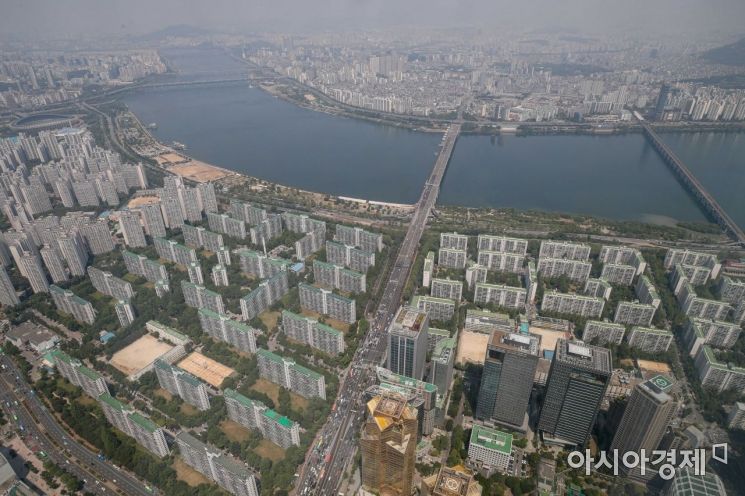 On the 17th, a view of apartments from Lotte World Tower Seoul Sky in Songpa-gu, Seoul. The Korea Real Estate Board announced that the actual transaction price index for apartment sales in Seoul in March was 175.1, up 1.4 points from the previous month (173.7). This marks the first time in five months since recording 180.0 in October last year that the Seoul apartment sales actual transaction price index has turned upward again. Photo by Jinhyung Kang aymsdream@
[Asia Economy Reporter Kim Min-young] In the first quarter of this year, 3 out of 10 homes sold in Seoul were purchased by non-locals. In particular, the area with the highest proportion of non-local buyers was Yongsan-gu, which benefits from the relocation of the Presidential Office. The housing supply shortage in Seoul remains unresolved, and due to the learned expectation that Seoul housing prices will not fall, the trend of non-local home purchases is continuously increasing.
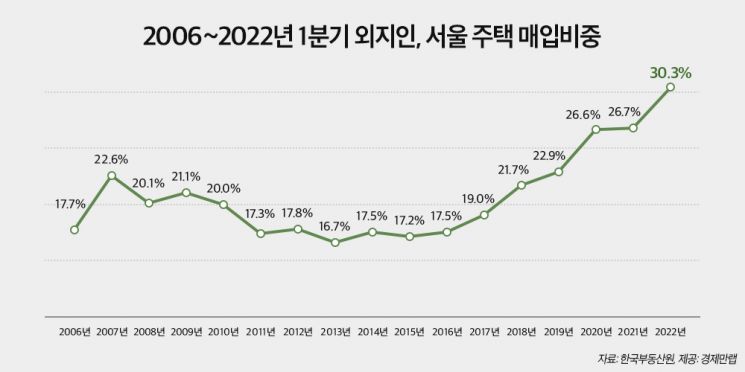
According to an analysis by real estate information provider Economy Man Lab of the Korea Real Estate Board's housing sales transaction data (including apartments, multiplex houses, and detached houses), out of 14,544 housing transactions in Seoul in the first quarter of this year, 4,406 were purchased by non-locals, accounting for 30.3% of the total. This is the highest figure for the first quarter since the Korea Real Estate Board began compiling related statistics in 2006.
Among Seoul districts, Yongsan-gu showed the highest proportion of non-local purchases. From January to March this year, out of 282 housing transactions in Yongsan, 111 were by non-locals, making the non-local purchase rate 39.4%. Following were Geumcheon-gu at 39.3%, Gangseo-gu at 39.0%, Songpa-gu at 38.1%, Yangcheon-gu at 37.3%, Seocho-gu at 35.3%, Yeongdeungpo-gu at 35.3%, Dobong-gu at 32.6%, Gangbuk-gu at 32.5%, and Gwanak-gu at 31.4%.
Since the Yoon Seok-yeol administration took office on the 10th and announced a one-year suspension of the capital gains tax surcharge on multi-homeowners, housing supply has increased. However, experts analyze that the preference for a single, well-located home in Seoul remains strong, leading to a relative increase in non-local investment purchases.
Hwang Han-sol, a research fellow at Economy Man Lab, said, "Non-residents and multi-homeowners from other regions are disposing of homes in outlying areas and choosing a single, high-priced home in Seoul, a trend of preferring a ‘smart single home’ that is expected to continue this year." He added, "The polarization caused by widening housing price gaps between regions may also intensify."
© The Asia Business Daily(www.asiae.co.kr). All rights reserved.


















