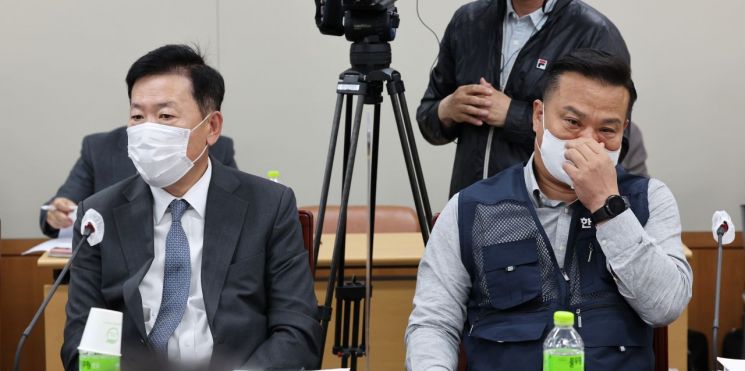
 On the afternoon of the 17th, at the 2nd plenary meeting held in the Minimum Wage Commission meeting room of the Government Complex Sejong in Sejong City, Ryu Ki-jung, Executive Director of the Korea Employers Federation (left), a user committee member, and Lee Dong-ho, Secretary General of the Korean Confederation of Trade Unions, a labor committee member, were seated.
 [Image source=Yonhap News]
Discussions between labor and management to determine next year's minimum wage officially began on the 17th. Both sides clashed fiercely over the rate of minimum wage increase and the differential application by industry at the first full meeting of the Minimum Wage Commission held since the inauguration of the Yoon Seok-yeol administration.
The Minimum Wage Commission, a social dialogue body under the Ministry of Employment and Labor, held its second plenary meeting for deciding next year's minimum wage at the Ministry of Employment and Labor's Government Sejong Complex plenary conference room on the same day.
Before the closed-door meeting, representatives of employers, workers, and public interest commissioners expressed their positions on current issues through opening remarks.
Ryu Ki-jung, an employer commissioner (Executive Director of the Korea Employers Federation), said, "The economic shock brought by COVID-19 will take a long time to return to its original state," adding, "Companies are worried about the delayed recovery in the industrial field as producer prices have risen twice as much as consumer prices."
He continued, "While cumulative prices have risen 8.2% over five years, the minimum wage has increased by 42%, leaving a lasting shock," and said, "I hope the minimum wage stabilizes."
Lee Tae-hee, an employer commissioner (Head of the Smart Job Division at the Korea Federation of SMEs), also said, "The biggest problem for small and medium-sized enterprises and small business owners is the rapid rise in producer prices," adding, "Since the minimum wage is a critical issue for small SMEs and small business owners, we need to focus on them in our considerations." He emphasized, "We must control the pace of minimum wage increases and sincerely and thoroughly discuss the realistic application of differentiated standards."
On the other hand, Lee Dong-ho, a worker commissioner (Secretary-General of the Federation of Korean Trade Unions), countered, "Last year, the operating profits of leading domestic conglomerates such as Samsung, Hyundai Motor, LG, and SK reached record highs, resulting in bonus celebrations and wage increases approaching 10%," adding, "Income inequality and polarization are worsening in our country, and this polarization will only make our future bleak."
There was also a significant difference in views regarding the differential application of minimum wages by industry.
Ryu Ki-jung, the employer commissioner, said, "The labor side is fundamentally opposed to the differential application by industry, but this is guaranteed by law," adding, "Since there are industries that cannot afford the minimum wage level, we need to consider various situations in the deliberations."
However, Lee Dong-ho, the worker commissioner, pointed out, "Since June 29 is the legal deadline for minimum wage deliberations, I hope the minimum wage will be decided within the deliberation period through productive discussions," adding, "To do so, unnecessary disputes such as industry classification should be set aside, and constructive discussions that can establish the original purpose of the minimum wage should continue."
Yoon Taek-geun, a worker commissioner (Korean Confederation of Trade Unions), who was detained on charges of violating the Assembly and Demonstration Act on the 10th, did not attend the meeting that day.
Through a prison message read by Lee Jeong-hee, a worker commissioner (Policy Director of the Korean Confederation of Trade Unions), he stated, "Government officials' interference and intervention in the minimum wage undermine the autonomous discussions of the Minimum Wage Commission and lead to unnecessary social conflicts," adding, "Due to this government attitude, the decades-long controversy over differential application by industry has recently intensified."
The Minimum Wage Commission received a report on the review results from the expert committee on living cost analysis, the effects of minimum wage application, and survey analysis, and presented the '2023 Minimum Wage Proposal for Deliberation.' It was decided to sequentially discuss the minimum wage determination unit, whether to distinguish by type of business, and the minimum wage level at the next plenary meetings.
They also agreed to do their best to complete the minimum wage proposal deliberations within the legal deliberation and resolution deadline this year. The third plenary meeting is scheduled to be held at 3 p.m. on the 9th of next month at the Government Sejong Complex.
© The Asia Business Daily(www.asiae.co.kr). All rights reserved.
![Clutching a Stolen Dior Bag, Saying "I Hate Being Poor but Real"... The Grotesque Con of a "Human Knockoff" [Slate]](https://cwcontent.asiae.co.kr/asiaresize/183/2026021902243444107_1771435474.jpg)
















