KEIP '2022 World Economic Outlook (Update)'
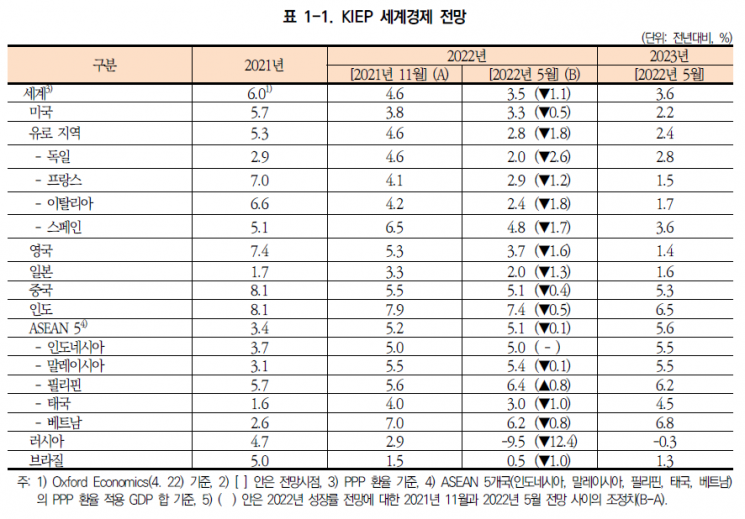
[Asia Economy Sejong=Reporter Son Seon-hee] The Korea Institute for International Economic Policy (KIEP), a government-funded research institute, projected the global economic growth rate for this year at 3.5%. This is a 1.1 percentage point downward revision from the previous forecast (4.6%) announced last November, just half a year ago. Geopolitical conflicts such as major countries' monetary policy shifts and Russia's invasion of Ukraine are expected to act as key risk factors.
On the 17th, KIEP held a press briefing on the "2022 World Economic Outlook (Update)" at the Government Complex Sejong, stating that "the global economy in the second half of this year is exposed to a policy transition period and extreme uncertainty in its trajectory." KIEP's forecast is slightly lower than the revised global economic growth rate of 3.6% announced last month by the International Monetary Fund (IMF). The institute cited ▲high inflation ▲global supply chain disruptions ▲prolonged Russia-Ukraine war ▲tightening monetary policy stance ▲resurgence of COVID-19 as major downside risks to growth.
In particular, Russia, which is waging war by invading Ukraine, is expected to see its growth rate plunge vertically by 12.4 percentage points from the previous 2.9% to -9.5% this year. Growth rates for major countries such as the United States (3.8%→3.3%), Europe (4.6%→2.8%), Japan (3.3%→2.0%), and China (5.5%→5.1%) were all revised downward simultaneously.
Regarding the economic outlook for advanced economies like the US and Europe, KIEP explained, "The war disrupts supply chains and further expands inflationary pressures caused by supply-demand imbalances," adding, "This exacerbates the difficulties faced by monetary authorities caught between post-COVID-19 economic recovery and price stability, thereby slowing the pace of economic recovery." While most emerging countries are also expected to experience a slowdown in recovery due to high inflation, KIEP forecasted that "the five ASEAN countries will generally recover to their pre-COVID-19 growth trends."
For next year, KIEP mentioned the continuation of inflationary trends, global supply chain disruptions, tightening monetary policies, prolonged war, and resurgence of COVID-19 as major downside factors, projecting "a growth rate of 3.6%."
President Kim Heung-jong stated, "We have entered a phase where the massive liquidity supplied to the market during the pandemic needs to be resolved," adding, "Inflation is occurring with considerable intensity in major countries, and monetary tightening is necessary in response to demand-driven sectors." He also noted, "Differences in views regarding the end of the Russia-Ukraine war suggest its prolongation," explaining, "Europe is directly experiencing economic impacts, and supply chain issues continue to persist," as the background for the downward revision of growth rates. Regarding COVID-19 containment policies, he added, "Repeated regional lockdowns act as a major uncertainty for the global economy through global supply chains," and expressed concerns that "new variants like Omicron may again restrict various economic activities."
© The Asia Business Daily(www.asiae.co.kr). All rights reserved.

















