Four Kim 'Painting Paradise on Earth' Hakgojae Gallery
First-generation Korean Artist Active in New York
Exhibition of 23 Works Depicting Unique Abstract World
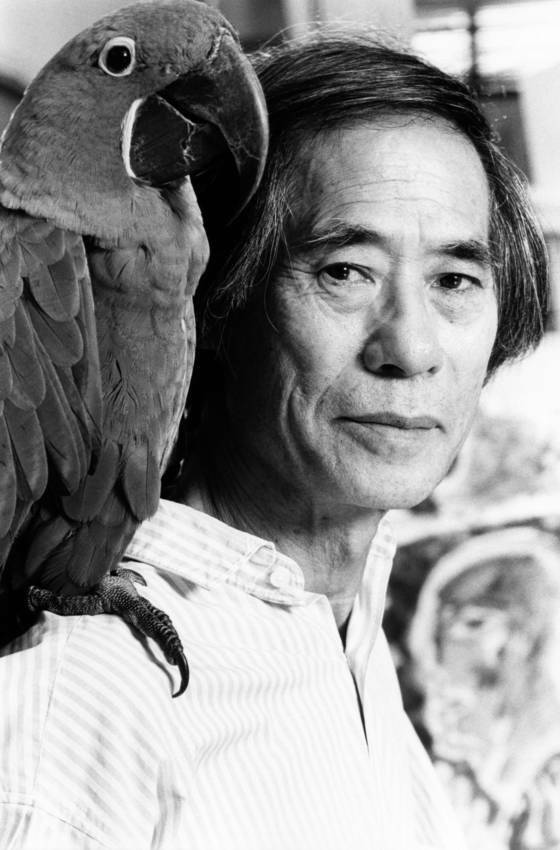
[Asia Economy Reporter Kim Heeyoon] Novelist Andr? Gide once said, "In a single work, there is the share of the author, the share of the reader, and the share of God." The landscapes reflected on PO KIM's (Korean name Kim Bohyun) canvas embody the indifference of God, who turned a blind eye to reality, and the fear of the artist suffering because of it.
Born in 1917 in Changnyeong, Gyeongnam during the Japanese colonial period, the artist completed his art studies in Japan through self-study and returned to his homeland the year after liberation. While dedicating himself to nurturing future generations by participating in the establishment of Chosun University’s College of Fine Arts, the artist endured severe hardships due to ideological conflicts, being at times labeled a leftist and at other times a rightist during the Yeosu-Suncheon Rebellion and the Korean War.
While detained in darkness and subjected to unexplained torture, the artist was gripped by the fear that he might die. Although the armistice came, his fear sank deep and did not disappear. The artist, who said he "often had terrible dreams of being chased by the police," went to the United States in 1955 as an exchange professor at the University of Illinois and settled there without returning.
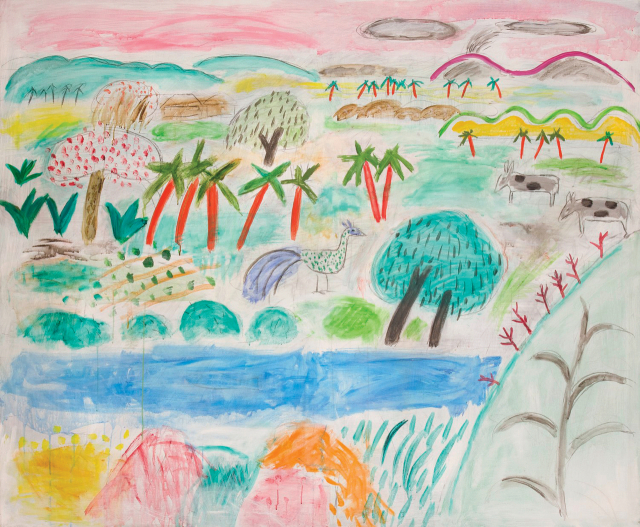
A solo exhibition titled "Painting Paradise on Earth," showcasing 23 works by Korean-American artist Po Kim, was held at Hakgojae in Samcheong-dong, Seoul. The artist was a first-generation Korean painter who began his full-fledged activities in New York and later interacted with Korean artists who had emigrated such as Kim Whanki, Kim Changyeol, and Nam Kwan, presenting diverse works.
Since his move to the U.S. was decided without preparation, the artist continued to pursue his art career while supporting himself by drawing patterns at a necktie factory, working on department store displays, and doing house repairs. After marrying sculptor Sylvia Wald in 1969, he adopted the name "Po Kim," which was easier to pronounce than Kim Bohyun, and devoted himself to his own creative work.
The artist, who said, "At that time, abstract expressionism was the style that best suited my psyche as I was yearning for freedom from the past of oppression and life-threatening danger," completed his unique abstract world through explosive emotional expression opposing conventions and traditions. His works, combining the brushstrokes reminiscent of Eastern ink painting with the bright colors of New York, established a sensual expressive technique.
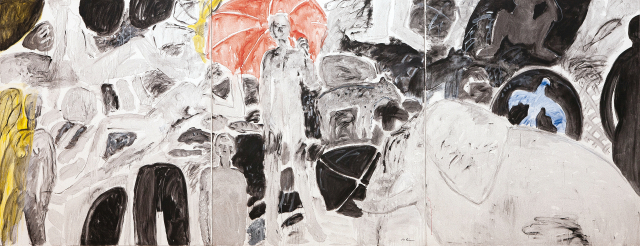 Po Kim donated his masterpiece "Blue Bird," completed between 1986 and 1988, to Chosun University, where he had worked. Photo by Hakgojae Gallery
At that time, New York was rapidly emerging as the center of the global art world, and interest in abstract expressionism was growing. The artist expanded the horizons of his work by closely interacting with contemporary artists active in New York such as Yayoi Kusama, Agnes Martin, and Robert Indiana.
In his later works, he depicted paradise through expressions that seemed to return to childlike innocence. The artist’s lifetime reflection, "I do not want to paint painful pictures because I myself have suffered a lot," deeply conveys the pure pain and fear of death that an individual had to endure amid turbulent history.
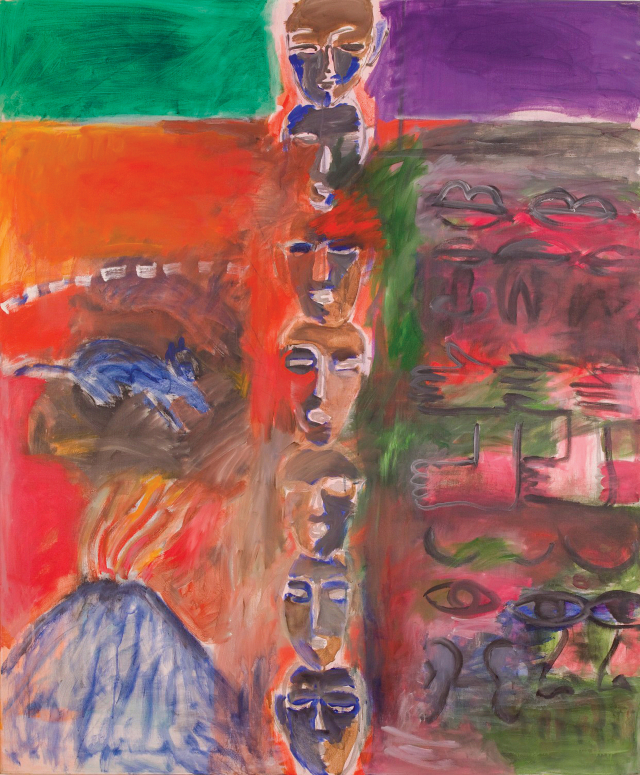
Despite his vigorous activities in New York, his homeland had forgotten him. Nevertheless, in 2005, the artist and his wife opened the "Sylvia Wald and Po Kim Art Gallery" in Manhattan, New York, hosting exhibitions introducing Korean artists. He donated many of his works to Chosun University, where he had taught. It was only in his later years that his artistic world began to be highlighted in Korea through solo exhibitions at the Seoul Arts Center and the National Museum of Modern and Contemporary Art.
The artist, who did not put down his brush until two days before his death at the age of 97 in 2014, lives on in his works with colors intertwined with a yearning for freedom and a diasporic life. Although God neglected His share, the artist never gave up creating. Now, only the share of the audience remains?to read the message contained in his canvases. The exhibition runs until June 12.
© The Asia Business Daily(www.asiae.co.kr). All rights reserved.



















