More Than Half of Seoul Real Estate Lease Contracts This Year Are Monthly Rent
Seoul Monthly Rent Index Hits 101.8... Highest Ever
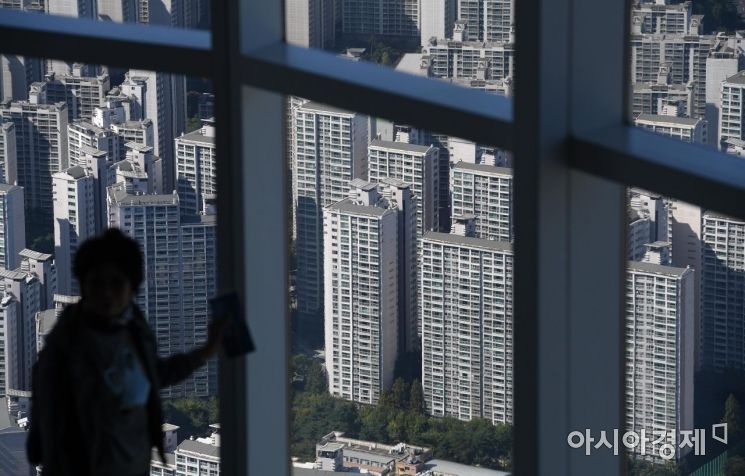 View of apartment complexes in Seoul city from Seoul Sky, the observation deck of Lotte World Tower in Seoul. Photo by Asia Economy DB.
[Asia Economy Reporter Heo Midam] In the first quarter of this year, the proportion of monthly rent transactions among rental contracts in Seoul exceeded half, marking an all-time high. This appears to be the result of the government's strengthened property tax, loan regulations, and interest rate hikes. The interests of landlords trying to cover the increased property tax burden through monthly rent and tenants feeling burdened by taking jeonse loans due to rising interest rates have aligned, accelerating the 'conversion of jeonse to monthly rent.'
On the 16th, real estate big data platform Zigbang analyzed the Supreme Court's registry information plaza and found that the proportion of monthly rent among jeonse and monthly rent contracts in Seoul from January to April this year was 51.6%. The monthly rent ratio has steadily increased since 2019 (41.0%) and surpassed 50% for the first time this year.
Especially in Seoul, the proportion of young tenants is on the rise. The share of tenants in their 20s and 30s was ▲52.7% in 2019 ▲55.7% in 2020 ▲57.9% in 2021, and ▲61.7% from January to April this year, exceeding 60%.
This seems related to the fact that real estate prices have skyrocketed in recent years and the financial burden from jeonse loans has increased due to interest rate hikes. Ultimately, tenants have to take jeonse loans to afford the soaring jeonse prices, but as interest rates rise, the interest burden grows, leading them to reluctantly choose monthly rent instead of jeonse. Landlords also tend to prefer monthly rent to reduce the significantly increased property tax burden under the Moon Jae-in administration.
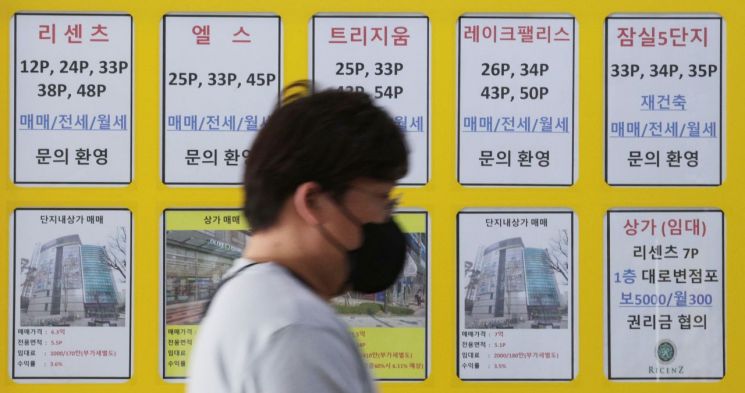
Kim (26), an office worker living alone in Eunpyeong-gu, Seoul, said, "Since my salary is low, I have been living in the same officetel for two years with monthly rent support from my parents. But I felt sorry to keep asking for help, so I tried to take a loan and move to jeonse, but the jeonse prices were too expensive to even consider." He added, "The average jeonse price for a one-room in Eunpyeong-gu is around 150 million KRW, and for new or fully equipped units, it reaches 200 million KRW. Even using the youth jeonse loan, you need a considerable lump sum, so it's a dilemma."
As demand for monthly rent increases, monthly rent prices are also rising. According to the KB Real Estate Monthly Housing Price Trend, the Seoul apartment monthly rent index recorded 101.8 in April. This figure is the highest since the related statistics began in 2016. The KB apartment monthly rent index surveys apartments of medium size (95.86㎡) or smaller.
Concerns are also emerging that the conversion of jeonse to monthly rent will accelerate further in the second half of this year. To enhance tenants' housing stability, the government implemented the Rental Protection Act 2 (contract renewal right and rent ceiling system) in August 2020. The core is that unless there are special reasons, tenants can request to limit rent increases to within 5% and stay for an additional two years.
However, as the two-year implementation period ends this August, new renewal contracts will not be subject to the rent ceiling system, and rents are expected to surge to market levels. With jeonse prices expected to rise, concerns are raised that the speed of conversion to monthly rent may also accelerate.
Experts predict that the conversion of jeonse to monthly rent will accelerate further. Professor Kim Taegi of Dankook University's Department of Economics said, "The Rental Protection Act influenced the conversion of jeonse to monthly rent, and in the future, the proportion of monthly rent is expected to be higher than jeonse. From the landlord's perspective, receiving monthly rent can be more beneficial. For example, Korea is an aging society, and elderly landlords without income may find it better to receive monthly rent to use as monthly living expenses."
© The Asia Business Daily(www.asiae.co.kr). All rights reserved.
![Clutching a Stolen Dior Bag, Saying "I Hate Being Poor but Real"... The Grotesque Con of a "Human Knockoff" [Slate]](https://cwcontent.asiae.co.kr/asiaresize/183/2026021902243444107_1771435474.jpg)

















