On the 17th, the Ministry of Land, Infrastructure and Transport announced that it will expand the review specialized institutions for the rapid and professional review of energy-saving plans for eco-friendly housing to include private organizations and local public corporations.
The "Review of Energy-Saving Plans" under the "Construction Standards for Energy-Saving Eco-Friendly Housing" is an essential procedure for housing project approval. When a developer constructing an apartment complex with 30 or more households submits an energy-saving plan regarding mandatory design requirements and heating/cooling efficiency, the local government, as the project approval authority, requests a specialized institution to review and evaluate the plan's appropriateness. Since the system was implemented in 2009, public institutions such as the Korea Real Estate Board have been conducting the review work.
However, recently, with the increase in review volume and issues such as a shortage of personnel at specialized institutions, delays in reviews have frequently occurred. Accordingly, the Ministry of Land, Infrastructure and Transport revised the "Construction Standards for Energy-Saving Eco-Friendly Housing" to expand the designation of specialized institutions to include private organizations and local public corporations possessing professional capabilities such as expert personnel and know-how.
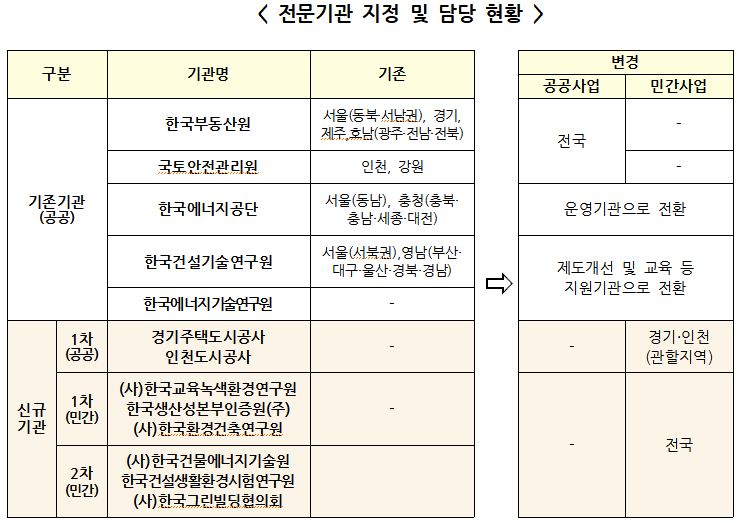
In the first phase, two local public corporations, Gyeonggi Housing and Urban Corporation and Incheon Urban Corporation, along with three private organizations?the Korea Education Green Environment Institute, Korea Productivity Center Certification Institute Co., Ltd., and Korea Environmental Architecture Institute?were designated and announced as specialized institutions. In the second phase, on May 18, three additional private organizations?the Korea Building Energy Technology Institute, Korea Construction Living Environment Testing Institute, and Korea Green Building Council?were selected to begin review work simultaneously with their designation by the end of this month.
As a result, a total of 10 institutions, including four public institutions such as the Korea Real Estate Board and the National Land Management Institute, and six private organizations, have been designated as specialized review institutions. The system has been dualized so that public institutions handle public projects, while private organizations and local public corporations handle private projects.
Additionally, the Korea Energy Agency, which previously conducted review work, will now perform operational tasks such as monitoring and managing the operation status. The Korea Institute of Civil Engineering and Building Technology and the Korea Energy Technology Institute will provide support tasks such as system improvement and education.
This reorganization is expected to not only strengthen the capabilities of the private sector by expanding energy-saving review work beyond the public sector but also contribute to job creation through the hiring of dedicated review personnel.
A Ministry of Land, Infrastructure and Transport official stated, "By diversifying the designation of specialized institutions to include local public corporations and private organizations beyond public institutions, we expect to broaden the choices for local governments and developers and significantly improve the quality of services provided to the public."
© The Asia Business Daily(www.asiae.co.kr). All rights reserved.

















