Bitcoin Daily Trading Volume Declines
Down 29% Since Luna Crash
Number of Wallets Holding Over 1000 Bitcoin Also ↓
"Market Confidence Clearly Broken"
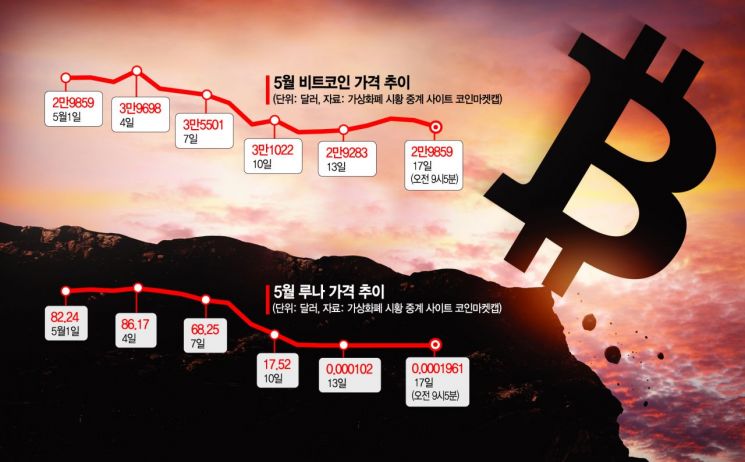
[Asia Economy Reporter Lee Jung-yoon] The 99.99% crash of Luna is sending shockwaves throughout the cryptocurrency market. Bitcoin, the leading cryptocurrency and a barometer of the market, has seen not only a price drop but also a decrease in trading volume. Experts point out that this incident has eroded trust in the overall cryptocurrency market, including Bitcoin.
According to the global cryptocurrency market tracking site CoinMarketCap, as of 9:05 a.m. on the 17th, Bitcoin's price was $29,859 (approximately 38.17 million KRW), down 4.29% from the previous day. This is the lowest price since July 20 of last year. Since the 9th of this month, Bitcoin's price has been fluctuating between $28,000 and $31,000. Compared to early this month, it has dropped about $7,000, and compared to the all-time high of over $36,000 recorded on November 8 last year, the price has fallen by more than $36,000. Despite such a significant drop compared to usual prices, the price has struggled to rebound due to the aftermath of the Luna incident.
◆ Sharp decline in trading volume amid price drop = Daily Bitcoin trading volume has also been on a downward trend due to this incident. On the 14th and 15th of this month, daily Bitcoin trading volumes were $28.57987 billion (approximately 36.5365 trillion KRW) and $25.83537 billion, respectively. Compared to the average daily trading volume of $36.6034 billion before the Luna price crash this month, these represent decreases of 21.91% and 29.41%, respectively. As of the 16th, daily trading volume increased to $32.61389 billion but was still below the pre-crash average.
This change appears to have also affected wallets holding large amounts of Bitcoin, commonly called "whales." According to cryptocurrency data analytics firm Glassnode, the number of wallets holding 1,000 or more Bitcoins (approximately 38.17 billion KRW) moved in a similar direction to Bitcoin's price trend. The number of such wallets was 2,257 on the 2nd of this month when Bitcoin was priced around $38,000, but it decreased to 2,212 by the 13th. Since March this year, the number of wallets holding over 1,000 Bitcoins had not fallen below 2,247, but after the Luna incident, the decline was more pronounced than before. The number of wallets holding over 10,000 Bitcoins also dropped from 95 on the 5th to 91 on the 10th as Bitcoin prices continued to fall. However, it later rose to 94 as of the 13th.
◆ Vicious cycle of crash due to loss of trust = The downward trend in various Bitcoin-related indicators is attributed to the collapse of trust in the cryptocurrency market caused by the Luna incident. Until last month, Luna's market capitalization exceeded 50 trillion KRW, but its price crashed by 99.99% in just a few days. The value of TerraUSD (UST), a stablecoin designed to peg its value at $1 per coin, fell, triggering a crash in the price of its sister coin, Luna.
Typically, stablecoins maintain their peg using safe assets such as cash or bonds. However, UST maintained its value through an algorithm linked to the supply of Luna. When UST's price fell below $1, Luna was sold to buy UST, and vice versa, to prevent value decline. However, during this process, both Luna and UST values fell together, causing panic selling and creating a vicious cycle of further declines in UST and Luna. As a result, Luna's market capitalization shrank to 2.1549 trillion KRW.
Concerns have also been continuously raised about Terraform Labs, the issuer of Luna and UST, and its decentralized finance (DeFi) service Anchor Protocol, which utilized UST. Terraform Labs promised an industry-leading annual interest rate of 19-20% for UST deposits on the blockchain. However, doubts about such high interest rates began to surface.
Earlier in February, the cryptocurrency evaluation and disclosure platform Xangle explained, "Terraform's Anchor Protocol pays an APY (annual percentage yield) of 19-20% for UST deposits. Since the cryptocurrency market downturn starting in November 2021, liquidity funds in the market have sought stablecoin deposits that maintain high APYs even in a bear market. Consequently, the TVL (total value locked) of Anchor Protocol increased sharply, and concerns have been continuously raised about whether the interest reserves can sufficiently cover interest payments." The market has also raised suspicions of a Ponzi scheme (a method of paying returns to existing investors using funds from new investors), arguing that such high interest rates cannot be sustained without continuous inflows of money.
Professor Hong Ki-hoon of Hongik University's Department of Business Administration said, "The Luna incident was a structure that was bound to explode, and it seems the cause was a lack of understanding of economics and finance. It is clear that trust in the cryptocurrency market has been broken due to this incident, and further price declines may occur," he explained.
© The Asia Business Daily(www.asiae.co.kr). All rights reserved.
![User Who Sold Erroneously Deposited Bitcoins to Repay Debt and Fund Entertainment... What Did the Supreme Court Decide in 2021? [Legal Issue Check]](https://cwcontent.asiae.co.kr/asiaresize/183/2026020910431234020_1770601391.png)
















