Profitability Indicators Rise... "Low Possibility of Sharp Demand Drop for the Time Being"
Long-term Risks Exist Such as China's Lockdown and the Russia-Ukraine Situation
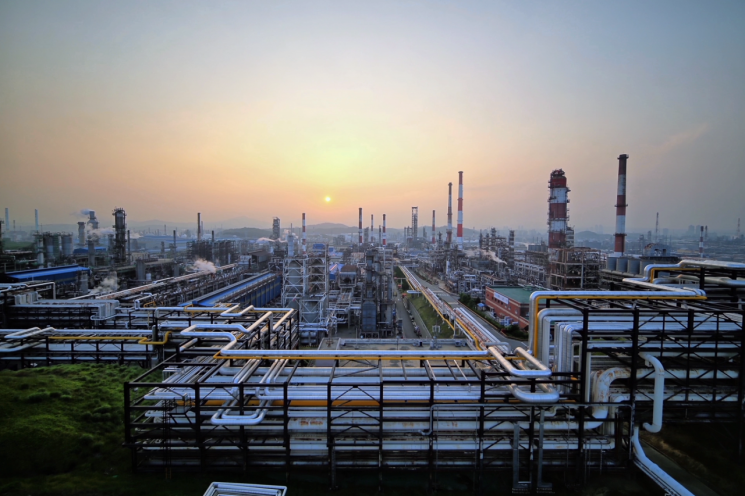 A view of SK Innovation Ulsan Complex located in Gosa-dong, Nam-gu, Ulsan Metropolitan City. (Photo by SK Inno)
[Asia Economy Reporter Moon Chaeseok] Although the refining margin, a profitability indicator for oil refiners, reversed and declined after 8 weeks, there are forecasts that these companies will still post strong earnings in the second quarter. This is due to the lower Official Selling Price (OSP) applied to Middle Eastern crude oil.
According to the securities industry on the 17th, the Singapore complex refining margin for the third week of this month recorded $20.06 per barrel, slightly down from $24.2 a week earlier. This is the first decline in the refining margin in 8 weeks since the third week of March. The refining margin refers to the profit margin refiners earn by refining crude oil into gasoline, diesel, and kerosene products, and is considered a key profitability indicator. Generally, $4 to $5 per barrel is regarded as the breakeven point.
Despite the drop in refining margins, the consensus is that refiners’ second-quarter earnings will improve because another profitability indicator, the OSP, has fallen. The OSP is the premium added to benchmark crude oil prices such as Dubai crude, West Texas Intermediate (WTI), and Brent crude. The pricing power lies with oil-producing countries like Saudi Arabia. According to the refining industry on this day, Aramco set the official selling price (OSP) for next month’s delivery of Arab Light crude oil exported to Asia at $4.4 per barrel, nearly half the $9.35 per barrel for this month’s delivery. This is the first OSP cut in four months.
Generally, refiners evaluate that both consumer demand and supply for petroleum products need to gradually increase for earnings to improve positively. When the economy and international oil prices are judged to rise steadily, they increase plant operating rates. There had been concerns that supply would decrease due to global supply chain disruptions caused by Russia’s invasion of Ukraine, and that demand would sharply drop due to economic uncertainties.
At least the concern over a sharp drop in demand has lessened, as shown by data. According to the Korea National Oil Corporation’s petroleum information site Petronet, domestic crude oil imports in March totaled 85.558 million barrels, up 7.5% from 79.584 million barrels in February and recovering to the level of 86.925 million barrels in December last year. Considering that Russia’s invasion of Ukraine began on February 24, this suggests that the war’s impact on refiners’ crude oil imports has not been significant. Based on the judgment that demand is firm, refiners are raising plant operating rates. According to the Korea National Oil Corporation and the Korea Petroleum Association, the operating rate in March was 77.9%, with a first-quarter average of 80%. This is an increase from 80.51% in February 2020 and 80.65% in March 2020, when COVID-19 began spreading worldwide. The annual average operating rates were only 75.9% in 2020 and 74.4% last year.
Although major indicators are volatile, the consensus is that the possibility of a sharp drop in demand and supply leading to reduced refiners’ earnings is limited for the time being. Hyunryul Cho, a researcher at Samsung Securities, wrote in an analysis report on SK Innovation, one of the four major refiners, “There are many inquiries about the possibility of sustained high margins. Although refining margin volatility is high, global refiners’ capacity expansions are limited, and there are insufficient factors to resolve short-term supply variables, so high margins are expected to continue for the time being.”
However, if high oil prices, China’s COVID lockdowns, and inflation-induced economic downturns persist, product demand could shrink. Aramco’s OSP cut is also a decision considering the possibility of long-term demand contraction. An industry official said, “Aramco’s downward adjustment of the OSP aligns with the fact that global economic growth forecasts are being lowered. Especially, the U.S. Energy Information Administration (EIA) and the Organization of the Petroleum Exporting Countries (OPEC) have lowered their indicators, citing geopolitical tensions from the Ukraine crisis, inflation, and supply chain deterioration as reasons.” According to the industry, OPEC lowered its global economic growth forecast from 3.9% last month to 3.5% this month, a 0.4 percentage point decrease.
© The Asia Business Daily(www.asiae.co.kr). All rights reserved.
![Clutching a Stolen Dior Bag, Saying "I Hate Being Poor but Real"... The Grotesque Con of a "Human Knockoff" [Slate]](https://cwcontent.asiae.co.kr/asiaresize/183/2026021902243444107_1771435474.jpg)
















