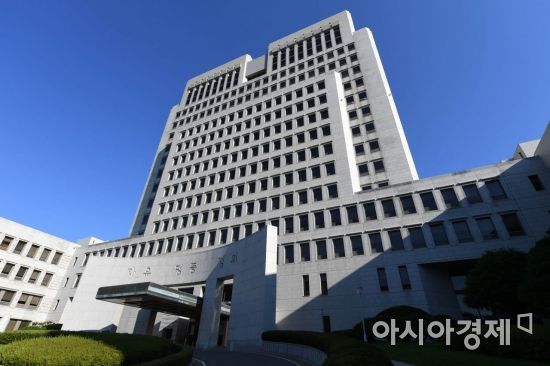
[Asia Economy Reporter Choi Seok-jin, Legal Affairs Specialist] The Supreme Court overturned a guilty verdict for defamation against a former employee who posted on social networking services (SNS) that the CEO of the company where they worked had committed 'gapjil' by forcing employees to drink alcohol at company dinners.
Even if some detailed parts differ from the facts, if the important parts align with the truth and the post can be seen as made for public interest, defamation charges do not apply.
The Supreme Court's 2nd Division (Presiding Justice Min Yu-sook) announced on the 17th that it quashed the lower court's ruling that sentenced former employee A of the video content production company 'Celeb' to a fine of 1 million won for defamation by spreading false information under the Information and Communications Network Act, and remanded the case to the Seoul Eastern District Court.
The court stated, "The lower court failed to conduct necessary investigations, violated the rules of logic and experience, exceeded the limits of free evaluation of evidence, and misinterpreted the legal principles regarding 'false facts' and 'intent to defame' as stipulated in Article 70, Paragraph 2 of the Information and Communications Network Act, which affected the judgment."
A was prosecuted for defamation after posting on their Facebook on April 19, 2018, eleven months after resigning, exposing the 'gapjil' of then-CEO B at company dinners.
At that time, A posted a message along the lines of "Even if someone had a chronic illness or was not feeling well, everyone had to drink at least three bottles of soju before leaving. On some days, the group would go to a room salon, and female employees had to choose a woman and sit next to her."
Based on testimonies from A's former colleagues, the prosecution judged that B did not force employees to drink a large amount of alcohol, such as three bottles of soju, nor did B force female employees to choose women at a room salon, concluding that A's post contained false information.
The first trial court agreed. The court found that the two facts posted by A on Facebook?that B forced employees to drink more than three bottles of soju and that after taking employees to a room salon, female employees were forced to choose women to sit with?were all false, and sentenced A to a fine of 2 million won.
The court reasoned that B only gave non-drinking employees soft drinks and did not force anyone to drink more than three bottles of soju. While B took employees to karaoke bars with hostesses, there was no evidence that B took them to a room salon and forced female employees to select entertainment workers to accompany them. Therefore, the court deemed A's post false.
During the trial, A argued that the content was based on personal experience or information from third parties, so it was not false, and that the post was made for public interest to expose the undemocratic and violent labor environment and workplace culture in the startup industry, not to defame B. However, this was rejected.
The court stated, "It seems B did make employees drink in a somewhat forced manner, such as 'wave drinking' or drinking penalty shots during games at company dinners, but the claim that 'everyone had to drink at least three bottles of soju' is not true. While B did take employees to karaoke bars with female hostesses, there is no fact that B took them to a room salon and made female employees choose entertainment workers, so this part of the defendant's post cannot be recognized as true."
Additionally, the court added, "The claim that female employees had to choose women and sit next to them at a room salon was not based on the defendant's own experience but on hearsay. Such behavior is not common sense, and considering the defendant relied solely on others' words and posted them as is, it is reasonable to believe the defendant was at least implicitly aware that the post could be false."
On the other hand, the second trial court judged that while the claim that B forced employees to drink was false, the part related to the room salon was substantially true, and acquitted A while reducing the fine to 1 million won.
The court noted, "According to testimony from employee C, company dinners were held in enclosed rooms within karaoke bars, and although female employees attended, several female hostesses entered the room, and only one was chosen to stay with the group. This behavior by the victim (B) can be seen as highly inappropriate toward female employees who did not consent to such situations. Therefore, the room salon part of the defendant's post can be viewed as pointing out the victim's problematic behavior. Although some details may differ slightly or be exaggerated, the main parts generally align with objective facts."
It further stated, "There is insufficient evidence to conclude that the room salon content was false or that the defendant was aware of its falsity."
However, the Supreme Court's judgment differed. The Supreme Court held that although the part about B forcing drinking was somewhat exaggerated, the main parts could be seen as factual, and since the motive for posting was related to public interest, it was difficult to recognize an intent to defame, thus defamation charges did not apply.
The court explained, "The defendant posted on Facebook after seeing B introduced as one of eight new talents leading the digital era in internet content created by journalists around April 2018. Besides this post, the defendant mentioned ongoing news about so-called 'gapjil' controversies involving large airline owners, pointing out that unfair treatment occurs not only in large corporations but also in small startups, which receive less social attention and have less impact. The post was written reflecting the victim's behavior projected onto the widely publicized actions of large corporate owners."
The court also pointed out, "Preferences or aversions to drinking vary greatly depending on an individual's physical and mental health, religion or beliefs, upbringing, and family environment. The pressure felt by employees regarding drinking at company dinners also varies depending on workplace size, job content and methods, interpersonal relationships, and organizational hierarchy."
It added, "The main point of the post is that the victim forced employees to drink a considerable amount of alcohol at company dinners. Considering testimonies about drinking methods at these dinners, it seems attendees found it difficult to control whether, how much, and how fast to drink. Given the victim's position and employees' testimonies about the victim's behavior and the pressure felt, the post can be seen as largely consistent with objective facts."
Furthermore, the court stated, "Although the defendant used the expression 'even with chronic illness, at least three bottles of soju had to be drunk,' this can be understood as a somewhat exaggerated description from the perspective of an employee attending drinking sessions led by the company CEO, who found it difficult to control drinking amount and speed and felt pressured."
The court also found that since the post was made for public interest, it could not be seen as intended to defame B.
The court concluded, "The desirable internal culture of startup companies concerns the interests of all current and prospective startup employees and relates to the common interests of many members of society. The defendant's main purpose or motive in posting the entire content, including this post, was to raise social awareness that so-called 'workplace gapjil' exists in small startups and needs improvement, which was a social concern at the time. The defendant posted this about a year after leaving the company, and even if some expressions were somewhat definitive or exaggerated, it cannot be concluded that the main purpose or motive was to defame the victim."
The Supreme Court has taken the position that regarding the element of 'intent to defame' in defamation by spreading false facts, "'intent to defame a person' is contrary to the actor's subjective intention when the facts concern public interest, so if the stated facts relate to public interest, intent to defame is generally denied unless special circumstances exist."
© The Asia Business Daily(www.asiae.co.kr). All rights reserved.
![Clutching a Stolen Dior Bag, Saying "I Hate Being Poor but Real"... The Grotesque Con of a "Human Knockoff" [Slate]](https://cwcontent.asiae.co.kr/asiaresize/183/2026021902243444107_1771435474.jpg)
















