[Seoul Autonomous District News] On the 14th, demolition of Remicon Batch Plant No. 5 begins, halting Remicon production due to removal of essential dust collection equipment... ‘2040 Seongdong Urban Development Basic Plan’ to create ‘Culture & Tourism-TOWN’ as a landmark with complex cultural facilities like an opera house... Jungnang-gu supports 3.3 billion KRW for school environment improvements and education subsidies... Guro-gu completes expansion of Bamdongsan Village access road... Gangseo-gu establishes ‘Gangseo Customized Smart City Implementation Plan’... Gwanak-gu announces 2022 Village Community Project Contest
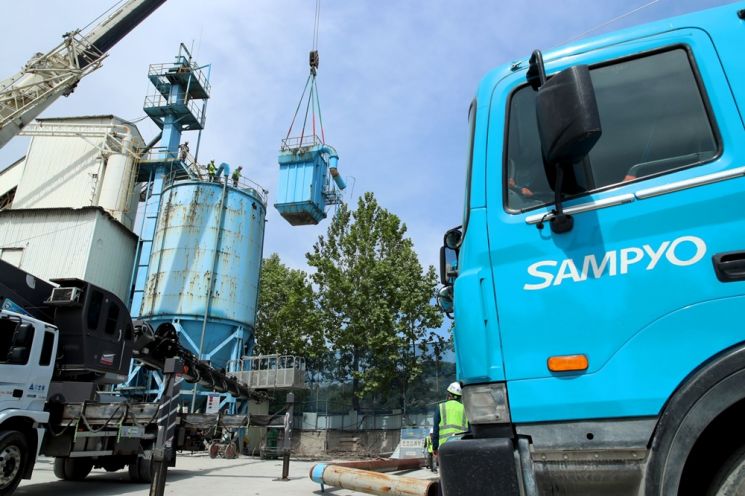
[Asia Economy Reporter Park Jong-il] Seongdong-gu announced on the 14th that it has begun the actual demolition of the Sampyo Remicon factory. On this day, Sampyo Industrial officially started dismantling Batch Plant No. 5, a key facility for Remicon production, and separated and removed the dust collection equipment.
The dust collection equipment, which acts like an air purifier by filtering and discharging dust caused by cement powder to prevent air pollution, is an essential facility for operating the Remicon batch plant. Removing it signifies the practical halt of Remicon production.
Starting with the demolition of the essential Remicon operation facility on this day, Sampyo Industrial plans to dismantle the entire Batch Plant No. 5 by the end of this week and complete the demolition of the remaining plants No. 1 to 4 by the end of June as originally promised. Thus, the 'Sampyo Remicon Factory,' which has operated for over 44 years and fulfilled the historical mission of supplying Remicon during the industrialization period, will now step back into the annals of history.
Located in Seongsu-dong, which has emerged as Seoul's most vibrant commercial district, adjacent to Seoul Forest and the Han River, the Sampyo Remicon factory site is highly anticipated for development and is planned to be transformed into a 'Culture & Tourism TOWN' once demolished.
Following the '2040 Seongdong Urban Development Master Plan,' which was created after about four years of professional services, expert consultations, and dozens of discussions and deliberations, the district has devised a plan to utilize underused idle sites, including the Sampyo Remicon factory site, the equestrian training center, and visitor center within Seoul Forest, linking them with local resources such as the Han River and Jungnangcheon Stream.
Specifically, various cultural facilities such as a Science Future Hall for young people, global entertainment companies, and tourism landmarks will be established.
Having achieved the long-standing local wish of demolishing the Sampyo Remicon factory through years of diverse efforts, Seongdong-gu plans to link the site with Seoul Forest and waterfront areas, installing complex cultural facilities like an opera house to create a landmark and transform it into a world-renowned attraction.
A district official said, “The execution of dismantling the batch plant, the core facility of the Remicon factory by Sampyo Industrial, holds great significance as it fulfills the promise made to the citizens. We especially appreciate Sampyo Industrial’s responsible attitude throughout the process.”
He also urged, “We ask for continued efforts until the end to ensure the complete demolition of the factory by the end of June without compromising safety or causing inconvenience to residents.”
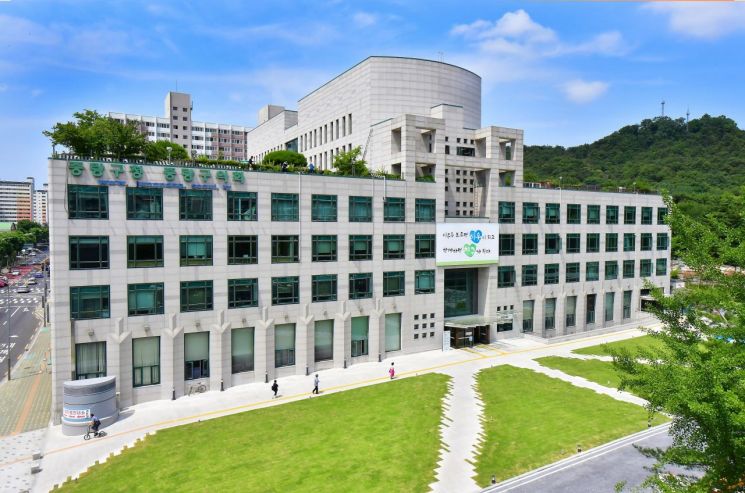
Jungnang-gu will support 3.3 billion KRW in educational expense subsidies for environmental improvements in 48 local schools during May to revitalize and strengthen the competitiveness of public education in the area.
The district held the Education Expense Subsidy Deliberation Committee on the 10th, reviewing and approving 85 projects and their budgets.
The environmental improvement education expense subsidies will be used for school environment improvement projects, staff capacity building, parent room improvement projects, and remodeling of aging libraries.
First, 2.14 billion KRW of district education expenses will be allocated to school environment improvement projects. This includes repairs and upgrades to school gates, fences, playgrounds, classrooms, learning environment equipment, and blackboards where aging or learning environment improvements are needed. The district conducted a demand survey in April to provide tailored support for each school.
Additionally, 480 million KRW will be invested in projects to enhance staff capacity and improve parent rooms to increase interest and participation in educational support projects among school staff and parents.
Lastly, 680 million KRW will be provided for remodeling the aging school libraries under the ‘Kkumdam Library’ remodeling project. This project, in cooperation with the education office, reconfigures school libraries into open and creative spaces that serve as multipurpose areas facilitating communication among students, parents, and local residents.
This year, support will be provided to five schools: Yangwon Sup Elementary, Dongwon Middle, Sinhyeon Middle, Hyewon Girls’ Middle, and Songgok High School.
Moreover, the district is actively working to attract external funding for educational environment improvements in addition to its own education expenses. Last year, it secured 3.6 billion KRW from the Ministry of Education and Seoul City to support facility improvements in 11 schools.
A district official said, “We will actively promote various educational support policies to revitalize public education and will continue efforts to improve school educational conditions.”
Meanwhile, the district has allocated 8 billion KRW in education expenses this year to support academic improvement projects for school curricula, kindergarten programs, and school-linked programs at the Bang Jeong-hwan Education Support Center.
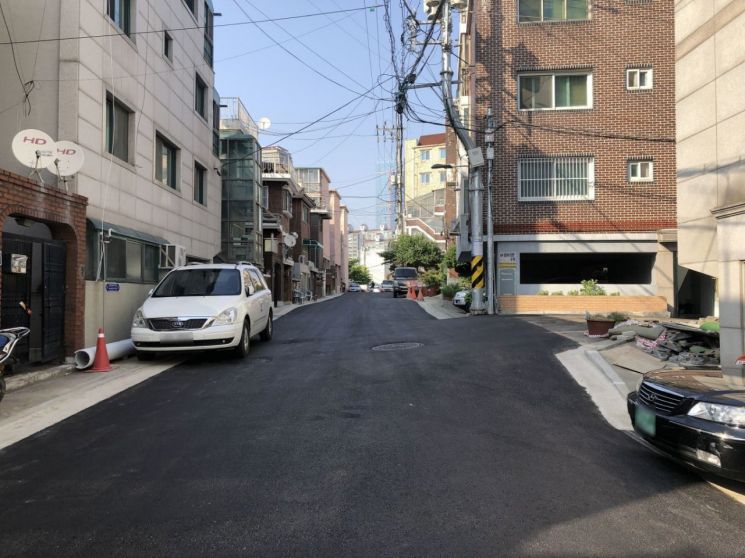
Guro-gu (Mayor Lee Sung) has expanded the entrance road to Bamdongsan Village.
A Guro-gu official stated on the 17th, “To reduce residents’ inconvenience caused by traffic congestion during commuting hours and to ensure pedestrian safety, we recently completed road expansion work around Gurojungang-ro 32ga-gil.”
This section had a narrow road width, causing inconvenience for vehicle and resident passage. To resolve this, the district invested a total budget of 3.6 billion KRW from national, city, and district funds to carry out the construction.
The construction was carried out in four phases: ▲Phase 1: Guro-dong 551-88 to 551-210 (width 8m, length 55m) ▲Phase 2: Guro-dong 551-192 to 551-127 (width 8m, length 50m) ▲Phase 3: Guro-dong 551-165 to 551-108 (width 8m, length 40m) ▲Phase 4: Guro-dong 551-209 to 570-186 (width 6~8m, length 115m).
Utility poles and communication poles were relocated, and compensation negotiations for private land were conducted to refurbish the road to a length of 260m and width of 6~8m. Road boundary stones, gutters, rainwater drains, road paving, and nearby facilities and road environments were also improved.
A Guro-gu official said, “We expect residents’ inconveniences to be resolved through the expansion of the entrance road, which was a long-standing wish. We will continue to do our best to expand roads so that residents can use them comfortably and safely.”
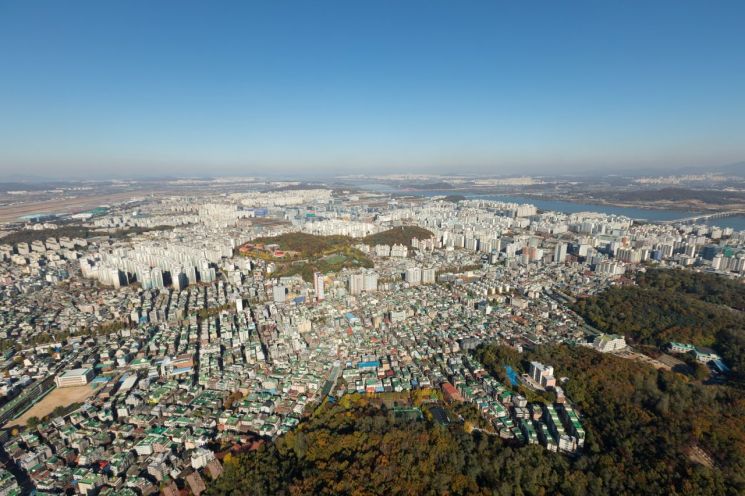
In the era of the 4th Industrial Revolution, smart technology makes life convenient for all residents.
Gangseo-gu, Seoul (Mayor Noh Hyun-song) announced that it has established the ‘Gangseo Customized Smart City Implementation Plan’ to solve urban problems with advanced technology and enhance urban competitiveness.
The plan aims to create a future city where the old and new urban areas grow harmoniously and all residents can enjoy advanced public services by implementing a smart city tailored to local characteristics.
The implementation plan is a follow-up to the ‘Gangseo Customized Smart City Basic Plan’ announced in December last year. Under the vision of ‘Realizing the Value of a Sustainable Future City,’ it will invest about 10.9 billion KRW over three years to carry out 35 projects.
The projects are divided into the ‘Lim Smart Project,’ focusing on the old urban area to solve urban problems arising in existing residential areas and create a safe and pleasant living environment, and the ‘Plus Smart Project,’ centered on the new urban area to foster coexistence and development through smart technology.
The ‘Lim Smart Project’ establishes four strategies: ▲Safe living and walking city ▲Pleasant residential environment management ▲Smart sharing and lifestyle using new technologies ▲Health promotion through smart devices, implementing 20 detailed projects.
These detailed projects focus on solving urgent issues in safety, housing, and welfare, such as safety support for single women households and stores, disaster safety management systems for facilities, IoT device distribution for elderly living alone and middle-aged single households, and advanced CCTV for illegal dumping.
The ‘Plus Smart Project’ sets five strategies: ▲Eco-friendly life through smart technology adoption ▲Integrated management using intelligent technology ▲Exploration of future life through new technology adoption ▲Smart urban agriculture and creation of nature-friendly spaces ▲Linking new spaces from places to streets, implementing 15 detailed projects.
These projects emphasize strengthening the city’s future competitiveness using advanced technology, including IoT indoor air quality management in daycare centers, metaverse-based tourism and experience non-face-to-face platforms, installation and operation of smart green shelters, and activation of the Magok Culture Street Smart Street.
The district plans to conduct evaluations semiannually and operate an implementation management system to successfully carry out the projects by 2024, starting with this implementation plan.
Mayor Noh Hyun-song said, “While it is important for the region to develop through advanced technology, I will carefully ensure that no one is left behind and everyone benefits. We will faithfully implement the plan and create a smart city where all residents can live conveniently in the era of the 4th Industrial Revolution.”
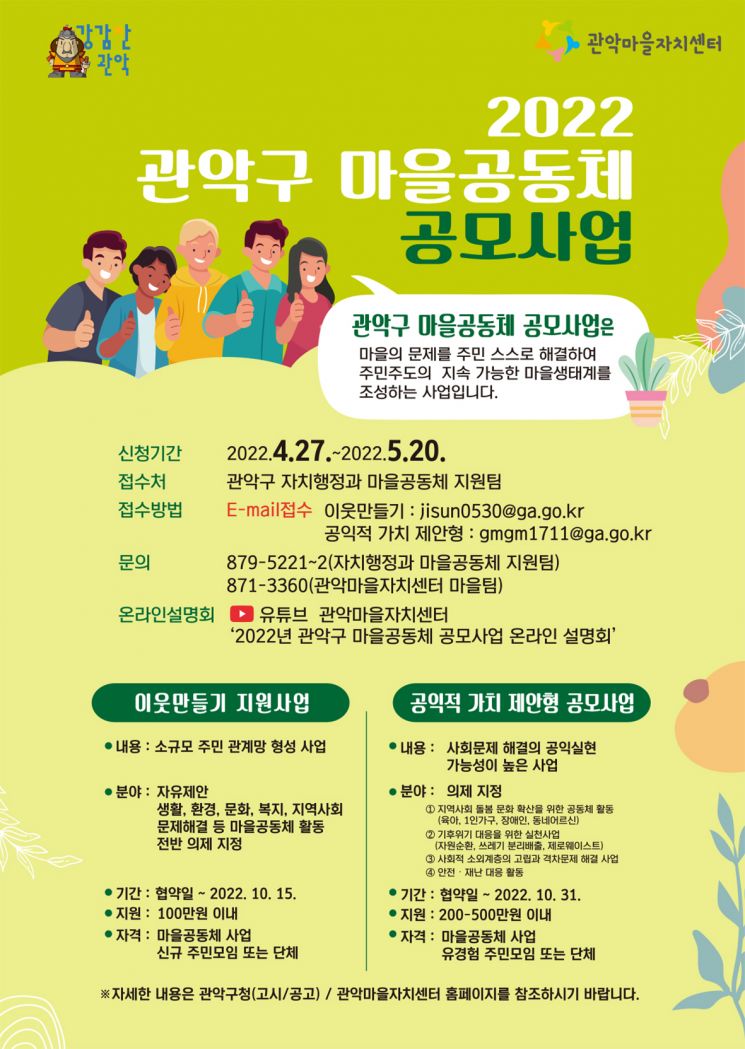
Gwanak-gu is promoting the ‘2022 Gwanak-gu Village Community Public Contest Project’ to foster a sustainable village ecosystem led by residents through communication and harmony among residents, solving local problems, and creating a community culture.
The ‘2022 Gwanak-gu Village Community Public Contest Project’ is a program where residents directly propose and execute projects needed in their village. There are two types of contest projects: ‘Neighbor Making Support Project’ and ‘Public Value Proposal Contest Project.’ Depending on the contest category, project funding ranging from 1 million KRW to a maximum of 5 million KRW per group is provided after screening.
Particularly, the project plans to focus on supporting projects with high public benefit potential that residents can feel, such as ▲community activities to spread a culture of local care ▲various practical projects to respond to the climate crisis ▲projects addressing isolation and disparity issues of socially marginalized groups.
The application period is until May 20. Any group or organization of three or more residents living or working/studying in Gwanak-gu can apply, including foreigners with foreign registration cards.
For more details, visit the district website (News & Notices → Announcements → Official Notices) or contact the Autonomous Administration Division’s Village Community Support Team or the Gwanak Village Autonomy Center.
Meanwhile, to facilitate smooth project implementation, the Gwanak Village Autonomy Center provides pre-consultations, accounting education, and other consulting services. It also posts project briefing videos on its YouTube channel, guiding on project proposals, how to write project plans, and project fund execution standards.
A district official said, “We discover various projects every year to revitalize village communities. We ask for residents’ active interest and participation in this year’s contest projects for village development.”
© The Asia Business Daily(www.asiae.co.kr). All rights reserved.
![Clutching a Stolen Dior Bag, Saying "I Hate Being Poor but Real"... The Grotesque Con of a "Human Knockoff" [Slate]](https://cwcontent.asiae.co.kr/asiaresize/183/2026021902243444107_1771435474.jpg)


















