Excerpt from recent column by former Deputy Prosecutor General Bong Wook
"Prosecutors investigating having prosecution rights is like holding life-and-death power"
"Separation of investigation and prosecution has a legitimate purpose to protect human rights"
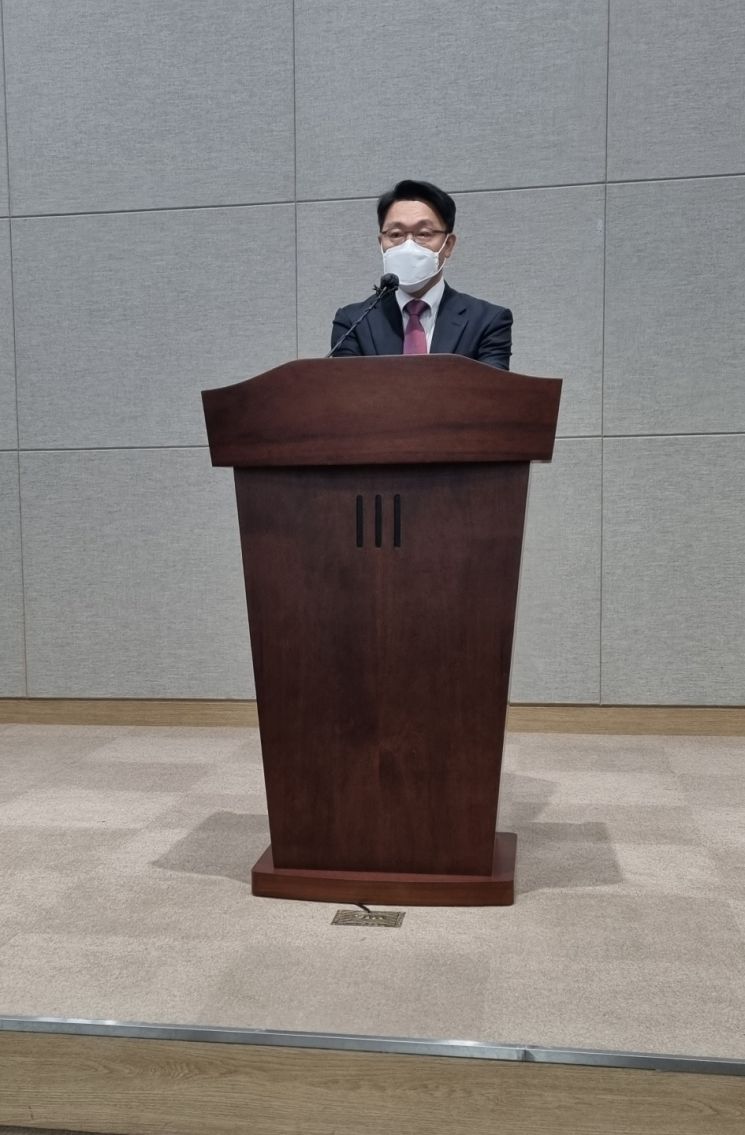 Kim Jin-wook, Chief of the High-ranking Officials' Crime Investigation Agency, is delivering opening remarks at a press briefing held on the 16th in the training hall on the first floor of the Government Complex Gwacheon./Photo by Choi Seok-jin
[Asia Economy Reporter Choi Seok-jin, Legal Affairs Specialist] Kim Jin-wook, Chief of the High-ranking Officials’ Crime Investigation Office (Gongsoocheo), recently commented on the so-called 'Geomsu Wanbak' (complete removal of the prosecution's investigative authority) laws, including the amended Prosecutors' Office Act and Criminal Procedure Act, which were recently promulgated. On the 16th, he said, "It seems more accurate to describe it as a gradual reduction of the prosecution's direct investigative authority and the separation of investigation and prosecution, rather than simply 'Geomsu Wanbak'."
Kim also stated regarding the ruling Democratic Party's push for the separation of investigation and prosecution, "I believe the separation of investigation and prosecution aligns with the justification of human rights protection and global trends."
On that day, during a press briefing held at Gongsoocheo in the Government Complex Gwacheon, Kim responded to a question about how he viewed the recent discussions on Geomsu Wanbak.
He said, "When Geomsu Wanbak was first proposed legislatively and when it was finally passed in the plenary session, the bill changed several times," adding, "So, if I were asked to choose terminology based on the final passed bill, I think it is more accurate to call it a gradual reduction of the prosecution's direct investigative authority and the separation of investigation and prosecution, rather than just Geomsu Wanbak."
However, when asked about legislative supplementation, Kim avoided a direct answer, saying, "It is not appropriate for the head of an investigative agency to comment on legislation."
Regarding the question, "There are criticisms that dividing investigative agencies into multiple bodies is complicated," he explained by citing specific foreign legislative examples introduced in a column. It appears he referred to the column titled '[MaeKyung’s Window] Geomsu Wanbak, is it a global standard?' by former Deputy Chief Prosecutor Bong Wook, published in the Maeil Business Newspaper on the 13th.
In that column, former Deputy Chief Prosecutor Bong objectively introduced the history and current status of prosecution systems worldwide. Among the content was "As complex financial and fiscal crimes increase, there is a trend toward strengthening prosecutorial investigative functions. The U.S. Attorney’s Offices overseeing Manhattan and LA directly investigate white-collar crimes, and similarly, France’s central investigative department, Germany’s central prosecution office, and the UK’s economic crime unit all do the same." On this day, Kim selectively introduced only the parts of the column related to foreign cases where investigation and prosecution were or had been separated.
Kim said, "I recently saw a column written by a former Deputy Chief Prosecutor from a few years ago who summarized other countries' situations well," adding, "To elaborate, in Germany, although it is known that prosecutors have direct investigative authority and investigative supervision, they hardly conduct direct investigations and mainly supervise investigations. Therefore, in Germany, prosecutors are called 'heads without hands and feet.'"
He also said, "France is the country where the prosecution system first started, and in France, direct investigations and major cases are conducted by investigative judges who supervise judicial police officers. Prosecutors only play the role of public prosecutors who file charges. That is a major characteristic of France."
He continued, "In the UK, prosecutors handled both investigation and prosecution from 1820 until the Confait murder case in 1972, where the real culprit was revealed and a wrongful conviction was exposed. This led to the establishment of a committee that significantly reformed the criminal law system," adding, "Thus, in 1986, the Crown Prosecution Service (CPS) was introduced, creating a public prosecution office."
He said, "Nowadays, with increasingly complex economic crimes and multinational corporations committing crimes across borders, large-scale cases are handled by the Serious Fraud Office (SFO), also known as the Serious Economic Crime Office. This agency specializes in large-scale fraud, corruption, and economic cases, and I consider the UK’s system the most meaningful."
He added, "Because investigation and prosecution were not separated initially, and the police handled everything until the prosecution office was created to separate investigation and prosecution, which became the principle. Exceptionally, the SFO handles both investigation and prosecution for serious economic crimes." He noted, "It has about 550 personnel and handles around 12 cases a year..."
Finally, Kim mentioned, "When our Criminal Procedure Act was enacted, Eom Sang-seop, known as the father of the Criminal Procedure Act, summarized the U.S. system as the police conducting investigations, prosecutors handling prosecutions, and judges presiding over trials," adding, "Anyway, it is well summarized, so we look meaningfully at other countries' systems when establishing our own. That is the fundamental point I want to make."
Meanwhile, when asked whether it is appropriate for Gongsoocheo to also separate investigation and prosecution since the prosecution will only handle prosecution after the Geomsu Wanbak law passes, Kim said, Gongsoocheo was originally designed on the premise of separating investigation and prosecution but chose a compromise approach for practical reasons.
He said, "We have something to say about this," and explained, "When Gongsoocheo was first established, the preparatory team designed it on the premise of separating investigation and prosecution."
Kim said, "When I took office as chief, there was an organizational structure already in place that separated investigation and prosecution. There was also a draft of case handling rules, and we accepted the separation of investigation and prosecution as is," adding, "The system was such that the investigative department would conduct investigations and prepare an investigative opinion report, which would then be handed over to the prosecution department, which would decide on prosecution or non-prosecution. It was a complete separation of investigation and prosecution, and we operated that way."
He continued, "After operating it and recently changing the selective indictment system, we switched to a compromise," explaining, "For general cases, the investigating prosecutor makes the prosecution decision, and for cases where the chief decides to separate investigation and prosecution, the previous method is maintained."
Kim said, "Is it really efficient to operate with 100% separation of investigation and prosecution for all cases with our personnel? It takes longer and is not efficient. Is it really necessary?" He explained, "There are about 3,000 complaint and accusation cases a year. Applying 100% separation of investigation and prosecution to all cases is not desirable, so we adopted a compromise."
Meanwhile, Kim emphasized that the separation of investigation and prosecution has justification for protecting the human rights of suspects and related parties, and in that regard, he evaluated the amended Prosecutors' Office Act, which prohibits prosecutors from prosecuting crimes they have investigated, as aligning with global trends.
He said, "I believe the separation of investigation and prosecution has justification in terms of protecting the human rights of suspects and related parties," adding, "If a prosecutor has both investigative and prosecutorial authority over me during an investigation, it means they hold life-and-death power over me."
He continued, "Looking at the current amended Prosecutors' Office Act, it states that prosecutors cannot file charges for crimes they have initiated investigations on," emphasizing, "This means separation of investigation and prosecution, and such separation aligns with global trends and human rights protection. It is justified."
© The Asia Business Daily(www.asiae.co.kr). All rights reserved.

















