[Interview] Lee Jeong-deok, Wife of the Late Painter Lee Gang-ha
'5·18 Leader' Label Thorny Path... Dreams and Family Shattered
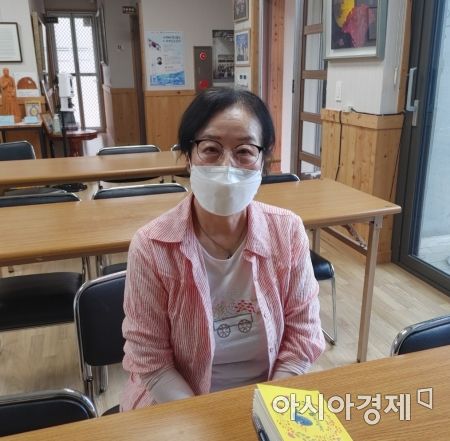
[Asia Economy Honam Reporting Headquarters Reporter Park Junho] Lee Jeong-deok, who changed his life completely due to the May 18 Democratic Movement, greeted us with a bright smile, wondering if the movement had dulled after 42 years. However, through his voice mixed with emotion during the interview, it was clear that his May 18 is still ongoing.
Spring of 1979. Lee, an ordinary teacher teaching elementary school students in Yeongam, Jeollanam-do, enrolled in an art academy to add colorful obangsaek (five traditional Korean colors) to his monotonous daily life. There, he met a fateful connection.
The art instructor before Lee was full of passion for painting, could not tolerate injustice, and was always righteous. He was the late artist Lee Gang-ha, who would become Lee’s husband five years later.
As their relationship continued, they dated and supported each other, seemingly enjoying happy days, but an incident ignited the flame in the artist’s righteous character.
It was the May 18 Gwangju Democratic Movement. As the democratization movement that started in Gwangju reached its peak, the artist Lee joined the citizen soldiers, gathered weapons at the Yeongam Police Station, and headed to Gwangju, fully engaging in the May 18 movement.
Lee, who witnessed this closely, was deeply worried. Whether aware of Lee’s feelings or not, the artist Lee moved to Gangjin when all roads to Gwangju were blocked and continued the resistance there.
Unable to enter Gwangju, Lee could only support his boyfriend, the artist Lee, and hope for his safety.
The democratization movement ended with the suppression operation at the old Jeonnam Provincial Office, and it seemed life would return to normal, but it was only the beginning of another chapter.
Lee recalled, “At that time, the cicadas’ cries and frogs’ croaks were drowned out by the cries of mothers who lost their children to the martial law troops’ guns and knives, the cries of wives, and the cries of children who lost their parents.”
After the uprising ended, Lee spent a few days with the artist Lee in Yeongam. However, the artist Lee was eventually arrested at the Yeongam Police Station and taken to a detention center.
Lee earnestly urged the artist Lee, “Don’t blame others and never act cowardly,” but secretly wiped away tears out of worry.
Unable to see him during visits, Lee supported him by sending books and underwear to the detention center. Lee still cannot forget the haggard appearance of the artist Lee when he came out of the Yeongam Police Station detention center and Sangmu Camp.
His entire body was covered with wounds that appeared to be scars from beatings and torture. While caring for him, Lee dreamed of returning to an ordinary life, but it all turned to dust.
When the artist Lee was wanted again, he had to live in hiding to avoid surveillance.
From Chosun University auditorium to acquaintances’ houses in Jangseong, warehouses, and relatives’ homes, the artist Lee moved around constantly, which was like hell for Lee to witness.
Lee was anxious, fearing that if the artist Lee was caught again, he might die. Whenever the phone rang, Lee was terrified, wondering if something had happened to him.
Whenever Lee went to meet him, she was always on guard, checking if anyone was following or coming to arrest him, never able to eat a meal in peace.
Unable to bear it any longer, Lee and Professor Choi Young-hoon advised the artist Lee to surrender, and in November 1980, the artist Lee was labeled a “May 18 ringleader.”
Eventually, after going to the Supreme Court, the artist Lee’s sentence was confirmed as 8 months in prison with 1 year probation. Although supporting him through his imprisonment was physically exhausting to the point of back pain, their relationship grew even stronger during that time.
Two years after May 18, in March 1982, Lee was assigned to Seosan Elementary School in Gwangju, and that year they had a precious daughter. Later, in 1984, they married and had a son, who was dearly loved.
They became a family of four, and although time passed, there was no sign of economic improvement. The artist Lee had difficulty finding a job due to his criminal record related to May 18.
Lee recalled, “It was so financially difficult that we could barely afford the studio costs where the four of us lived together.”
In August 2003, when living in Gwangju became impossible, the couple returned to their hometown Yeongam by renting a closed school building. They set a goal to reemerge into the world through five years of work.
However, this dream shattered shortly after. Two months later, the artist Lee showed abnormal symptoms and was diagnosed with colorectal cancer. After five years of battling illness instead of creating art, the artist Lee eventually became a star in the sky.
Lee said, “My husband and I have lived painfully because of May 18. They say sharing sorrow halves it, so I listen to the grievances of May 18 bereaved families at the May Mothers’ House, but tears come first. There are daughters who lost fathers, wives who lost husbands, siblings who lost brothers, and mothers who lost children, some of whom spent their entire lives in tears and passed away. I hope the truth is uncovered soon to wipe away the tears of the bereaved families,” wiping her eyes.
© The Asia Business Daily(www.asiae.co.kr). All rights reserved.

















