Employment Recovery Stalls Amid External Uncertainties Such as Supply Chain Disruptions and Interest Rate Hikes
[Asia Economy Reporter Park Sun-mi] Although two years have passed since the spread of COVID-19, the domestic employment market has not recovered to the pre-COVID-19 situation, according to a recent survey. Concerns are rising that employment recovery will be slow due to external uncertainties such as the weakening of global supply chains and interest rate hikes.
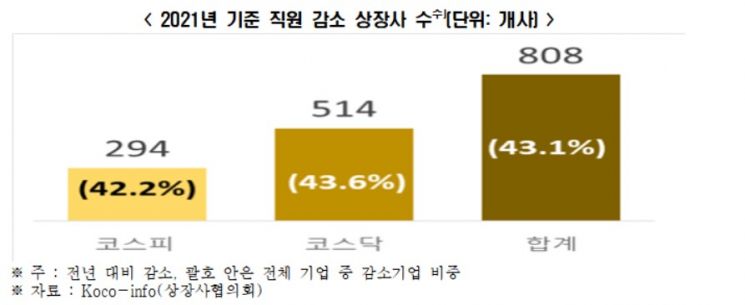
On the 17th, the Federation of Korean Industries (hereafter FKI) surveyed the number of employees at 1,874 non-financial KOSPI and KOSDAQ listed companies from 2018 to 2021. The results showed that as of last year, 4 out of 10 listed companies (43.1%, 808 companies) had fewer employees compared to the previous year. The proportion of companies with decreased employees was slightly higher in the KOSDAQ market than in the KOSPI market. Last year, the number of companies with reduced employees was 294 out of 696 companies (42.2%) in the KOSPI market and 514 out of 1,178 companies (43.6%) in the KOSDAQ market.
The total number of employees at listed companies still has not recovered to the pre-COVID-19 level. Last year, the number of employees at listed companies was 1,483,000, which is 14,000 more than 1,469,000 in 2020, but 14,000 fewer than 1,497,000 in 2019. Among listed companies, 3 out of 10 (26.7%, 500 companies) experienced a continuous decrease in the number of employees for two consecutive years (2020?2021) since the full-scale spread of COVID-19. The proportion was higher among KOSPI-listed companies (29.0%, 202 companies) than KOSDAQ-listed companies (25.3%, 298 companies).
The number of employees at the 500 listed companies that experienced a decrease for two consecutive years was 436,000 in 2021, which is 72,000 fewer than 508,000 in 2019 before COVID-19. The FKI analyzed, “Companies often use workforce reduction as a last resort to overcome management crises, so the fact that the number of employees at these 500 listed companies decreased for two consecutive years indicates that their business conditions were very difficult.”
In fact, last year, 1 out of 10 listed companies (11.2%, 210 companies) experienced a ‘triple hardship’ with simultaneous decreases in the number of employees, sales, and operating profit. The proportion was higher among KOSDAQ-listed companies (12.1%, 143 companies) than KOSPI-listed companies (9.6%, 67 companies). When both growth potential and profitability deteriorate, it can lead to corporate insolvency, placing a significant burden on the job market.
Choo Kwang-ho, head of the FKI Economic Headquarters, emphasized, “It is still too early to judge that the employment market is experiencing a full-fledged upturn,” and added, “The government should implement policy support such as easing labor and industrial regulations and expanding tax incentives so that companies can overcome uncertainties and actively expand investment and employment.”
© The Asia Business Daily(www.asiae.co.kr). All rights reserved.

















