KAIST Research Team
[Asia Economy Reporter Kim Bong-su] A technology to treat Alzheimer's dementia using nanoparticles that respond to low-frequency magnetic fields has been developed.
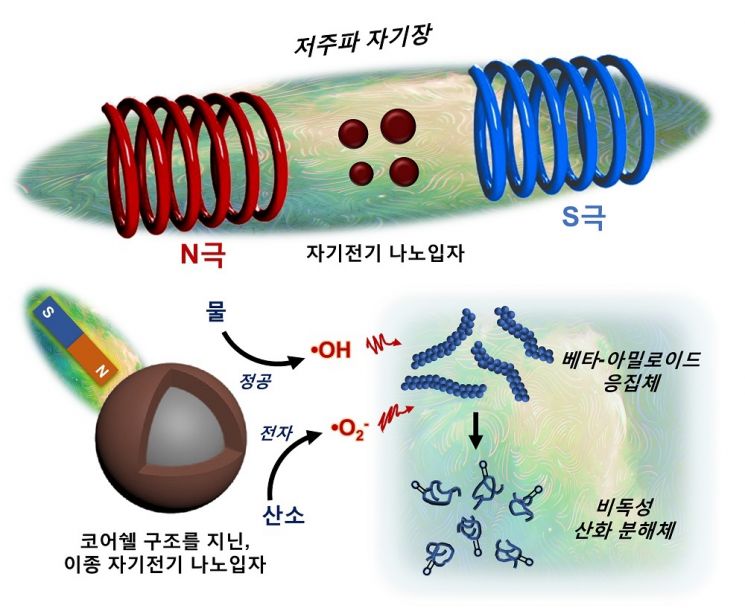
The Korea Advanced Institute of Science and Technology (KAIST) announced on the 16th that a research team led by Professor Park Chan-beom of the Department of Materials Science and Engineering succeeded in developing low-frequency magnetic field-responsive nanoparticles with such functionality. The team stated that these nanoparticles can decompose beta-amyloid peptide (an amino acid compound) aggregates that cause Alzheimer's disease using magnetic fields.
Magnetoelectric materials possess properties combining magnetism and electricity and are key materials in various electronic devices such as spintronics devices and transducers. However, magnetoelectric materials have limitations in performance improvement due to the electrostatic interaction of protons (spin-orbit interaction) that interferes with the rotation and orbital motion of electrons within atoms.
The research team developed heterogeneous magnetoelectric nanoparticles by bonding cobalt ferrite and bismuth ferrite?types of magnetoelectric materials mainly used in semiconductors and batteries?in a core-shell structure. Through uniform bonding of different magnetoelectric materials, they were able to induce a magneto-piezoelectric effect responsive to low-frequency magnetic fields at their interface.
In particular, the team focused on the phenomenon where nanoparticles generate charge carriers in response to low-frequency magnetic fields without releasing heat. Magnetic fields can penetrate brain tissue without damage and have already been verified for medical safety through applications such as Magnetic Resonance Imaging (MRI).
When the nanoparticles developed by the research team were exposed to low-frequency magnetic fields, they oxidized beta-amyloid peptides, weakening the binding force of their aggregates and decomposing them, while also neutralizing neurotoxicity. Amyloid aggregates are commonly observed in various degenerative neurological diseases such as Alzheimer's disease and are known to be difficult to decompose due to their highly stable protein secondary structure formed by regular hydrogen bonds.
Professor Park Chan-beom said, "Low-frequency magnetic field-responsive nanomaterials have low toxicity and can efficiently decompose amyloid aggregates by reacting with magnetic fields, so they have potential for expansion into the medical field." He added, "To verify this, animal experiments using Alzheimer's transgenic mice are primarily needed."
Meanwhile, this research was conducted with support from the Ministry of Science and ICT's Leader Researcher Support Project (Creative Research) and was published on the 13th in the international academic journal Science Advances.
© The Asia Business Daily(www.asiae.co.kr). All rights reserved.
![Clutching a Stolen Dior Bag, Saying "I Hate Being Poor but Real"... The Grotesque Con of a "Human Knockoff" [Slate]](https://cwcontent.asiae.co.kr/asiaresize/183/2026021902243444107_1771435474.jpg)
















