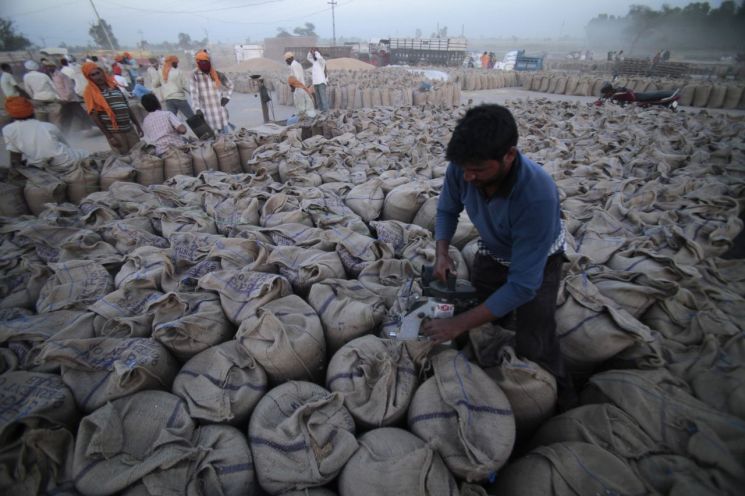
[Asia Economy Reporter Kim Hyunjung] Amid the global food supply emergency caused by the Ukraine war, concerns over a surge in international wheat prices triggered by India's wheat export restrictions are becoming a reality.
According to Bloomberg News, on the 16th, the wheat futures price at the Chicago Board of Trade, the benchmark for international wheat prices, rose 5.9% from the previous trading day to $12.47 per bushel. This increase hit the daily trading limit and marked the highest level in nearly two months. International wheat prices also rose 6.2% last week. Wheat prices have surged about 60% this year alone, making it a representative inflation-driving raw material that has pushed up the prices of processed wheat products such as bread, cakes, and noodles.
The price surge trend has become more pronounced since India's export ban on the 13th. India ranks 8th in global wheat exports (8.2 million tons), so it does not directly impact supply volume, but Bloomberg News analyzed that the move has further unsettled future supply and demand forecasts, causing prices to soar.
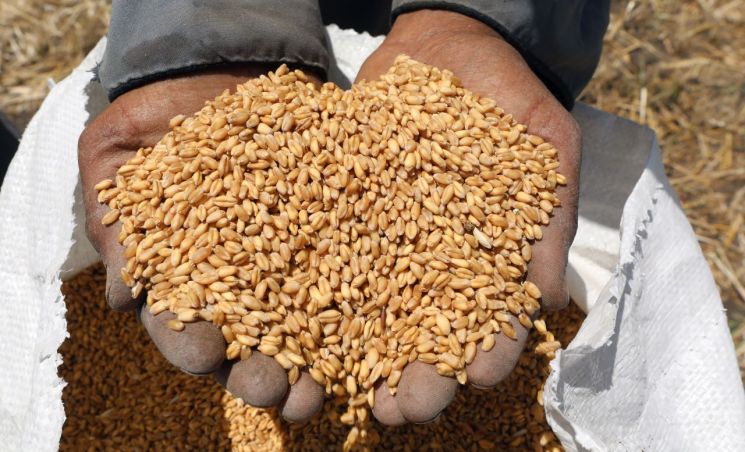
Andrew White, a grain analyst at Thomas Elder Markets in Australia, said, "If this export suspension had occurred during normal times, the impact would have been minimal, but now it is exacerbating the problem due to the sharp decline in supply from Ukraine." The world's largest wheat exporter is Russia, with 33 million tons, followed by the European Union (31 million tons), Australia (27.5 million tons), the United States (21.9 million tons), Ukraine (19 million tons), Argentina (15.5 million tons), and Canada (15.5 million tons).
In India, the recent heatwave with daily maximum temperatures approaching 50 degrees Celsius has raised concerns about a global production decline, which is believed to be the reason behind this measure. The political crisis faced by Prime Minister Narendra Modi due to soaring prices is also cited as a background factor.
However, the Indian government plans to partially approve exports to some countries in need of wheat, such as Bangladesh, Sri Lanka, the United Arab Emirates, and Indonesia. The Indian Ministry of Food stated in a press release, "Exports to neighboring countries in urgent need of wheat, such as food-deficient nations, can be approved through government channels," adding, "We have sufficient stockpiles."
Some worry that India's decision will further solidify the rising food protectionism since the Ukraine war. Governments worldwide are stepping in to secure regional food supplies amid soaring agricultural product prices. Indonesia has halted palm oil exports, and Serbia and Kazakhstan have imposed quotas on grain shipments.
© The Asia Business Daily(www.asiae.co.kr). All rights reserved.
![Clutching a Stolen Dior Bag, Saying "I Hate Being Poor but Real"... The Grotesque Con of a "Human Knockoff" [Slate]](https://cwcontent.asiae.co.kr/asiaresize/183/2026021902243444107_1771435474.jpg)

















