Directly Inspecting Savannah, Georgia
Receiving Negotiation Updates from State Government
Hyundai Motor's First Electric Vehicle Factory in Sight
Production Process Differentiation Strategy
Critical Focus on Enhancing Efficiency
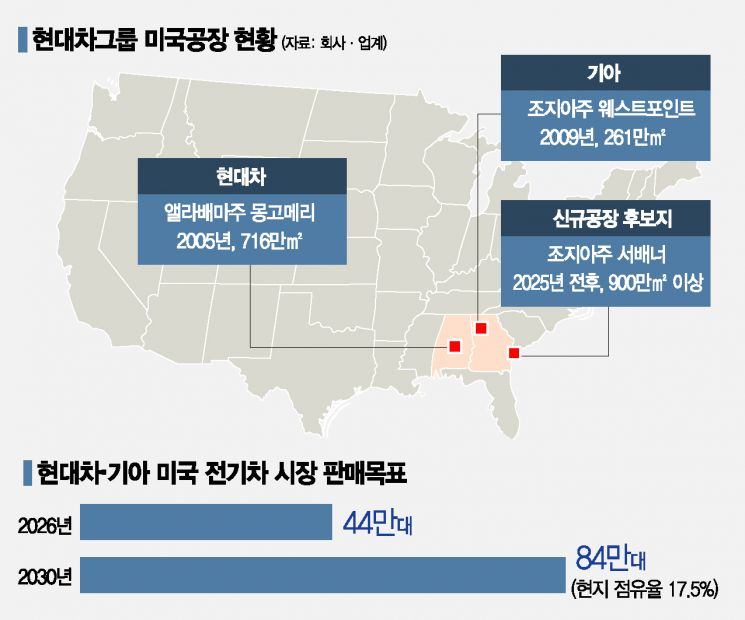
[Asia Economy Reporter Choi Dae-yeol] Chung Eui-sun, Chairman of Hyundai Motor Group, visited Savannah, Georgia, one of the candidate sites for a new factory in the U.S. in late February this year to inspect the factory site and receive reports on the surrounding infrastructure and negotiations with the state government. This was part of the U.S. business and investment plan announced around the Korea-U.S. summit last year, where several regions suitable for building an electric vehicle (EV) dedicated factory were shortlisted, leaving only the final decision.
Georgia is a familiar region to Chairman Chung, as Kia, a subsidiary, has been operating a complete vehicle factory there since 2009. In particular, SK, which has many transactions with Hyundai Motor Group, operates a large-scale battery factory and is building an additional one. At the end of last year, the state also attracted Rivian, an electric truck startup known as the second Tesla. The state government is actively creating an EV ecosystem by offering substantial incentives. If Hyundai Motor Group ultimately selects the Georgia site as the new factory, it is expected to become Hyundai Motor Group's first EV dedicated factory.

Hyundai's First U.S. EV Dedicated Factory Negotiations Near Completion
According to local media and industry sources on the 16th, negotiations between the state government and the company regarding building Hyundai's new factory near the 'Bryan County Megasite' close to Savannah on Georgia's eastern coast are in the final stages. When Chairman Chung visited the U.S. in February, he personally inspected this area as well as candidate regions in neighboring South Carolina, North Carolina, and Tennessee for a final review. This region is preferred by non-U.S. automakers such as Volkswagen and Toyota for local production plants.
Earlier, the Georgia state government purchased this site from the Savannah Economic Development Authority last year. The site covers 2,284 acres (9.24 million square meters). Local media estimate employment could reach 8,500 people. Considering Hyundai's Montgomery plant in Alabama, established in 2006, which operates on a 716,000 square meter site with 3,100 employees, this is a considerable scale.
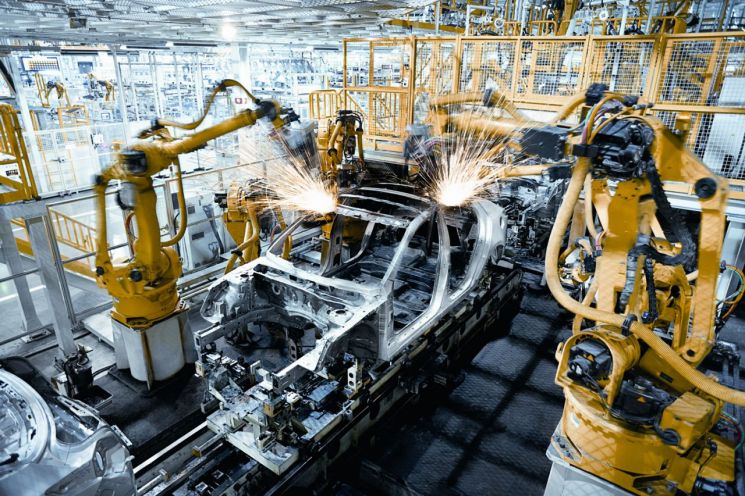
What the industry is paying close attention to is that this will be Hyundai Motor Group's first EV dedicated factory. Currently, Hyundai produces EVs at some domestic plants in Ulsan, Hwaseong, and Gwangju, as well as some plants in the Czech Republic and Indonesia, but all of these are factories where existing internal combustion engine production lines have been converted to EV production.
Kia, a subsidiary, is internally reviewing plans to build a new EV dedicated factory using part of its existing domestic plant sites. The new U.S. factory is expected to mainly produce electric pickup trucks tailored to local demand, as well as mid-to-large size sport utility vehicles (SUVs). There is also speculation about contract manufacturing for Genesis and Kia models.
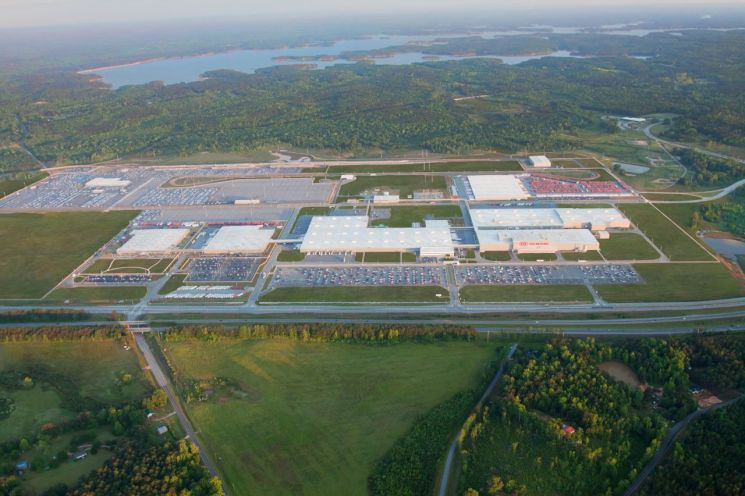 Kia vehicle assembly plant located in West Point, Georgia, USA. Completed in 2009, with the completion ceremony held the following year.
 U.S. Factory to Feature Differentiated Production Processes
The EV dedicated factory will not only produce finished vehicles with a changed powertrain system but also differentiate the entire production process from existing ones. Tesla, unlike traditional automakers, casts the integrated body as a single piece and incorporates several times more electronic components such as vehicle semiconductors, making software control technology more important.
Hyundai Motor Group is expected to apply a flexible production system and real-time customized logistics system at the new factory to manufacture vehicles based on customer demand and minimize inventory of parts. Hyundai Motor Group considers improving production efficiency crucial for future EVs and is working on establishing a standardized production system at its Global Innovation Center in Singapore, which will begin operations in the second half of this year, to apply it to factories scattered worldwide.
This move is interpreted as Hyundai Motor Group placing greater importance on the U.S. market than in the past. Not only the total sales of finished vehicles including EVs but also new businesses such as robotics, urban air mobility (UAM), and autonomous driving will be promoted or advanced based on local business sites. Particularly in the U.S., although EV demand is still lower compared to China and Europe, the Biden administration's clear efforts to expand EV adoption and regain leadership in mobility businesses have made U.S. business expansion inevitable.
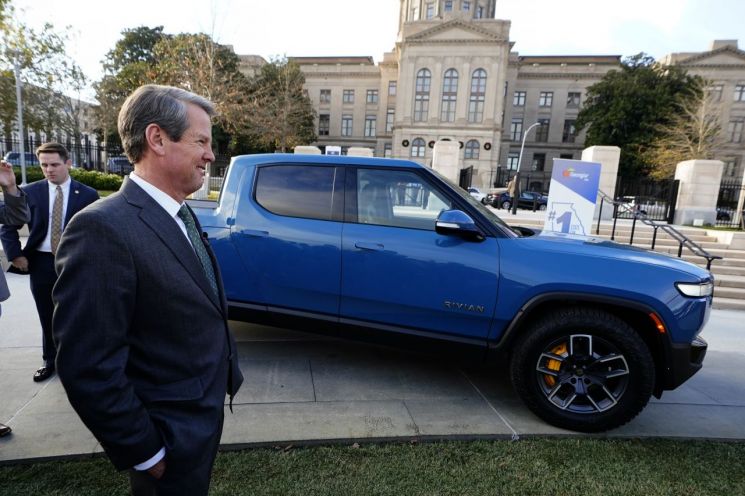 Brian Kemp, Governor of Georgia, USA, stands next to Rivian's electric truck. Rivian is an electric pickup truck startup considered the second Tesla, and recently decided to build a factory in Georgia.
© The Asia Business Daily(www.asiae.co.kr). All rights reserved.
![Clutching a Stolen Dior Bag, Saying "I Hate Being Poor but Real"... The Grotesque Con of a "Human Knockoff" [Slate]](https://cwcontent.asiae.co.kr/asiaresize/183/2026021902243444107_1771435474.jpg)













