Government Expands Support for Freight Trucks, but Effectiveness Questioned Due to Limited Benefits for Low-Income People
"Tax Reduction Not Reflected," Suspicions Arise
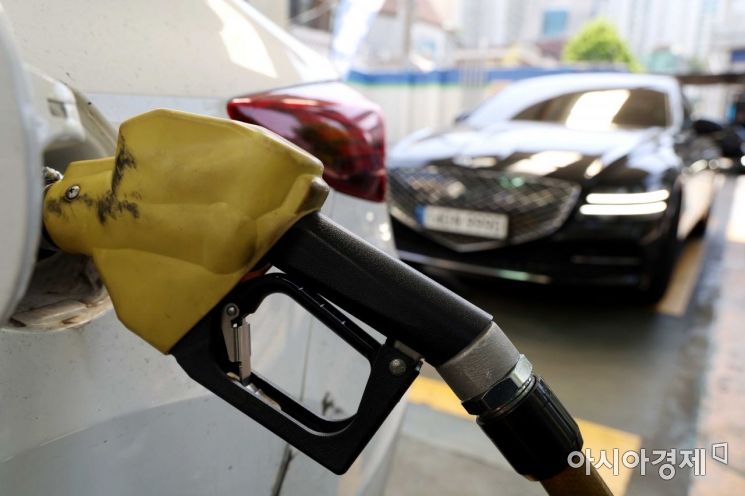
[Asia Economy Reporter Moon Chaeseok] As the average diesel price at gas stations nationwide has risen to around 2,000 KRW per liter, some gas stations have entered the final countdown to surpassing 3,000 KRW. Although the government has announced plans to increase diesel fuel price-linked subsidies mainly for business operators such as freight trucks and taxis, there are criticisms that support for ordinary citizens driving diesel vehicles is lacking and insufficient.
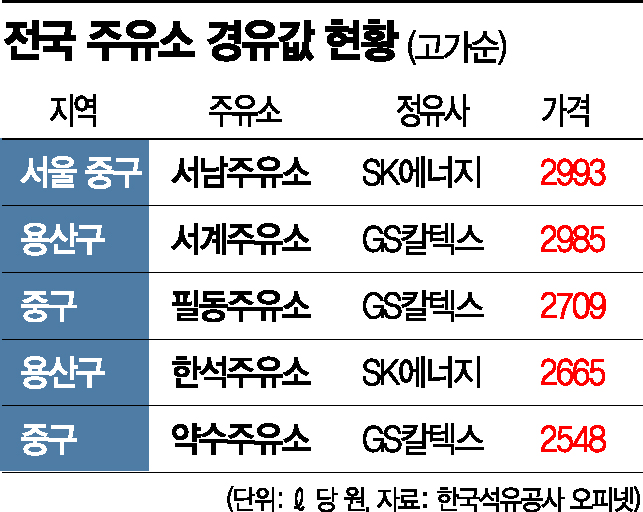
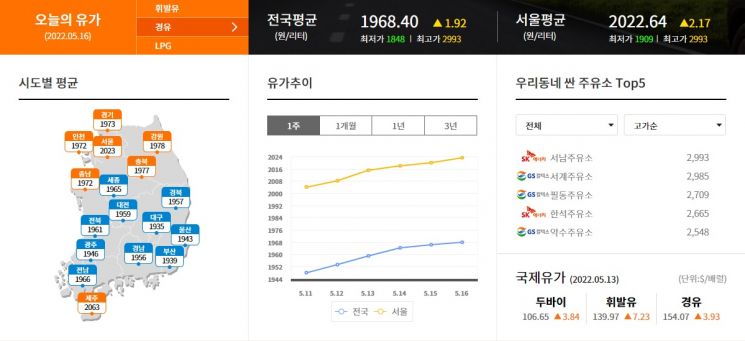
According to Korea National Oil Corporation's Opinet as of 9 a.m. on the 16th, diesel prices at some gas stations nationwide exceeded 2,900 KRW per liter. The highest prices were recorded at Seonam Gas Station (SK Energy) in Jung-gu, Seoul at 2,993 KRW, Seogye Gas Station (GS Caltex) in Yongsan-gu, Seoul at 2,985 KRW, and Pildong Gas Station (GS Caltex) in Jung-gu, Seoul at 2,709 KRW. By local government, prices were highest in Jeju (2,063 KRW), Seoul (2,023 KRW), and Gangwon (1,978 KRW).
The government has decided to lower the subsidy payment reference price from the current '1,850 KRW per liter.' It is also reportedly considering raising the payment rate for the excess amount to 50% (with a cap of 183.21 KRW per liter). Since early this month, subsidies have been provided to commercial freight trucks, buses, and coastal cargo ships, but the scope of support will be expanded.
While the direction is correct, the effectiveness remains uncertain, according to prevailing reactions. In particular, there is much dissatisfaction over why only 'business operators' receive benefits. There are concerns that the rise in diesel prices will lead to increases in fuel costs and freight charges, causing other 'ordinary citizens' price items such as parcel delivery to continue rising. This is why voices say the policy effect may not be high despite the use of tax funds. Professor Lee Deokhwan, Emeritus Professor of Chemistry and Science Communication at Sogang University, said, "Before the new government took office, President Yoon, while still president-elect, exhausted the 'fuel tax reduction expansion' card, making it difficult for the current government to prepare additional measures."
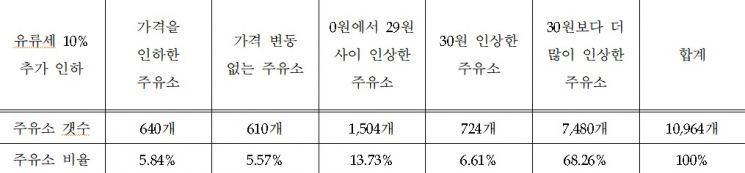 Status of nationwide diesel price reductions at gas stations for two weeks after the government expanded the fuel tax cut from 20% to 30%. (Data provided by the Petroleum Market Monitoring Group)
There are also suspicions that oil refiners and gas stations are not properly reflecting the tax reduction in their selling prices. According to data released by the civic group Energy and Oil Market Monitoring Team on the same day, after the government increased the fuel tax reduction rate from 20% to 30% earlier this month, only 25.1% (2,754 out of 10,958) of gas stations nationwide limited diesel price increases to '30 KRW per liter or less' over two weeks. The reason for using '30 KRW' as a benchmark is that the time lag between the 58 KRW fuel tax reduction and the 88 KRW international diesel price increase during that period is 30 KRW, so prices should have risen by less than that.
The refining industry counters that the monitoring team's data lacks credibility and that refiner-operated gas stations are already reflecting 100% of the fuel tax reduction. They argue that the impact is mainly due to independent gas stations, which account for about 80% of gas stations nationwide, selling off inventory purchased before the government policy was applied before lowering prices, and thus it is not the responsibility of the refiners.
© The Asia Business Daily(www.asiae.co.kr). All rights reserved.
![Clutching a Stolen Dior Bag, Saying "I Hate Being Poor but Real"... The Grotesque Con of a "Human Knockoff" [Slate]](https://cwcontent.asiae.co.kr/asiaresize/183/2026021902243444107_1771435474.jpg)


















