From 192 Trillion in 2020 to Expected Growth of 258 Trillion by 2025
Asia-Pacific Region Leads Market Size... Increasing Interest in Organic Products with Fewer Additives
[Asia Economy Reporter Koo Eun-mo] As interest in health continues to rise, the global snack market is expected to grow centered on organic and premium products.
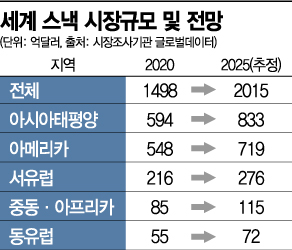
According to market research firm GlobalData on the 16th, the global snack market was valued at $149.8 billion (approximately 192.3432 trillion KRW) in 2020. The global snack market is projected to grow at an average annual rate of 6.1%, reaching $201.5 billion (258.726 trillion KRW) by 2025.
Recently, the snack market's growth factors include increasing demand reflecting health and sustainability trends such as low-fat, low-calorie, and organic products. An industry insider said, "Demand for low-sugar and low-calorie products is increasing due to health concerns," adding, "There is growing interest in products that are baked instead of fried, use whole grains as much as possible, and have increased protein content to enhance exercise effects."
By continent, the Asia-Pacific region, including Korea, accounted for the largest share at 39.7% ($59.4 billion). The Asia-Pacific region is noted as the fastest-growing market with an average annual growth rate of 7% until 2025, driven by an increasing number of consumers seeking convenient snacks and the development of the online food market. In particular, interest in organic products with fewer additives has increased since the spread of COVID-19, as people aim for healthier eating habits.
The domestic snack market is also recovering its growth trend after COVID-19. According to Euromonitor, the domestic snack market reached 3.6997 trillion KRW last year, growing 4.5% compared to the previous year. The salty snack market, mainly bagged snacks, formed the largest market share at 45.3%, followed by sweet biscuits (32.4%), nut mixes (9.8%), and popcorn (3.6%). In the salty snack category, traditional leaders such as Nongshim Saewookkang (7.4%), Lotte Cones (6.3%), and Orion Pokachip (6.0%) held top positions.
Following the Asia-Pacific region, the Americas accounted for 36.6%, Western Europe 14.1%, the Middle East and Africa 5.7%, and Eastern Europe 3.7%. The Americas showed a strong preference for premium products. As demand for healthy and nutritious snacks increases, more consumers are seeking products that provide daily nutrients such as low-carbohydrate, low-fat, low-calorie options, as well as protein, vitamins, and minerals.
© The Asia Business Daily(www.asiae.co.kr). All rights reserved.
















