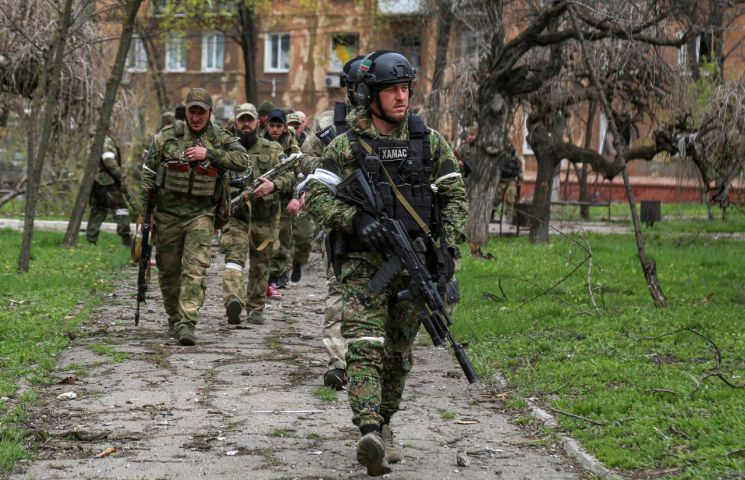
 Russian soldiers from the Chechen Republic were patrolling a residential area in the southern Ukrainian port city of Mariupol on the 21st of last month (local time).
 [Image source=Yonhap News]
[Asia Economy Reporter Hwang Sumi] Russia, which boasted overwhelming military power and invaded Ukraine, is struggling, and this has been evaluated as proof of errors in a representative military principle.
Recently, the Wall Street Journal (WSJ) analyzed Russia's difficulties as showing the error of the "3-to-1 principle," a universal truth accepted by armies around the world for over 150 years.
The 3-to-1 principle states that to win a war, the attacking side must have more than three times the troops of the defending side. This principle spread worldwide after Prussia subdued France with three times the troops during the Franco-Prussian War in 1870. The U.S. Army adopted the 3-to-1 principle in its 1955 manual, and the former Soviet Army officially introduced it after World War II.
According to WSJ, the Russian military also prepared for the invasion of Ukraine based on this principle. According to the UK think tank International Institute for Strategic Studies (IISS), Russia deployed 900,000 troops to invade Ukraine, which was 4.6 times more than Ukraine's 196,600 troops.
The military equipment was similar. Russia had 2,927 tanks, a ratio of 3.4 to 1 compared to Ukraine's 858 tanks. Additionally, the ratio of Russian to Ukrainian armored fighting vehicles was 4.3 to 1, and the ratio of infantry fighting vehicles was 9.7 to 1. This indicates that Russian forces had a significantly superior military strength.
However, Russia is currently struggling due to fierce resistance from Ukraine. What initially seemed like a short-term Russian victory has turned into a prolonged war.
Regarding this, Professor Stephen Biddle of Columbia University pointed out through WSJ that "the 3-to-1 principle is not science but merely a hypothesis based on human intuition." The 3-to-1 principle only reflects a simple difference in troop numbers and does not account for factors such as the intelligence-gathering capabilities and military supply support from the U.S. and its allies seen in the Ukraine war.
Professor Biddle also explained that the strong will of the Ukrainian people to resist, low morale and supply failures of the Russian army, and operational errors by the Russian military leadership cannot be quantified.
According to WSJ, challenges to the 3-to-1 principle existed even during the Cold War in the 1980s. It was argued that while it could apply in limited situations such as battles breaking through narrow defensive lines, it could not be a universal principle for war operations planning.
Meanwhile, due to Russia's struggles, there have been speculations that Valery Gerasimov, Chief of the General Staff commanding the Russian forces (equivalent to Chairman of the Joint Chiefs of Staff), is undergoing dismissal procedures.
On the 13th (local time), the British daily The Independent reported, citing Oleksiy Arestovych, an advisor to the Ukrainian presidential office, that Gerasimov might be in a state of suspension from duty.
Advisor Arestovych claimed, "According to prior information, Russian President Vladimir Putin and his close aides are evaluating whether Gerasimov should continue to hold military command," adding, "This suggests that Gerasimov is absent from his position while being evaluated." Russia has not officially confirmed the possibility of Gerasimov's dismissal.
© The Asia Business Daily(www.asiae.co.kr). All rights reserved.