Bank Loan Growth May Slow Down
Lower Interest Rate Appeal Compared to the Past, Actual Impact Needs to Be Monitored
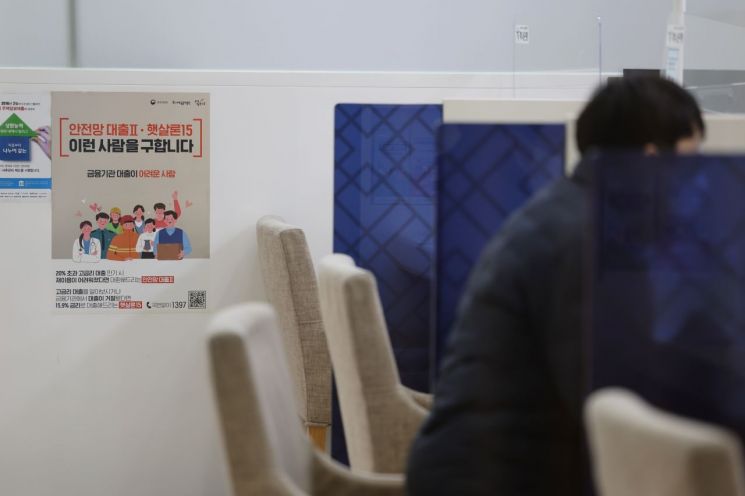
[Asia Economy Reporter Minwoo Lee] The government will supply 40 trillion won worth of Anshim Conversion Loans to ease the burden on those who have taken out variable-rate mortgage loans. Although this may reduce bank loan growth, the actual effect remains to be seen as the interest rate attractiveness is not as high compared to the past due to increased rates.
According to the financial sector on the 15th, the Financial Services Commission announced on the 12th that it will first supply 20 trillion won of Anshim Conversion Loans this year through the second supplementary budget. Considering next year’s interest rates, market conditions, and budget repayments, it plans to supply up to an additional 20 trillion won.
Anshim Conversion Loans are a policy that converts variable-rate (including hybrid) mortgage loans from primary and secondary financial institutions into long-term fixed-rate loans to reduce borrowers’ interest burdens. The government will invest 109 billion won in the Korea Housing Finance Corporation, which will issue mortgage-backed securities (MBS) to create funds and lend to borrowers.
The Anshim Conversion Loans consist of a general type and a preferential type. The general type provides loans up to 500 million won for houses valued up to 900 million won based on market price, with no income criteria for borrowers. The preferential type offers loans up to 250 million won for houses valued at 400 million won or less, but the combined income of the couple must be 70 million won or less. Loan increases are not allowed.
Interest rates for the general type will be set at the level of the Bogeumjari Loan (4.1?4.4% as of May), while the preferential type will be up to 30 basis points (0.3%) lower than the Bogeumjari Loan rates. If the supply is exhausted, support will be provided in order of lower house prices. The implementation is expected in the second half of the year.
This Anshim Conversion Loan is the third, following the 40 trillion won scale in 2015 and the 20 trillion won scale in 2019. Considering the rise in housing prices, the conditions have been tightened compared to the past when loans were executed with a market price limit of 900 million won. Interest rates are also higher than the 2.55?2.65% in 2015 and 1.85?2.2% in 2019, leading to evaluations that the attractiveness is not significant.
Since this policy involves refinancing bank loan assets into securitized loans, bank assets decrease at the time of refinancing/securitization. In the past, it caused a significant shock to the net increase in mortgage loans in banks in Q3 2015 and Q1 2020. However, there is also analysis that the impact on banks this time may not be significant.
Researcher Byunggeon Lee of DB Financial Investment said, "This time, it covers loans from secondary financial institutions as well, unlike the second round, and the interest rate merit seems not to be large compared to the past, so the actual effect needs to be observed." He added, "The 20 trillion won planned for execution in the second half of this year corresponds to about 2% based on the household loan balance of 1,060.2 trillion won in the banking sector as of the end of April, and about 3% based on the mortgage loan balance of 786.8 trillion won."
Concerns in the market about bad banks or measures related to non-performing loans are expected to have little impact on banks, and considering the interest rate situation, the effect of securitized loans on margins is also expected to be small. The timing of Anshim Conversion Loan securitization is likely to be early next year based on past cases, so the impact on bank performance this year is expected to be minimal. The researcher added, "However, if the scale increases depending on the situation, the bank’s loan growth rate next year could fall by up to about 2 percentage points (p), and subsequently, bank earnings forecasts could be lowered by 1.5?2.5%."
© The Asia Business Daily(www.asiae.co.kr). All rights reserved.
![Clutching a Stolen Dior Bag, Saying "I Hate Being Poor but Real"... The Grotesque Con of a "Human Knockoff" [Slate]](https://cwcontent.asiae.co.kr/asiaresize/183/2026021902243444107_1771435474.jpg)
















