Korea Expects Investment with Hydrogen Act Passing in National Assembly
Japan Builds Hydrogen and Ammonia Supply Chains
China Expands Hydrogen Fuel Cell Vehicle Pilot Areas
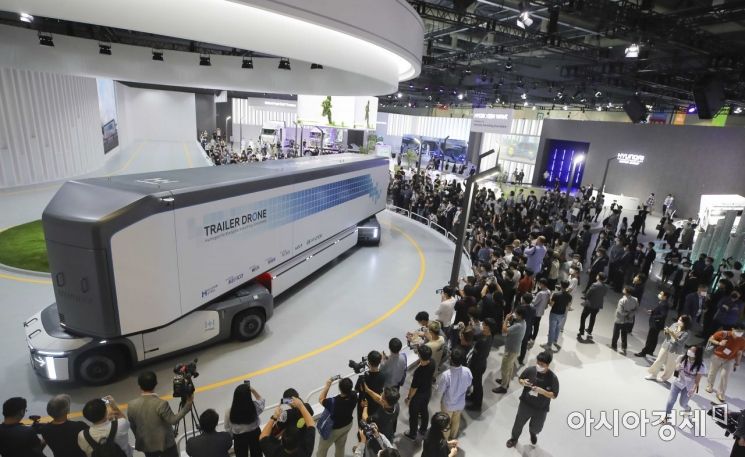 Guests visiting the Hyundai Motor Company booth at the "2021 Hydrogen Mobility Show," which opened on the 8th at Kintex Exhibition Hall 2 in Goyang City, are watching a demonstration of Hyundai's trailer drone. Photo by Jinhyung Kang, Goyang aymsdream@
[Asia Economy Reporter Oh Hyung-gil] South Korea, China, and Japan are all accelerating their competition to dominate the hydrogen and ammonia markets, which are gaining attention as new energy technologies in the carbon-neutral era.
South Korea is expected to begin full-scale investment as it speeds up the passage of the Hydrogen Act (Partial Amendment to the Act on the Promotion of Hydrogen Economy and Hydrogen Safety Management), which includes expanding hydrogen power generation.
Japan plans to establish a "Clean Energy Strategy" within the first half of the year, aiming to promote economic growth through global warming countermeasures. China is increasing production of major energy sources such as coal, oil, gas, and electricity while accelerating plans to foster hydrogen fuel cell vehicles.
According to the industry on the 15th, the amendment to the Hydrogen Act, which was proposed in July last year, passed the full meeting of the National Assembly's Industry, Trade, Small and Medium Enterprises Committee on the 9th. It is expected to be finalized after review by the Legislation and Judiciary Committee and approval by the plenary session.
The Hydrogen Act includes key points such as the introduction of a separate tariff system for natural gas used in hydrogen power generation, an obligation to sell and use clean hydrogen, a purchase and supply system for hydrogen power generation by electricity businesses, and the introduction of a hydrogen power generation bidding market.
Until now, the amendment to the Hydrogen Act had been stalled several times due to differing views on the scope of clean hydrogen. Without clear definitions and standards for hydrogen investment, companies were unable to establish concrete investment plans.
In September last year, Hyundai Motor, SK, Hanwha, Hyosung, Kolon, and others launched the hydrogen consortium "Korea H2 Business Summit," agreeing to invest about 50 trillion won across all sectors of the hydrogen economy by 2030.
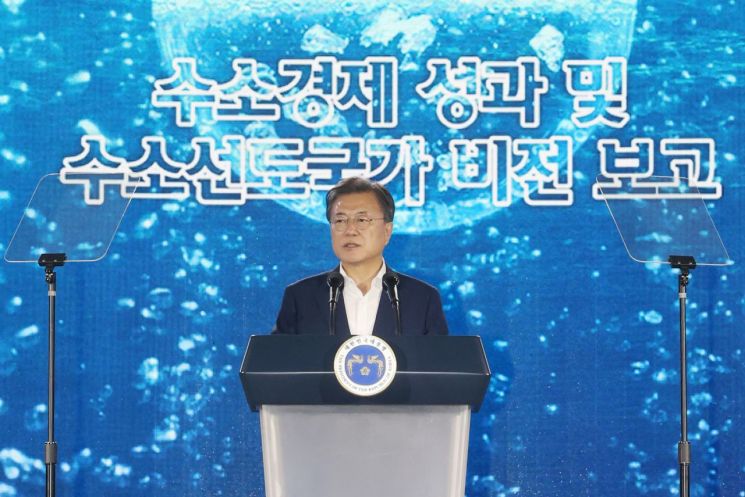
The Japanese government is also expected to present plans within its clean energy strategy to support initial corporate investments as part of building supply chains for hydrogen and ammonia production, storage, and transportation, as well as plans to expand transmission networks to increase the adoption of renewable energy.
Additionally, to reduce dependence on Russian fossil fuels, the government is expected to strengthen its role by supporting upstream LNG development and other measures.
According to Japan's Ministry of Economy, Trade and Industry, the estimated public-private investment required for decarbonization to achieve carbon neutrality by 2050 is at least about 17 trillion yen by 2030. This is three times the current level of approximately 5 to 6 trillion yen. The Japanese government is expected to actively consider subsidy programs to promote corporate investment.
China's National Energy Administration (NEA) selected three pilot regions centered on Beijing, Shanghai, and Guangdong Province as hydrogen fuel cell vehicle demonstration areas in September last year. In December, two additional pilot regions centered on Hebei and Henan Provinces were added as the second phase. In total, the five pilot regions include 47 cities.
During the four-year pilot period, the demonstration regions must achieve final targets such as deploying more than 1,000 hydrogen fuel cell vehicles, accumulating over 30,000 km per vehicle, and establishing more than 15 hydrogen refueling stations.
© The Asia Business Daily(www.asiae.co.kr). All rights reserved.
![Clutching a Stolen Dior Bag, Saying "I Hate Being Poor but Real"... The Grotesque Con of a "Human Knockoff" [Slate]](https://cwcontent.asiae.co.kr/asiaresize/183/2026021902243444107_1771435474.jpg)

















