Fostering 185 Prospective and Early-Stage Entrepreneurs This Year Through Campus Town Startup Competition... Surpassing 1,500 Companies
Expanded to 783 Office Spaces in 32 Campus Towns... Supporting Entire Startup Process from Education to Technology Development
[Asia Economy Reporter Lim Cheol-young] The 1,500th startup company will be born in the ‘Seoul Campus Town,’ a collaboration between Seoul City, universities, and local communities to create youth jobs and revitalize the region.
According to Seoul City on the 15th, Creators Lab (Chung-Ang University) has developed safe-to-eat play materials using food ingredients discarded due to overproduction, and has completed registration with the U.S. Food and Drug Administration (FDA) and is preparing for overseas expansion.
AiOL (Korea University), in its fifth year since founding, started with three members but has grown into a company with 33 employees. Currently, it is expanding its business area by establishing a mass production system for new material MOF (Metal Organic Framework) and focusing on entering overseas markets. Lytton Technologies (Yonsei University) started during the COVID-19 pandemic with an AI-based writing assistant tool for Generation Z, showcasing AI-based technology that supports various types of writing. This solution was recognized for its technological capability and business potential and was recently selected for the Ministry of SMEs and Startups’ TIPS program.
Furthermore, Seoul City announced that it will select 185 future unicorn companies this year by holding startup competitions in 32 campus towns and supporting startup spaces and commercialization funds. From this year, each campus town will focus on fostering companies in specialized university fields such as bio-medical and design by leveraging their strengths. Eligibility is open to prospective and early-stage startup founders (teams) residing in Seoul, and any citizen wishing to participate can apply by submitting the application form, business plan, and other required documents online by the deadline. Final resident teams will be selected through an in-depth evaluation by judges composed of experts in technology, marketing, investment, and other fields.
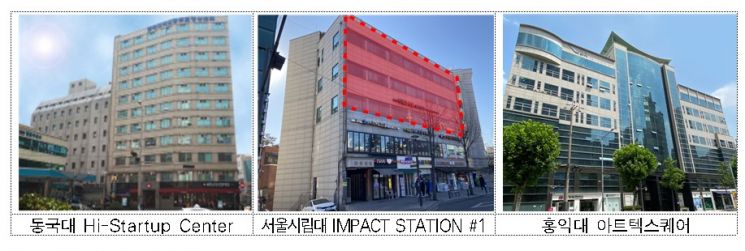
Startup companies in campus towns will receive customized growth support packages for innovative growth, including provision of residence space, startup support funds, investment attraction, startup education and consulting, market development, and marketing. This year, startup support spaces will be expanded to 14 locations (154 rooms) across about 10 schools including Dongguk University, University of Seoul, and Hongik University.
Especially from this year, by utilizing overseas networks owned by each university, support for overseas expansion of companies will be provided, and differentiated strategies by campus town will be strengthened, such as operating expert advisory groups and introducing open innovation to foster companies in fields with strengths like bio and design.
Some campus towns have already selected resident companies and started full-scale startup fostering. Sookmyung Women’s University Campus Town, which completed resident company selection in March, supports the entire startup cycle from ‘idea discovery to commercialization to growth (scale-up)’ through a dense network-style startup fostering program. Sejong University Campus Town operates a makerspace where expensive equipment such as laser cutters and 3D printers can be used free of charge, supporting prototype development and production for resident companies. In particular, it also operates a ‘showroom’ space, providing opportunities to promote and sell products of resident companies.
Meanwhile, through the ‘Campus Town Technology Matching Project,’ when companies face technical difficulties or lack technical capabilities to realize technology, they can receive technology development and consulting support through one-on-one matching with professors and researchers affiliated with each university. Companies selected for the technology development support project can receive up to 100 million KRW in technology development funds for one year.
Hwang Bo-yeon, Director of Seoul City’s Economic Policy Office, said, “Customized support for companies leveraging the strengths of each campus town will expand opportunities for overseas expansion and collaboration with large corporations,” adding, “Through Seoul Campus Town, capable startup companies will grow to play a pivotal role in the local economic and industrial structure, and together we will create a virtuous ecosystem where they lead future startup generations.”
© The Asia Business Daily(www.asiae.co.kr). All rights reserved.
![Clutching a Stolen Dior Bag, Saying "I Hate Being Poor but Real"... The Grotesque Con of a "Human Knockoff" [Slate]](https://cwcontent.asiae.co.kr/asiaresize/183/2026021902243444107_1771435474.jpg)
















