Korea Investment & Securities Report

[Asia Economy Reporter Myunghwan Lee] Recently, there has been an analysis from the securities industry that major advanced countries' stock markets are showing a bearish trend. Along with this, advice has been given that a conservative approach is necessary due to the possibility of high volatility in the stock market for the time being.
On the 14th, Korea Investment & Securities analyzed that there are two factors increasing stock market volatility in May: geopolitical risks and supply chain uncertainties. Until the announcement of the U.S. Federal Reserve's Federal Open Market Committee (FOMC) in May and the Consumer Price Index (CPI) for April, the burden of rising inflation was significant, but from mid-May, the burden of geopolitical risks has become more prominent.
Korea Investment & Securities evaluated that both the U.S. CPI and Producer Price Index (PPI) for April came out higher than expected. The April U.S. PPI rose 11.0% year-on-year, exceeding the expected 10.7%. However, it was lower than last month's 11.2%. The U.S. indices fluctuated for two consecutive days, but immediately after the CPI and PPI announcements, the U.S. indices collectively showed an upward trend.
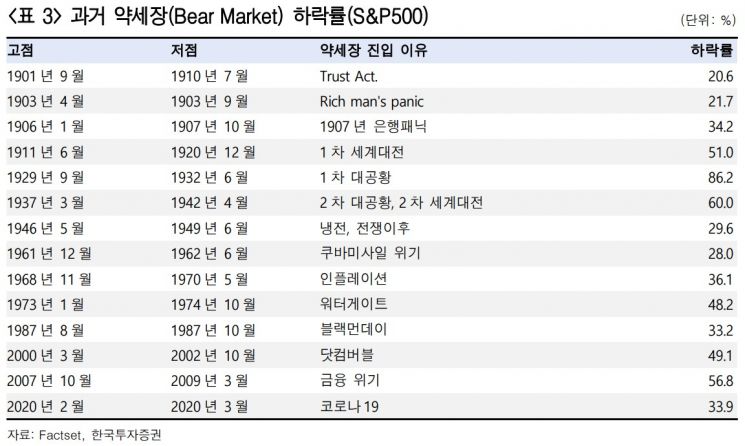
Korea Investment & Securities' analysis is that the recent market shows characteristics of a bear market. Typically, a market is considered bearish when the index falls more than 20% from its peak. Looking back since 1900, including the Great Depression and World Wars, there have been a total of 14 bear markets. The average decline of the S&P 500 index since 1990 is 42%, and since 2000, it is 46.6%. During the periods of the two World Wars, the average decline was 55.5%. Researcher Choi Bowon of Korea Investment & Securities stated, "The U.S. and Europe maintain a cautious stance on military conflicts, but since bear markets continued even during the Cold War era, the burden on risk assets could increase."
Nevertheless, Korea Investment & Securities advised maintaining a conservative approach for the time being. Since war is involved, it is difficult to predict the responses of all representative countries in North America and Europe, and it cannot be ignored that countries which led world wars are involved, not just some nations. Therefore, they recommend continuing a conservative approach at least until the NATO summit.
Researcher Choi further commented on the response to major advanced countries' stock markets this month: "While inflows for bargain buying are expected, since the attractiveness of value stocks compared to growth stocks may be highlighted, a gradual dollar-cost averaging strategy is more effective than aggressive overweighting," adding, "Given the characteristics of past bear markets, volatility may be high, so a conservative approach and selective weighting adjustments are necessary."
© The Asia Business Daily(www.asiae.co.kr). All rights reserved.
![Clutching a Stolen Dior Bag, Saying "I Hate Being Poor but Real"... The Grotesque Con of a "Human Knockoff" [Slate]](https://cwcontent.asiae.co.kr/asiaresize/183/2026021902243444107_1771435474.jpg)

















