Support for Coastal Patrol Speedboats and Disease Eradication, etc.
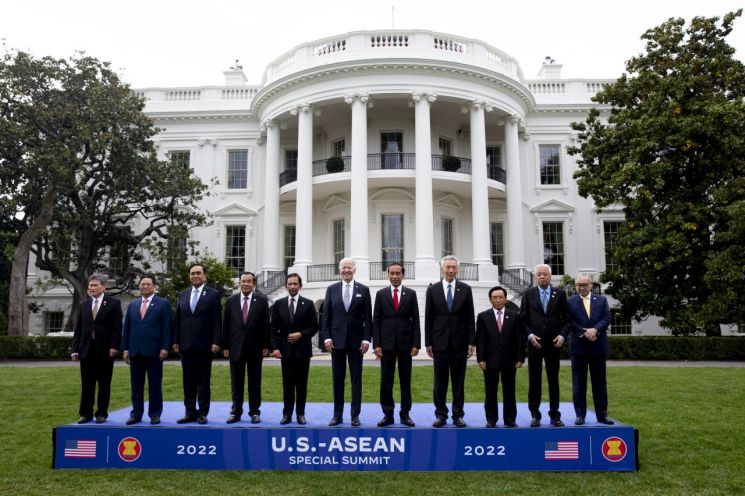
[Asia Economy Reporter Cho Hyun-ui] The United States has decided to invest $150 million (approximately 193.6 billion KRW) to expand its influence in the Association of Southeast Asian Nations (ASEAN) region.
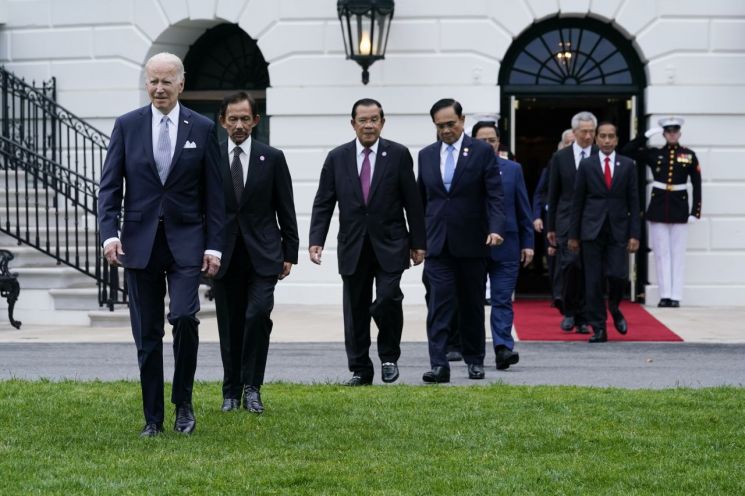
On the 12th (local time), the White House announced this investment support plan, stating, "The United States and ASEAN are beginning a new era of partnership." U.S. President Joe Biden will hold a special summit with ASEAN leaders at the White House over two days starting today.
First, $60 million will be allocated to support coastal patrol fast boats and training personnel. This is aimed at enhancing maritime law enforcement capabilities to respond to illegal fishing, and is analyzed as a U.S. move to counter China in the South Pacific region, where the two countries are competing for hegemony.
Some ASEAN countries, including Vietnam, the Philippines, and Malaysia, are engaged in territorial disputes with China in the South China Sea and are troubled by China's illegal fishing activities. However, despite these situations, many ASEAN countries maintain close economic ties with China.
According to foreign media, a senior U.S. administration official said, "We need to increase our capabilities in Southeast Asia," adding, "We want to make it clear that the U.S. seeks a stronger relationship with these countries, not to force them to choose between the U.S. and China."
In addition, the U.S. plans to invest $40 million in the clean energy sector and $15 million to combat diseases such as COVID-19 and tuberculosis.
Among the 10 ASEAN member countries, eight attended the summit: Brunei, Cambodia, Indonesia, Laos, Malaysia, Singapore, Thailand, and Vietnam. The last time the U.S. invited ASEAN leaders to the mainland was during the Barack Obama administration in 2016, and this is the first time the event has been held at the White House.
Foreign media reported, "ASEAN countries are frustrated with the delayed U.S. investment plans following former President Donald Trump's suspension of trade agreements in 2017."
Details of the 'Indo-Pacific Economic Framework' (IPEF) were not included in President Biden's announcement.
Bloomberg reported that the participating countries expressed disappointment, saying the U.S. has not taken a more active role in strengthening economic cooperation. Malaysian Prime Minister Ismail Sabri Yaakob raised his voice, saying, "The U.S. should adopt more proactive trade and investment plans with ASEAN."
© The Asia Business Daily(www.asiae.co.kr). All rights reserved.
![Clutching a Stolen Dior Bag, Saying "I Hate Being Poor but Real"... The Grotesque Con of a "Human Knockoff" [Slate]](https://cwcontent.asiae.co.kr/asiaresize/183/2026021902243444107_1771435474.jpg)

















